
작품2013
드라큘라 2: 마지막 성역
Dracula 2: The Last Sanctuary
2013년 어드벤처 게임
작품2013
Dracula 2: The Last Sanctuary
2013년 어드벤처 게임
이 항목이 포함된 사건 파일에서 정보와 관계를 함께 살펴보세요.
이 항목이 포함된 사건 파일이 아직 없습니다.
이 항목으로 조사 시작하기아직 댓글이 없어요. 먼저 한마디 남겨 보세요.
2013년 어드벤처 게임
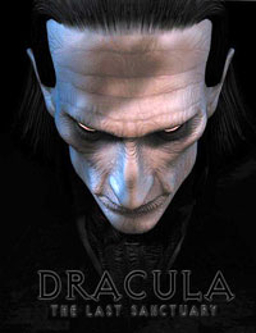
Dracula 2: The Last Sanctuary (originally released as Dracula: The Last Sanctuary) is a 2000 graphic adventure video game developed by Wanadoo Edition and jointly published by Index+, France Telecom Multimedia, Canal+ Multimedia and Cryo Interactive. Originally released for Windows and Mac OS, it was ported to the PlayStation in 2002. A modified version developed and published by Microïds was released for iOS and OS X in 2012 and for Android in 2013. In 2014, the remade version was made available on Steam. There were dubbing mutations in French, English, Spanish, German, Italian, Hungarian and Czech.
The game is a direct sequel to Dracula: Resurrection, which itself is an unofficial sequel to Bram Stoker's Dracula; set seven years after the end of the novel, Jonathan Harker finds that he must once again do battle with the evil Count Dracula in an effort to save his wife, Mina. A third game, with an unrelated storyline, followed in 2008, Dracula 3: The Path of the Dragon. A loose sequel to Path of the Dragon was released in a two-part form in 2013; Dracula 4: The Shadow of the Dragon and Dracula 5: The Blood Legacy.
Dracula: The Last Sanctuary was most widely reviewed for the PC, where it received mixed reviews, with critics praising the graphics, but criticising the nature of some of the puzzles. By 2007, the game and its predecessor had reached combined global sales above 1 million units.
The game opens with the final scene from Dracula: Resurrection; Jonathan Harker (voiced by David Gasman) rescuing his wife Mina (Gay Marshall) from Dracula's castle and vowing to defeat the Count upon returning to London. Harker has come to realise Dracula called Mina to Transylvania precisely so Harker would follow her. Upon arriving in the Borgo Pass, Dracula knew Harker would uncover the Dragon Ring, which Dracula himself could not do as it had been placed under the protection of Saint George. Harker then brought the ring to the castle just as Dracula had planned. Once Harker arrived in the castle, Dracula had instructed his brides to kill him and take the ring, but Harker had been able to rescue Mina and escape, with the ring still in his possession.
As the game begins, Harker has left the Dragon Ring with Dr. Seward (Paul Barrett), and has gone to Dracula's former London home, Carfax Abbey, to search for clues. Inside, he is attacked by several bat-like humanoids. He manages to destroy them, and heads to Seward's insane asylum. Seward tells Harker that Dracula has purchased a cinema in London called The Styx. He also informs him that his research has led him to conclude part of the Dragon Ring is missing - a diamond at its centre which is said to counteract the evil of the outer ring. In an effort to determine how to proceed against Dracula, Seward puts Mina under hypnosis and she describes the nearby Highgate Cemetery. Harker heads to the cemetery, where he see Dracula entering a secret tomb. He attempts to follow, but a light is emitted from some nearby stone gargoyles, and
출처: Dracula 2: The Last Sanctuary (CC BY-SA)
확인된 구조화 정보, 사용자 의견, AI가 찾은 관계를 구분해 표시해요.
Dracula: The Last Sanctuary is a first-person point-and-click adventure game, which employs an "empty" HUD; the player's inventory is accessible through a button press, whilst another button press will bring the player to a screen with options to save their game, quit their game, or load a previously saved game. As such, the entire screen depicts only direct gameplay.
The game uses a basic point-and-click interface to move the player around and manipulate the game world. Within each static screen, the player is free to look around 360 degrees. As the player moves the cursor around the screen it can change into different styles depending on the situation; neutral cursor (no interaction is possible), an arrow (the player can move in the direction indicated), an arrow within a red circle (access temporarily blocked) a hand (the player can take the object), a magnifying glass (an area which can be examined in more detail), a backwards arrow (the player can move backwards from an area with which they have examined via the magnifying glass), a cog (the player must use an inventory item to initiate interaction with the object), a cog with a hand (the player can operate the object without using an inventory item), an object within a red circle (use of the item temporarily prohibited).
The most often encountered symbol in the game is the cog. When the player encounters this symbol, they must enter their inventory and select an item. If it is the correct item to operate the object, the item will appear in a green circle, replacing the cog icon. If it is the incorrect item, the cog icon will remain.
The game introduces two new elements not found in Dracula: Resurrection; rudimentary combat and combining inventory items. Combat mode replaces the cursor with a reticle, and occurs infrequently, involving either a revolver or a crossbow. It is usually (but not always) timed, and often requires the player to perform a particular action, such as hitting the enemy in a specific spot to achieve victory. If they fail to do so within the designated time, the player will die. In relation to combining inventory items, unlike in the first game, the inventory screen is divided into two - a full circle, and a small semi-circle on the outer edge of the screen. Items placed within the semi-circle cannot be used directly in the game itself, but must be combined by the player with items placed within the full circle. For example, the player's gun is in the full circle, but their bullets are placed within the semi circle.
The 2012 iOS version adds several new features to the game, such as an optional help feature (which highlights interactive zones on each screen), a "quick inventory" (which allows the player to hold one item and access it without having to enter the inventory screen), an autosave feature, and a "Compass Look" feature (which utilises the gyroscopic-based iDevice accelerometer controls to mimic looking around in the 360 degree environment).