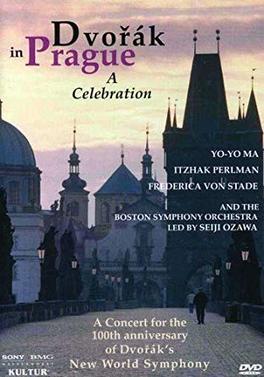
On 16 December 1893, the New York Philharmonic, which had commissioned the work, premiered Dvořák's Symphony No. 9 in Carnegie Hall under the direction of Anton Seidl. Exactly one hundred years later, that event was commemorated in a concert mounted in Prague's Smetana Hall, an art nouveau building erected between 1906 and 1911 and named in honour of Bedřich Smetana, the Czech composer popularly regarded in the Czech Republic as the father of the nation's music. The concert was staged in the presence of the Republic's first President, Václav Havel. It included Itzhak Perlman's first performance in Prague, and was the first occasion on which the Boston Symphony Orchestra was heard there since 1956.
The Carnival Overture that opened the gala, although published as an independent work, is the central piece in a trilogy of concert overtures that Dvořák entitled "Nature, life and love". The first in the cycle is V přírodě ("In nature's realm", Op. 91, B. 168, 1891), and the third is Othello (Op. 93, B. 174, 1892).
The Romance in F minor was written at the request of Josef Markus, first violin of the orchestra of Prague's Provisional Theatre, for a concert that the orchestra gave under the direction of Adolf Čech at the Žofín Palace on 9 December 1877. It was adapted by Dvořák from a string quartet that he had composed four years previously, but which remained unpublished until after his death.
Silent Woods originated in a cycle of five piano pieces, From the Bohemian forest, that Dvořák composed in 1883 at the request of Fritz Simrock, the German who published most of his works. After a version of the fifth part that Dvořák arranged for cello and piano in 1891 was received enthusiastically, he composed an orchestral version of it in 1893. It was Simrock who changed Dvořák's title from Die Ruhe (German for the Czech "Klid", meaning "Silence") to Waldesruhe ("Wood-silence").
The Humoresques began as fragmentary ideas that Dvořák jotted down in notebooks while director of the National Conservatory of Music of America in 1892-1895. He worked them up into a piano cycle while holidaying in Bohemia in 1894. The seventh humoresque's transcription for violin, cello and orchestra that was heard during the gala was commissioned from the Czech-Canadian composer Oskar Morawetz at Yo-Yo Ma's suggestion.
The Symphony No. 9, another fruit of Dvořák's time in charge of the National Conservatory of Music of America, was inspired by African-American and Native American music. He wrote that he regarded its second movement as a "sketch or study for a later work, either a cantata or opera ... which will be based on Longfellow's Hiawatha".