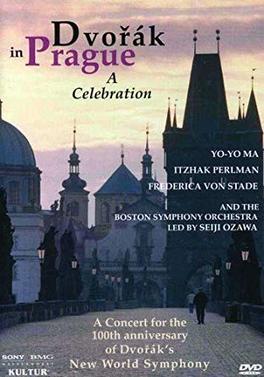
Dvořák in Prague: A Celebration was an 89-minute televised concert presented in Prague's Smetana Hall on 16 December 1993, in which thirteen pieces of music by Antonin Dvořák were performed by the pianist Rudolf Firkušný, the cellist Yo-Yo Ma, the violinist Itzhak Perlman, the mezzo-soprano Frederica von Stade, the Prague Philharmonic Chorus and the Boston Symphony Orchestra under the direction of Seiji Ozawa. It was produced by Sony Classical Film and Video, Czech Television and Germany's Zweites Deutsches Fernsehen in association with Pragokoncert, the Netherlands' Algemene Vereniging Radio
Dvořák in Prague: A Celebration was an 89-minute televised concert presented in Prague's Smetana Hall on 16 December 1993, in which thirteen pieces of music by Antonin Dvořák were performed by the pianist Rudolf Firkušný, the cellist Yo-Yo Ma, the violinist Itzhak Perlman, the mezzo-soprano Frederica von Stade, the Prague Philharmonic Chorus and the Boston Symphony Orchestra under the direction of Seiji Ozawa. It was produced by Sony Classical Film and Video, Czech Television and Germany's Zweites Deutsches Fernsehen in association with Pragokoncert, the Netherlands' Algemene Vereniging Radio
소개 자세히 읽기
Dvořák in Prague: A Celebration was an 89-minute televised concert presented in Prague's Smetana Hall on 16 December 1993, in which thirteen pieces of music by Antonin Dvořák were performed by the pianist Rudolf Firkušný, the cellist Yo-Yo Ma, the violinist Itzhak Perlman, the mezzo-soprano Frederica von Stade, the Prague Philharmonic Chorus and the Boston Symphony Orchestra under the direction of Seiji Ozawa. It was produced by Sony Classical Film and Video, Czech Television and Germany's Zweites Deutsches Fernsehen in association with Pragokoncert, the Netherlands' Algemene Vereniging Radio Omroep and the United States' Public Broadcasting Service and MJI Broadcasting, and was released on Laserdisc, VHS video cassette, CD and audio cassette by Sony Classical Records and on DVD by Kultur Video.
DVD chapter listing
Antonin Dvořák (1841-1904)
1 (2:02) Opening credits, over footage of Prague in winter
2 (10:22) Karneval, koncertni ouvertura ("Carnival, a concert overture", Op. 92, B. 169, 1891), with the Boston Symphony Orchestra conducted by Seiji Ozawa
3 (12:17) Romance f moll pro housle a orchestr ("Romance in F minor for violin and orchestra", Op. 11, B. 39, Prague, 1877), arranged by Dvořák from the second movement, Andante con moto quasi allegretto, of his Smyčcový kvartet č. 5 f moll ("String quartet No. 5 in F minor", Op. 9, B. 37, Prague, 1873), with Itzhak Perlman and the Boston Symphony Orchestra, conducted by Seiji Ozawa
4 (7:32) Klid ("Silence", also known as "Silent woods", for cello and orchestra, B. 182, 1893), transcribed by Dvořák from the fifth part of his Ze Šumavy ("From the Bohemian forest", for piano four hands, Op. 68, B. 133, 1883), with Yo-Yo Ma and the Boston Symphony Orchestra, conducted by Seiji Ozawa
On 16 December 1893, the New York Philharmonic, which had commissioned the work, premiered Dvořák's Symphony No. 9 in Carnegie Hall under the direction of Anton Seidl. Exactly one hundred years later, that event was commemorated in a concert mounted in Prague's Smetana Hall, an art nouveau building erected between 1906 and 1911 and named in honour of Bedřich Smetana, the Czech composer popularly regarded in the Czech Republic as the father of the nation's music. The concert was staged in the presence of the Republic's first President, Václav Havel. It included Itzhak Perlman's first performance in Prague, and was the first occasion on which the Boston Symphony Orchestra was heard there since 1956.
The Carnival Overture that opened the gala, although published as an independent work, is the central piece in a trilogy of concert overtures that Dvořák entitled "Nature, life and love". The first in the cycle is V přírodě ("In nature's realm", Op. 91, B. 168, 1891), and the third is Othello (Op. 93, B. 174, 1892).
The Romance in F minor was written at the request of Josef Markus, first violin of the orchestra of Prague's Provisional Theatre, for a concert that the orchestra gave under the direction of Adolf Čech at the Žofín Palace on 9 December 1877. It was adapted by Dvořák from a string quartet that he had composed four years previously, but which remained unpublished until after his death.
Silent Woods originated in a cycle of five piano pieces, From the Bohemian forest, that Dvořák composed in 1883 at the request of Fritz Simrock, the German who published most of his works. After a version of the fifth part that Dvořák arranged for cello and piano in 1891 was received enthusiastically, he composed an orchestral version of it in 1893. It was Simrock who changed Dvořák's title from Die Ruhe (German for the Czech "Klid", meaning "Silence") to Waldesruhe ("Wood-silence").
The Humoresques began as fragmentary ideas that Dvořák jotted down in notebooks while director of the National Conservatory of Music of America in 1892-1895. He worked them up into a piano cycle while holidaying in Bohemia in 1894. The seventh humoresque's transcription for violin, cello and orchestra that was heard during the gala was commissioned from the Czech-Canadian composer Oskar Morawetz at Yo-Yo Ma's suggestion.
The Symphony No. 9, another fruit of Dvořák's time in charge of the National Conservatory of Music of America, was inspired by African-American and Native American music. He wrote that he regarded its second movement as a "sketch or study for a later work, either a cantata or opera ... which will be based on Longfellow's Hiawatha".
Rusalka is about a water-spirit who falls in love with a human Prince who passes by her lake while hunting. In her "Song to the moon", she pleads with "the pilgrim of the starry vault" to tell the Prince about her feelings for him.
Dvořák's setting of Psalm 149 was one of a number of works in which he expressed his profound religious sentiments. His Christian œuvre includes a Mass in D major, a Requiem, a Stabat Mater, a Te Deum and an oratorio, Svatá Ludmila ("Saint Ludmila").
The Gypsy Songs include "Songs my mother taught me", a piece frequently recorded in instrumental arrangements as well as by vocalists. A singing translation of its text is: "Songs my mother taught me, In the days long vanished; Seldom from her eyelids were the teardrops banished. Now I teach my children each melodious measure, Oft the tears are flowing, oft they flow from my memory's treasure".
"Dumky", the subtitle of the Piano Trio No. 4, is the plural of the Ukrainian word "dumka", a musical term which is a diminutive form of the word "duma" (plural "dumy") that Ukrainians use for their epic folk ballads. Dumky are characterized by alternating cheerfulness and gloom.
Inspired by Johannes Brahms's Hungarian Dances and the rhythms of traditional Bohemian folk dances, the Slavonic Dances were originally piano pieces. Both of those performed in the gala were presented in transcriptions, one for violin, cello and orchestra by Oskar Morawetz and one for orchestra by Dvořák himself. Dvořák was asked to orchestrate his dances by his publisher in order that they "should sound like the very devil".