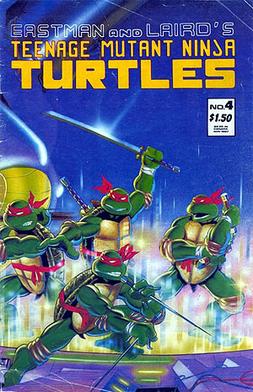
Teenage Mutant Ninja Turtles (TMNT) is a comic book series that was published by Mirage Studios between 1984 and 2014. Conceived by Kevin Eastman and Peter Laird, it was intended as a one-shot, but due to its popularity it became an ongoing series. The comic created the Turtles franchise of five television series, seven feature films, numerous video games, and a range of toys and merchandise.
Teenage Mutant Ninja Turtles (TMNT) is a comic book series that was published by Mirage Studios between 1984 and 2014. Conceived by Kevin Eastman and Peter Laird, it was intended as a one-shot, but due to its popularity it became an ongoing series. The comic created the Turtles franchise of five television series, seven feature films, numerous video games, and a range of toys and merchandise.
閱讀詳細介紹
Teenage Mutant Ninja Turtles (TMNT) is a comic book series that was published by Mirage Studios between 1984 and 2014. Conceived by Kevin Eastman and Peter Laird, it was intended as a one-shot, but due to its popularity it became an ongoing series. The comic created the Turtles franchise of five television series, seven feature films, numerous video games, and a range of toys and merchandise.
Notable for its black and white format and darker tone compared to later adaptations, the series follows the exploits of four genetically mutated turtles trained in ninjutsu and martial arts by the mutated rat sensei Splinter to combat various foes, most notably the evil ninja clan known only as the "Foot", and their leader Oroku Saki, the samurai-esque "Shredder".
Over the years, the Turtles have appeared in numerous cross-overs with other independent comics characters such as Dave Sim's Cerebus, Bob Burden's Flaming Carrot, Stan Sakai's Usagi Yojimbo, Image Universe series including Erik Larsen's Savage Dragon and Todd McFarlane's Spawn.
In October 2009, Laird sold the rights to the Teenage Mutant Ninja Turtles franchise to Viacom, the parent company of Nickelodeon. Mirage Studios was shut down on September 19, 2021. In 2011, IDW Publishing secured the rights to publish a new series and reprint the older comics.
Origin of the concept
The concept originated from a comical drawing sketched out by Kevin Eastman during a casual evening of brainstorming with his friend Peter Laird. The drawing of a short, squat turtle wearing a mask with nunchaku strapped to its arms was humorous to the young artists, as it played upon the inherent contradiction of a slow, cold-blooded reptile with the speed and agility of Japanese martial arts. Laird suggested that they create a team of four such turtles, each specializing in a different weapon. Eastman and Laird often cited the work of Frank Miller and Jack Kirby as their major artistic influences.
With money from a tax refund and a loan from Eastman's uncle, they formed Mirage Studios and self-published a single-issue comic book that combined their original idea with elements meant to pastiche four popular comics of the early 1980s: Marvel Comics' The New Mutants, which featured teenage mutants; Cerebus, which featured anthropomorphic animals; Ronin; and Daredevil, which featured ninja clans dueling for control of the underworld.
Volume 1: 1984–1993
The first issue of was advertised in issues #1 and #2 of Eastman and Laird's 1984 comic, Gobbledygook, in addition to the Comics Buyer's Guide, issue 545. The full page advertisement in CBG helped gain the attention of retailers and jump-started their early sales. Because of the CBG's newspaper format, many were disposed of, making it a highly sought-after collector's item today. The book premiered in May 1984 at a comic book convention in Portsmouth, New Hampshire. It was printed in an oversized, magazine-style format using black and white artwork on cheap newsprint and had a print run of only 3,275 copies. It was a period of intense speculation in comic book investment, with especially strong interest in black and white comics from independent companies. The first printings of the original TMNT comics had small print runs that made them instant collector items. Within months, the books were trading at prices over 50 times their cover price.
The Turtles' origin had direct allusions to Daredevil: the traffic accident between a blind man and a truck carrying radioactive ooze is identical to Daredevil's own story (and in fact, in the first issue relating the Turtles' birth, Splinter sees the canister strike a boy's face). The name "Splinter" served to parody Daredevil's mentor Stick. The Foot, a clan of evil ninjas who became the Turtles' archenemies, satirizes the Hand, a mysterious and deadly ninja clan in the pages of Daredevil.
Eastman and Laird originally wanted to give their characters Japanese names to fit the theme, but as Laird explained, "we couldn't think of authentic-sounding Japanese names". Instead, they went with Renaissance artists, and picked the four they were most familiar with, with the help of Laird's copy of Janson's History of Art.
The success also led to a black-and-white comics boom in the mid-1980s, wherein other small publishers put out animal-based parody books hoping to make a quick profit. Among them, the Adolescent Radioactive Black Belt Hamsters, the Pre-Teen Dirty-Gene Kung Fu Kangaroos, and the Karate Kreatures were obvious parodies of TMNT. Even Marvel Comics featured an advertisement for Adult Thermonuclear Samurai Elephants in 1986, but it evolved into an X-Men parody eventually released as Power Pachyderms in 1989. Most of them were sold to comic shops in large numbers, but failed to catch on with readers. This speculation led to financial problems with both comic shops and distributors, contributing to a sales collapse in 1986–87.
The "Return to New York" story arc concluded in the spring of 1989 and by this time the Ninja Turtles phenomenon was well established in other media. Eastman and Laird then found themselves administrating an international merchandising juggernaut, overseeing a wide array of licensing deals. This prevented the two creators from participating in the day-to-day work of writing and illustrating a monthly comic book. For this reason, many guest artists were invited to showcase their unique talents in the TMNT universe. The breadth of diversity found in the various short stories had the adverse effect of somewhat disrupting continuity and gave the series a disjointed, anthology-like feel. Some of these artists, including Michael Dooney, Eric Talbot, A.C. Farley, Ryan Brown, Steve Lavigne, Steve Murphy, and Jim Lawson, continued to work with Mirage Studios for years to come.
Issue #45 kicked off a major turning point, as Mirage made a concerted effort to return the series to continuity. A 13-part story arc entitled "City at War" began with issue #50, which was the f