
條目
戰鬥機飛行員
fighter pilot
军事航空飞行员
在包含此條目的事件檔案中探索資訊與關係。
還沒有包含此條目的事件檔案。
從此條目開始調查正在查找與此條目有關的作品或人物。
戰鬥機飛行員
正在尋找與它相連的內容。
军事航空飞行员
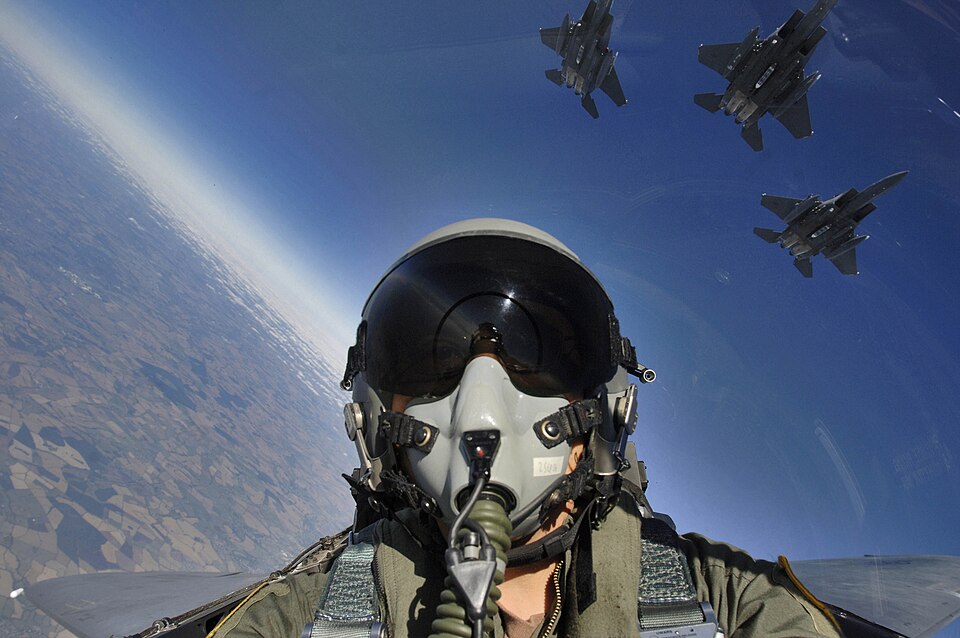
A fighter pilot or combat pilot is a military aviator trained to engage in air-to-air combat, air-to-ground combat and sometimes electronic warfare while in the cockpit of a fighter aircraft. Fighter pilots undergo specialized training in aerial warfare and dogfighting (close range aerial combat). A fighter pilot with at least five air-to-air kills becomes known as an ace.
Fighter pilots are one of the most important positions of any air force. Selection processes only accept the elite out of all the potential candidates. An individual who possesses an exceptional academic record, physical fitness, healthy well-being, and a strong mental drive will have a higher chance of being selected for pilot training. Candidates are also expected to exhibit strong leadership and teamwork abilities. In nearly all air forces, fighter pilots are commissioned officers. This is the same for pilots of most other aircraft.
Fighter pilots must be in optimal health to handle the physical demands of modern aerial warfare. Excellent heart condition is required, as the increased "G's" a pilot experiences in a turn can cause stress on the cardiovascular system. One "G" is equal to the force of gravity experienced under normal conditions, two "G"s would be twice the force of normal gravity. Some fighter aircraft can accelerate to up to 9 G's. Fighter pilots also require strong muscle tissue along the extremities and abdomen, for performing an anti-G straining maneuver (AGSM, see below) when performing tight turns and other highly accelerated maneuvers. Better-than-average visual acuity is also a highly desirable and valuable trait.
Pilots are trained to employ specific tactics and maneuvers when they are under attack. Attacks from missiles are usually countered with electronic countermeasures, Flares and chaff. Missiles like the AIM-120 AMRAAM, however, can actively home in on jamming signals.
Dogfighting at 1 to 4 miles (1,600 to 6,400 m) is considered "close". Pilots perform stressful maneuvers to gain advantage in the dogfight. Pilots need to be in good shape in order to handle the high G-forces caused by aerial combat. Pilots flex their legs and torso to keep blood from draining out of the head. This is known as the AGSM or the M1 or, sometimes, as the "grunt".
Many early air-to-air and surface-to-air missiles had very simple infrared homing ("heat seeking") guidance systems with a narrow field of view. These missiles could be avoided by simply turning sharply, which essentially caused the missile to lose sight of the target aircraft. Another tactic was to exploit a missile's limited range by performing evasive maneuvers until the missiles had run out of fuel.
Modern infrared missiles, like the AIM-9 Sidewinder, have a more advanced guidance system. Supercooled infrared detectors help the missile find a possible exhaust source, and software assists the missile in flying towards its target. Pilots normally drop flares to confuse or decoy these missiles by creating more multiple heat signatures hotter than that of the aircraft for the missile to lock onto and guide away from the defending aircraft.
Radar homing missiles could sometimes be confused by surface objects or geographical features causing clutter for the guidance system of either the missile or ground station guiding it. Chaff is another option in the case that the aircraft is too high up to use geographical obstructions. Pilots have to be aware of the potential threats and learn to distinguish between the two where possible. They use the radar warning receiver (RWR) to discern the types of signals hitting their aircraft.
When maneuvering fiercely during engagements, pilots are subjected to high G-force. G-forces express the magnitude of gravity, with 1G being equivalent to Earth's normal pull of gravity. Because modern jet aircraft are highly agile and have the capacity to make very sharp turns, the pilot's body is often pushed to the limit.
When executing a "positive G" maneuver like turning upwards the force pushes the pilot down. The most serious consequence of this is that the blood in the pilot's body is also pulled down and into their extremities. If the forces are great enough and over a sufficient period of time this can lead to blackouts (called G-induced loss of consciousness or G-LOC), because not enough blood is reaching the pilot's brain. To counteract this effect pilots are trained to tense their legs and abdominal muscles to restrict the "downward" flow of blood. This is known as the "grunt" or the "Hick maneuver". Both names allude to the sounds the pilot makes, and is the primary method of resisting G-LOCs. Modern flight suits, called G-suits, are worn by pilots to contract around the extremities exerting pressure, providing about 1G of extra tolerance.
Some notable fighter pilots, including some for being flying aces and others who went on to non-fighter pilot notability (record-breaking test pilots, astronauts and cosmonauts, politicians, business leaders, etc.):
Until the early 1990s, women were disqualified from becoming fighter pilots in most of the air forces throughout the world. The exceptions being Turkey, where Sabiha Gökçen became the first female fig
來源:Fighter pilot (CC BY-SA)
結構化資訊、使用者意見與 AI 擷取的關係會分別標示。
等待第一則留言。