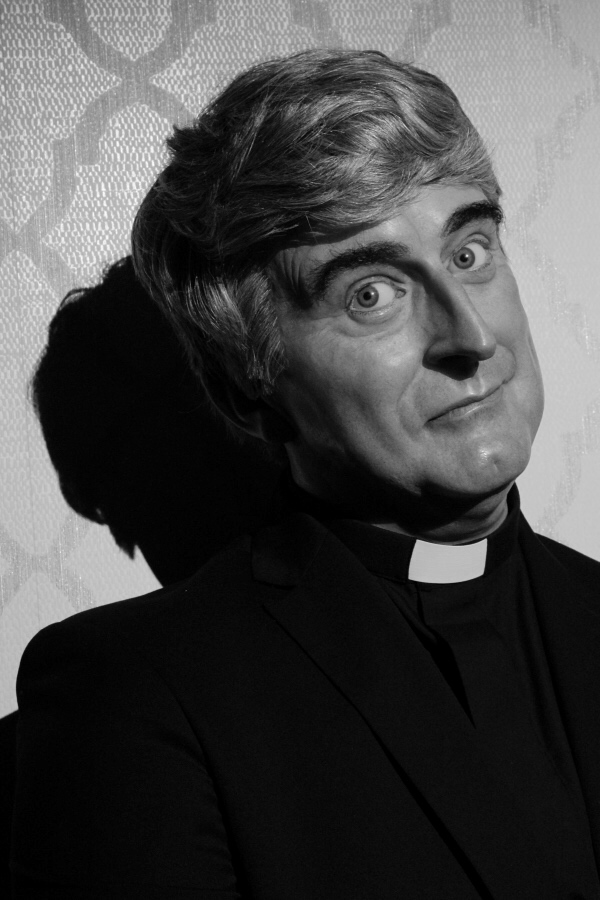
Dermot John Morgan was an Irish comedian and actor, best known for his role as the title character on the Channel 4 sitcom Father Ted. Morgan died one day after filming of the third and final series of Father Ted was completed. In 1999 he was posthumously awarded the British Academy Television Award for Best Comedy Performance.
Dermot John Morgan was an Irish comedian and actor, best known for his role as the title character on the Channel 4 sitcom Father Ted. Morgan died one day after filming of the third and final series of Father Ted was completed. In 1999 he was posthumously awarded the British Academy Television Award for Best Comedy Performance.
閱讀詳細介紹
Dermot John Morgan (31 March 1952 – 28 February 1998) was an Irish comedian and actor, best known for his role as the title character on the Channel 4 sitcom Father Ted. Morgan died one day after filming of the third and final series of Father Ted was completed. In 1999 he was posthumously awarded the British Academy Television Award for Best Comedy Performance.
Early life
Dermot John Morgan was born on 31 March 1952 in Dublin, the son of Donnchadh Morgan, a civil servant, gifted amateur artist and sculptor, and Hilda "Holly" (née Stokes). His father died young of an aneurysm, leaving Holly with three children: Dermot, Paul, and Denise. A fourth child, Ruth, died in childhood in 1956.
Morgan was educated at Oatlands College in Stillorgan and University College Dublin, where he studied English literature and philosophy. During his time there, he honed his comic skills; he also fronted a country and Irish band named Big Gom and the Imbeciles, a kind of "tribute" act to Big Tom and The Mainliners, a major Irish band of the era. According to Morgan in a January 1986 article, "Everybody slagged country and western at some stage".
Big Gom and the Imbeciles were never signed by a record label, and Morgan subsequently worked as a teacher, which, he admitted, was a type of performance in itself:
There is a comparison between the performance of a schoolteacher and performance in general. You're on your feet and you have to be able to think. The best way of maintaining discipline is to have the ready reply. That's what being a performer is like. If you have a rowdy crowd in a pub or cabaret somewhere you've got to be on top.
Father Trendy and The Live Mike
Morgan made his debut in the media on the Morning Ireland radio show produced by Gene Martin, whose sister Ella was the mother of one of Morgan's friends. It was through this contact that Morgan made the break into radio and eventually television.
As a singer: "Thank You Very Much, Mr. Eastwood"
Morgan released a comedy single, "Thank You Very Much, Mr. Eastwood", in December 1985 on Dolphin Records. It was a take on the fawning praise that internationally successful Irish boxer Barry McGuigan gave his manager, Barney Eastwood, at the end of successive bouts. The single 'featured' impressions of McGuigan, Ronald Reagan, Bob Geldof and Pope John Paul II, and was the Christmas number one in the Irish Singles Chart for 1985. Morgan spoke later to the press that he was "a bit worried" that his "take off" of the Pope during the song could have been received badly by the public, especially in Northern Ireland due to tensions there at the time.
Barry Devlin, the former Horslips lead singer produced the single, whilst Paul McGuinness, the U2 manager, "struck a deal" for its release in Britain, with Morgan clarifying "I don't think he particularly wants to get involved with comedians. I think he just liked the idea and looked after some of the business for me." Speaking with the Evening Herald in January 1986, Morgan announced that he would shortly be filming an accompanying music video for the single at Windmill Lane Film Studios in Dublin:
Scrap Saturday
Morgan's biggest Irish broadcasting success occurred in the late 1980s on the Saturday morning radio comedy show Scrap Saturday, in which Morgan, co-scriptwriter Gerard Stembridge, Owen Roe and Paulin
According to a 1986 article in the Evening Herald, Morgan first got nationwide attention through letters he sent in to the Mike Murphy radio show:
"The letters were on anything, from sitting in the traffic to Moss Keane. Michael was quite biting in his humour at the time so my letters fitted in quite well with the show." And it was Mike Murphy who eventually gave him a regular spot on his TV series, The Live Mike. Dermot had been asked to do a routine on a TV pilot show hosted by Brendan Balfe. That was when he first introduced his ever-so laid back character, Father Trendy. "After all the letters to him, and after Murph saw the pilot show, he asked me to come on his own show..."
Morgan subsequently came to prominence as part of The Live Mike, which became hugely successful in Ireland. Between 1979 and 1982, Morgan played a range of comic characters who appeared between segments of the show. Morgan lampooned the rampant Modernism within the Post–Vatican II Roman Catholic Church in Ireland by incorporating his Father Trendy character, a wishy-washy, trying-to-be-cool hippie-priest (modelled after Father Brian D'Arcy). Father Trendy always wore an Elvis Presley-style haircut and sometimes a leather jacket. He was also given to drawing ludicrous parallels between religion and secularism in two-minute 'sermons' to the camera. Morgan also satirised extreme nationalist "Little Irelanders", by playing an irate and bigoted GAA member who waved his hurley around while verbally attacking his pet hates.
At the height of the Troubles, Morgan also lampooned both the Wolfe Tones and the clichés of Irish rebel songs, which he said "always have lots of blood and guts and fire and thunder in them". He then sang his own parody of Thomas Osborne Davis's iconic song "A Nation Once Again", about the martyrdom of Fido, a dog who saves his IRA master by eating a hand grenade during a search of the house by the Black and Tans during the Irish War of Independence. When Fido farts and the grenade accidentally detonates, the Black and Tans comment, "'Scuse me mate, was that something your dog ate?" The song climaxed with the words: "I hope that I shall live to see Fido an Alsatian once again."
But the fun doesn't stop there. In fact, Thank You Very Much, Mr. Eastwood is just the first part of a new major offensive by Mr. Morgan on the Irish comedy scene... "I'm going to be doing an album next as the interest is now there and I have plenty of original material lying around. The video for the single is also part of a 20 minute pilot programme that myself and Windmill Lane studios are putting together. It's a full comedy production and we hope to interest RTÉ and Channel 4 with it." Dermot wants to get a comedy series off the ground made by an independent film company and he hopes to sell it both here and in Britain.