
作品
Land of the Lustrous
日本電視動畫系列
在包含此條目的事件檔案中探索資訊與關係。
還沒有包含此條目的事件檔案。
從此條目開始調查等待第一則留言。
日本電視動畫系列
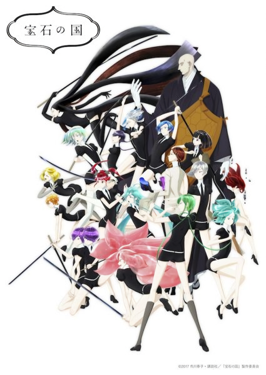
Land of the Lustrous (Japanese: 宝石の国, Hepburn: Hōseki no Kuni; lit. 'Land of Jewels') is a 2017 Japanese anime television series based on Haruko Ichikawa's manga series Land of the Lustrous. It is produced by the computer graphics (CG) animation studio Orange and directed and written by Takahiko Kyōgoku and Toshiya Ono, respectively. It follows the Lustrous – immortal humanoid lifeforms who are the embodiments of gemstones – who fight to defend themselves against a celestial humanoid race known as the Lunarians, who seek to harvest their bodies for decorations. Phosphophyllite is the youngest of the Lustrous, and is given the task to assemble a natural history since they are too brittle to fight.
Orange created the series with 3D animation as a base, a decision made partially due to the difficulty in depicting translucent gemstones using hand-drawn animation. Yoichi Nishikawa's concept art greatly influenced Kyōgoku's vision for the series, with several shots directly based on Nishikawa's art. While the manga is more ambiguous and subtle, the anime had to be clear on a single viewing, so Phos was given more close-up shots and repeated lines to give them a larger presence and more easily identifiable goals. As Kyōgoku was used to writing teenaged characters with clear motives and desires, he initially had problems with portraying Phos, but his image of the character solidified after hearing Tomoyo Kurosawa's performance as them.
The series was well received by critics, frequently called among the best of the 2010s and a turning point for CG anime, and convincing skeptics that an action series could be well done outside of a 2D production. The writing was also positively received, with critics calling the characters and world likable and intriguing. It received several awards and nominations, namely for its visuals.
Land of the Lustrous is set in the far future, in a land inhabited by an immortal life form called the Lustrous, who is the embodiment of gemstones. The twenty-eight Lustrous led by their teacher, Kongo, are fighting to defend themselves against a celestial humanoid race called the Lunarians, who inhabit the Moon and invade Earth every few days while seeking to harvest the Lustrous' bodies for decorations. Phosphophyllite, nicknamed Phos, currently 300 years old, is the youngest of the Lustrous, and because of their brittleness is unable to fight. They feel useless, but are given the task of assembling a natural history by Kongo. While looking for information to include in the book, Phos meets the nightwatch, Cinnabar, who is poisonous and thus dangerous even to other Lustrous, and therefore lives in isolation. Finding this sad, Phos decides to find Cinnabar a better job.
Land of the Lustrous was produced at the computer graphics (CG) animation studio Orange, and adapts Haruko Ichikawa's 2012 manga series Land of the Lustrous, covering little over its first four volumes. The series had Katsuhiro Takei and Kiyotaka Waki as production staff; and was directed by Takahiko Kyōgoku, with Toshiya Ono in charge of the series scripts, Eiji Inomoto serving as chief CG director, Kenji Fujita being director of photography, and with Daisuku Imai in charge of editing. Asako Nishida designed the characters, while Yōichi Nishikawa created the concept art, and Osamu Mikasa painted the color key art. The sound team included composer and sound director Yukio Nagasaki. The opening theme, "Kyōmen no Nami", was performed by Yurika, and the ending theme, "Kirameku Hamabe", by Yuiko Ōhara.
After reading the manga for the first time, Kyōgoku thought that it would be difficult to surpass the manga by simply copying what was shown in each panel: according to him, the appeal of the manga was its ambiguity and subtlety, saying that there is more room for subtle portrayal in a manga since the reader can re-read it, whereas an anime aired on television needs to be clearer on a single viewing. Because of this, they made the protagonist clearer by giving Phos more close-up shots and having them repeat certain important lines, leading to them appearing to have a larger presence in the story and have more easily identifiable goals. Ono helped in this by breaking down difficult portions of the manga's story into scenes.
Kyōgoku and Ichikawa discussed the story development, and Kyōgoku was asked to leave it uncertain whether Phos's changes during the story are good or not, and to portray the change as starting with
來源:Land of the Lustrous (TV series) (CC BY-SA)
結構化資訊、使用者意見與 AI 擷取的關係會分別標示。
The project started in 2015, while Kyōgoku was working on the anime series Gate, and was approached by Katsuhiro Takei from Toho to work on an adaptation of the Land of the Lustrous manga. Kyōgoku had always wanted to create a work based on CG animation with complementing 2D animation, rather than the more common use of a 2D base with complementing 3D, and both Kyōgoku and Takei thought that that style would fit Land of the Lustrous. Takei wanted Orange to work on the project from the start; despite trusting their abilities due to the staff's previous experience with action in the Rebuild of Evangelion films, Kyōgoku was initially worried about them handling the full production due to the low number of staff members, but the studio expanded from 50 to 100 staff members during the production.
Although voice recording for anime productions typically is done after the animation is finished, it was done prior to the CG creation for Land of the Lustrous, after the animatics were created. Kyōgoku was happy with the casting, saying that Kurosawa embraced her role and "became" Phos, acting out lines physically, and that the supporting cast helped support the spontaneity of Phos's character. Kyōgoku also specifically noted being happy with casting Nakata as Kongo, as they had worked together before and as he loved Nakata's acting. Describing Nakata as a gentleman, he thought he was perfectly suited for the role, and said that a too charming or sultry voice would not have worked for the character.