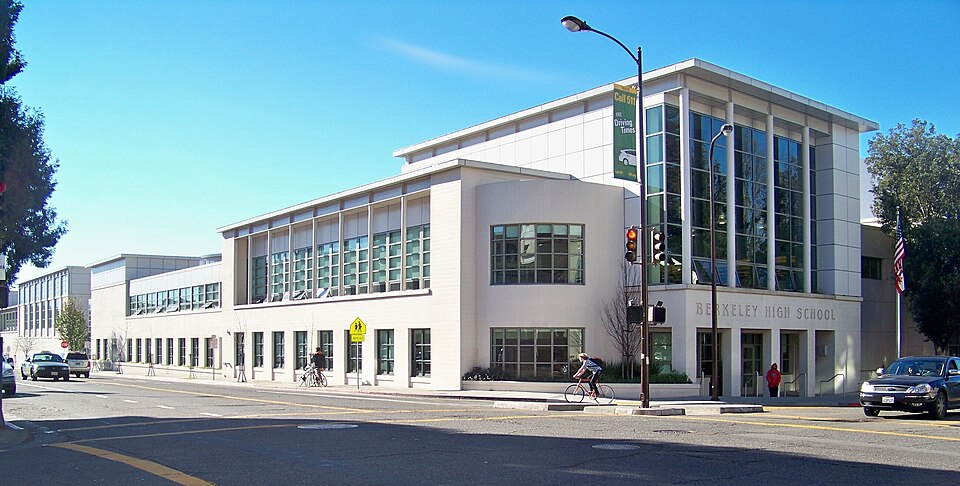
Berkeley High School is a public high school in the Berkeley Unified School District, and the only public high school in the city of Berkeley, California, United States. It is located one long block west of Shattuck Avenue and three short blocks south of University Avenue in Downtown Berkeley. The school mascot is the Yellowjacket.
Berkeley High School is a public high school in the Berkeley Unified School District, and the only public high school in the city of Berkeley, California, United States. It is located one long block west of Shattuck Avenue and three short blocks south of University Avenue in Downtown Berkeley. The school mascot is the Yellowjacket.
閱讀詳細介紹
Berkeley High School is a public high school in the Berkeley Unified School District, and the only public high school in the city of Berkeley, California, United States. It is located one long block west of Shattuck Avenue and three short blocks south of University Avenue in Downtown Berkeley. The school mascot is the Yellowjacket.
Some of the campus buildings are recognized as a Berkeley Landmark by the city; and since January 7, 2008, eight of the campus buildings were designated a historic district by the National Register of Historic Places under the name, the Berkeley High School Campus Historic District.
Demographics
Berkeley High demographics, as of the 2017–2018 school year, out of 3,118 enrolled students:
463 (15%) African American or Black
7 (0.2%) American Indian or Alaska Native
251 (8%) Asian
22 (0.7%) Filipino
731 (23%) Hispanic or Latino
11 (0.3%) Pacific Islander or Native Hawaiian
1,258 (40%) White, non-Hispanic
375 (12%) identifying as two or more races
949 (30%) received free/reduced meals, English learners or foster youth
884 (28%) received free and reduced-price meals
177 (6%) English learners
652 (21%) fluent English proficient
Achievement gap
The achievement gap refers to the academic disparity between certain groups, including African-Americans, Latinos, students whose first language is not English, and students living in poverty, who perform significantly below others. This gap extends beyond the results of standardized test scores and also applies to the disparity between certain groups regarding dropout rates, participation in honors classes and Advanced Placement (AP) exams, and numbers of students admitted to colleges. Due to Berkeley High School's racially, ethnically and socio-economically diverse student population, it has been called the "most integrated high school in America." However an achievement gap continues to exist between the white students and black and Latino students. For ex
The first public high school classes in Berkeley were held at the Kellogg Primary School located at Oxford and Center streets adjacent to the campus of the University of California. It opened in 1880 and the first high school graduation occurred in 1884. In 1895, the first high school annual was published, entitled the Crimson and Gold (changed to Olla Podrida by 1899).
In 1900, the citizens of Berkeley voted in favor of a bond measure to establish the first dedicated public high school campus in the city. In 1901, construction began on the northwest portion of the present site of the high school. The main school building stood on the corner of Grove (now Martin Luther King Way) and Allston Way, where the "H" building is located today. At that time, Kittredge Street ran through what is today's campus site instead of ending at Milvia. The local office of the Bay Cities Telephone Company sat on the site of today's administration building at the corner of Allston Way and Milvia by 1911.
On Arbor Day of 1902, noted naturalist John Muir joined Berkeley's mayor William H. Marston in planting a giant sequoia in a yard south of the new high school buildings. The tree is apparently no longer there, pending results from a future investigation.
The main building of the high school suffered moderate damage in the form of toppled chimneys, broken windows, and some weakened walls as a result of the 1906 San Francisco earthquake. Professor Andrew Lawson of the University of California included one of his photographs (shown at left) of the damage in his famous report issued in 1908. The building was subsequently repaired and re-opened. In 1934, it was demolished and soon thereafter replaced by the buildings that stand there now, the "H" and "G" buildings.
In 1955, Berkeley High School band director Bob Lutt (who eventually was made executive director of the Berkeley Symphony Orchestra) founded Cazadero Performing Arts Camp.
In 1964, the West Campus of Berkeley High School was opened in the buildings of the former Burbank Junior High School at Bonar Street and University Avenue. It served all ninth graders, while the main campus served grades 10–12, except for an interval from the mid-1970s to the early 1980s when it was 7–9 to accommodate construction at Willard Junior High School. It was turned over to the Berkeley Adult School in 1986, which used it until 2004. West Campus is currently closed, but the main building is being used as the administrative offices of the Berkeley Unified School District.
Several famous performers have played at the Berkeley Community Theater on the Berkeley High campus. On May 23, 1952, Paul Robeson sang, despite a small McCarthy-era furor. In 1957, Stan Getz was one of the featured performers of the Berkeley Jazz Festival.
A significant portion of students and faculty alike were involved with the various forms of political activism that characterized the sixties in Berkeley, including protests against the Vietnam War, advocacy for civil rights and third world studies, and supporting People's Park. The campus included a Black Students Union, Chicano Student Union, and Asian Student Union (formerly called the Oriental Student Union). In 1971, Berkeley High students elected a homosexual male African American student as Homecoming Queen.
Berkeley High School has been innovative in its high school curriculum. In the fall of 1970, a "school within a school" opened at Berkeley High called Community High School. It was "alternative", in keeping with the sixties culture which permeated life in Berkeley at the time. By 1974, there were several small schools within Berkeley High: Genesis-Agora (formerly Community and Community 2), Model School A, School of the Arts, and College Prep. Berkeley High School was also the first public high school in the United States with an African American Studies department, established in 1969.