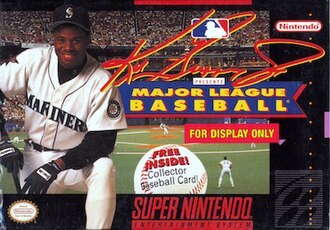
Ken Griffey Jr. Presents Major League Baseball is a 1994 baseball video game developed by Software Creations and published by Nintendo for the Super Nintendo Entertainment System. A Game Boy version was released in 1997. The game has a Major League Baseball (MLB) license but not a Major League Baseball Players Association (MLBPA) license, meaning that the game has real stadiums and real teams, but not real players. The fictitious players have the same statistics as their real-world counterparts, and the game comes with a name-changing feature that allows players to change the athletes' names.
Ken Griffey Jr. Presents Major League Baseball is a 1994 baseball video game developed by Software Creations and published by Nintendo for the Super Nintendo Entertainment System. A Game Boy version was released in 1997. The game has a Major League Baseball (MLB) license but not a Major League Baseball Players Association (MLBPA) license, meaning that the game has real stadiums and real teams, but not real players. The fictitious players have the same statistics as their real-world counterparts, and the game comes with a name-changing feature that allows players to change the athletes' names.
閱讀詳細介紹
Ken Griffey Jr. Presents Major League Baseball is a 1994 baseball video game developed by Software Creations and published by Nintendo for the Super Nintendo Entertainment System. A Game Boy version was released in 1997. The game has a Major League Baseball (MLB) license but not a Major League Baseball Players Association (MLBPA) license, meaning that the game has real stadiums and real teams, but not real players (except Ken Griffey Jr.). The fictitious players have the same statistics as their real-world counterparts, and the game comes with a name-changing feature that allows players to change the athletes' names. Nintendo released a portable version of the game in 1997 for the Game Boy with real players and stats from the 1996 season. The gameplay is similar to its predecessors, though it is sometimes sluggish due to hardware restrictions. The SNES version came with a promotional Griffey collector's card packed inside. It is often rated by the public as one of the best baseball games of all time.
Features
Fictitious players in the game are themed with their teammates. Some of the themes include:
The Atlanta Braves are famous dance DJs, such as Sasha & Digweed who stand in for starting pitcher John Smoltz and closer Mike Stanton. Tony Humphries stands in for middle relief pitcher Jay Howell, Grant Park, fills in for pitcher Steve Avery. C. Edwards stands in for pitcher Tom Glavine, D. Chapman stands in for rightfielder David Justice, A. Barker stands in for ace pitcher Greg Maddux, J.Evans stands in for leftfielder Ron Gant, M. Larson is utility player Francisco Cabrera, D. Neon stands in for Deion Sanders and D. Crime stands in for first baseman Fred McGriff.
The Baltimore Orioles pay tribute to Baltimore native John Waters who stands in for Cal Ripken Jr., B. Divine filling in for second baseman Harold Reynolds, P. Flamingo standing in for pitcher Mike Mussina, M. Trasho standing in for third baseman Mike Pagliarulo, Cry-Baby stands in for catcher Chris Hoiles, Pepper Walker stands in for middle reliever Todd Frohwirth, Ramona Rickettes stands in fo
The game was groundbreaking and had a long list of features for its time. The game featured statistics from the real-life 1993 MLB season, and also kept statistics for the team controlled by the user throughout a season, though all of the statistics of CPU-controlled teams remained unchanged. The team rosters are based on the 1993 MLB season, with stats included.
Nearly every team has its own venue, sometimes complete with unique features, including Dodger Stadium's "slants" by the outfield crowd (the outfield "roof"), Shea Stadium's minuscule center field crowd, and the large scoreboard in the right field of Comiskey Park. Due to cartridge space limitations, some stadiums could not be added, and in those cases a generic stadium with green or blue walls is used (this layout was mostly used for the concrete donuts such as Riverfront Stadium and Three Rivers Stadium, themselves noted for being generic). Some of the stadiums are particularly realistic; Fenway Park's trademark Green Monster is in the game, as is Joe Robbie Stadium's teal wall and Oriole Park at Camden Yards' trademark Warehouse in right field. The Cincinnati Reds have a blue outfield wall as opposed to their signature green wall at Riverfront Stadium.
The Kansas City Royals and Chicago White Sox are the only two teams to play night games at their respective ball parks. Kauffman Stadium features its signature water falls in the outfield and signature scoreboard in Center Field. Both Yankee Stadium and Tiger Stadium are almost identical except that Yankee Stadium has shorter right field bleachers and the ball can be hit out of the park while Tiger Stadium has an upper deck all the way around. Toronto's SkyDome hotel/restaurant are visible in play if a homerun heads to center field. Wrigley Field has its signature Ivy on the outfield wall but is missing the apartment houses in left and right field respectively and the manual operated scoreboard in center field. The Kingdome has its signature large right field wall, as does the Metrodome.
The Philadelphia Phillies are the only team to play in the generic stadium with astroturf and the green outfield wall. The Colorado Rockies, San Francisco Giants, and the Oakland Athletics are the only teams to play in the generic stadium with natural grass and the green outfield wall. The Pittsburgh Pirates, St. Louis Cardinals, Houston Astros, Montreal Expos, and Cincinnati Reds are the only teams to play in the generic stadium with astroturf and have a blue outfield wall. The Atlanta Braves, Milwaukee Brewers, San Diego Padres, and California Angels are the only teams to play in a generic stadium with natural grass and a blue outfield wall.
The Chicago White Sox wear their black alternate top as their home uniform in the game. The Los Angeles Dodgers have a player on the bench, Lou Graves (actually Darryl Strawberry), who is known for timely home runs in clutch situations; he is often substituted in at shortstop.
Pitching is one of the simplest elements in this game. There is also a battery-backed season mode, where players can select a team to play for 26, 78, or all 162 games. Players who finish first in their division earn a playoff berth and a chance to play in the World Series. Unique to the game was the ability to choose playing a season using a system of either four or six divisions, as the game was released after the six division system was proposed for MLB, but before the first MLB season with six divisions (1994).
The game also features the five new logos and uniforms designs of the Houston Astros, Milwaukee Brewers, San Francisco Giants, Texas Rangers, and the Detroit Tigers compared to what they looked like in 1993. The game also features the new ballparks The Ballpark in Arlington (home ballpark of the Rangers), and Jacobs Field (home ballpark of the Cleveland Indians), which replaced Arlington Stadium and Cleveland Stadium, respectively.