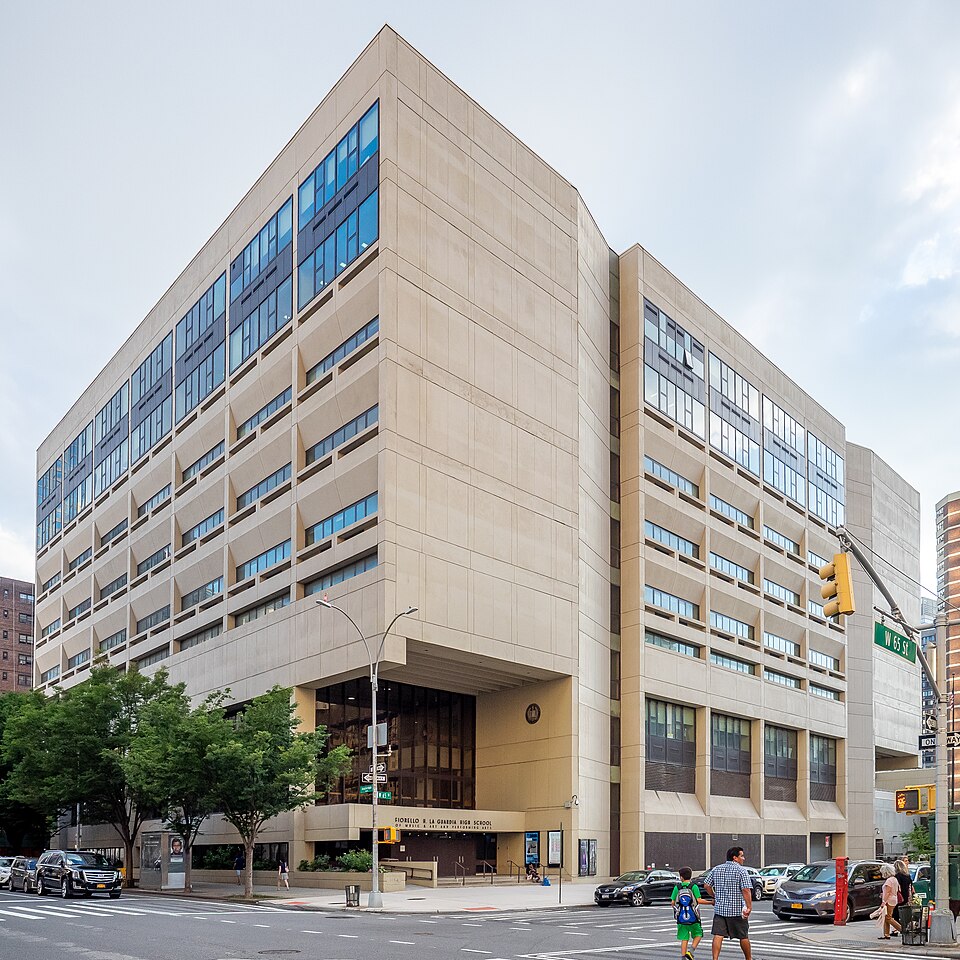
The Fiorello H. LaGuardia High School of Music and Art and Performing Arts is a public high school in the Lincoln Square neighborhood of the Upper West Side in Manhattan, New York City. It specializes in teaching visual arts and performing arts. It is operated by the New York City Department of Education.
The Fiorello H. LaGuardia High School of Music and Art and Performing Arts is a public high school in the Lincoln Square neighborhood of the Upper West Side in Manhattan, New York City. It specializes in teaching visual arts and performing arts. It is operated by the New York City Department of Education.
閱讀詳細介紹
The Fiorello H. LaGuardia High School of Music and Art and Performing Arts (often referred to simply as LaGuardia or "LaG") is a public high school in the Lincoln Square neighborhood of the Upper West Side in Manhattan, New York City. It specializes in teaching visual arts and performing arts. It is operated by the New York City Department of Education.
Situated at 100 Amsterdam Avenue between West 64th and 65th Streets, near Lincoln Center, the school was created by merging the High School of Music & Art and the School of Performing Arts. The school aims to prepare students for higher education, including conservatory study, and a career in the arts.
The school is the only one of New York City's nine specialized high schools to receive special funding from the New York State Legislature through the Hecht-Calandra Act, as well as the only specialized high school that does not use the Specialized High Schools Admissions Test (SHSAT) as admissions criteria.
The school in 2024–2025 had 2251 students and 153 full-time equivalent staff members, with a teacher–student ratio of 1:14.7.
History
The High School of Music & Art was founded in 1936 by Mayor Fiorello H. LaGuardia, who sought to establish a public school where students could hone their talents in music, art, and the performing arts. Music & Art – colloquially known as "The Castle on the Hill" – was located in Manhattan at Convent Avenue and 135th Street in what has since become part of City College of New York's South Campus; the building is home to A. Philip Randolph Campus High School. LaGuardia regarded Music & Art as the "most hopeful accomplishment" of his 12 years as mayor.
In 1948, a similar institution – the High School of Performing Arts – was created to harness students' talents in dance. It was located on West 46th Street in Midtown Manhattan. The schools merged on paper in 1961, but didn't move to the same building until 1985. The building was designed by Argentine architect Eduardo Catalano and named in honor of LaGuardia. The school is located next to Lincoln Center.
The school's alumni association, which has a full-time executive director and offices at the school, functions as an independent charitable organization organized under the laws of New York. Alumni of LaGuardia and its predecessor schools have endowed scholarships and support for special programs, school events, and reunions held at the school and throughout the world.
Academic curriculum
Students at LaGuardia take a full academic course load while participating in conservatory-style arts concentration. Each student majors in one studio, choosing from either Dance, Drama, Art, Vocal Music, Instrumental Music, or Technical Theater.
Students can take honors classes by choice or programming. LaGuardia also offers several Advanced Placement courses, with 57% of students in at least one AP course. 81% of students attended college directly after graduating.
Entrance Audition
LaGuardia is open to all New York City residents entering 9th or 10th grade. Admission is based on an audition, which can be done in any of the six departments. Students submit an online audition for whichever category they apply for, and then depending on the subject they may receive a callback for an in-person audition. Students must also have at least a 65 grade in all core subjects.
Demographics
In the 2024 academic year, there were a total of 2248 students. 39% of students were White, 19% of students were Asian, 17% of students were Hispanic, 11% of students were Black, <1% of students were Native American and <1% of students were Pacific Islander. 71% of LaGuardia students are female.
Studio curriculum
The school presents an annual musical. The Musical Theater class, an elective school-wide course, is offered through the collaboration of faculty members from Music, Drama, Dance, and the Tech Theater Studios, culminating in a major musical theater performance. Productions have included Gypsy, Les Misérables, West Side Story, Hair, Ragtime, Hairspray, Guys and Dolls, Sweet Charity, Grease, In the Heights, Beauty and the Beast, The Sound of Music, and Cinderella.
Art
For the first two years of education, the art department stresses traditional artistic skills and discipline. Students work on drawing from observation, learning color theory, and the principles of design. Students then choose vocationally oriented courses in the fine arts such as Digital Media, Architecture, Painting, Sculpture, Fashion Design, and Photography. In their senior year, art majors can submit portfolios to the department for consideration for a place in the senior galleries, which are a series of shows organized and constructed by the chosen students and a student curator.
Music
The music department has two symphony orchestras, five choirs, four string ensembles, two concert bands, two jazz bands, a chamber group, a gospel choir, a show choir, and an opera company with a pit orchestra. Vocal and instrumental students study in a conservatory curriculum with three hours of music per day, including performing ensembles, electives (in areas such as music technology and composition), music theory and history. The department has worked with composers and organizations such as Eric Whitacre, Josh Groban, Arturo O'Farrill, Béla Fleck and NPR's Radiolab.
Instrumental programs
Every student in the instrumental department must join a performing ensemble and a class specific to their instrument's musicological classification (one of three winds ensembles, three string orchestras or a percussion corps). After completing their first year with an ensemble, students may fulfill the remainder of performance credits with electives.
The LaGuardia Symphony Orchestra ("Junior Orchestra") was formed to expose students to complex and professional repertoire.
The LaGuardia Philharmonic ("Senior Orchestra") accepts students through a secondary audition process. It is one of LaGuardia's best-known ensembles.
Junior Jazz teaches elementary jazz performance and theory.