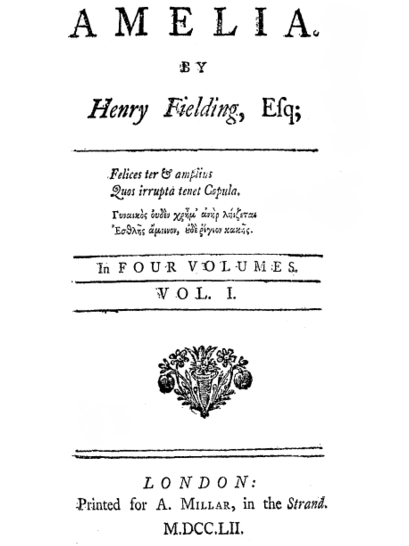
Amelia is a sentimental novel written by Henry Fielding and published in December 1751. It was the fourth and final novel written by Fielding, and it was printed in only one edition while the author was alive, although 5,000 copies were published of the first edition. Amelia follows the life of Amelia and Captain William Booth after they are married. It contains many allusions to classical literature and focuses on the theme of marriage and feminine intelligence, but Fielding's stance on gender issues cannot be determined because of the lack of authorial commentary discussing the matter. Altho
Amelia is a sentimental novel written by Henry Fielding and published in December 1751. It was the fourth and final novel written by Fielding, and it was printed in only one edition while the author was alive, although 5,000 copies were published of the first edition. Amelia follows the life of Amelia and Captain William Booth after they are married. It contains many allusions to classical literature and focuses on the theme of marriage and feminine intelligence, but Fielding's stance on gender issues cannot be determined because of the lack of authorial commentary discussing the matter. Altho
閱讀詳細介紹
Amelia is a sentimental novel written by Henry Fielding and published in December 1751. It was the fourth and final novel written by Fielding, and it was printed in only one edition while the author was alive, although 5,000 copies were published of the first edition. Amelia follows the life of Amelia and Captain William Booth after they are married. It contains many allusions to classical literature and focuses on the theme of marriage and feminine intelligence, but Fielding's stance on gender issues cannot be determined because of the lack of authorial commentary discussing the matter. Although the novel received praise from many writers and critics, it received more criticism from Fielding's competition, possibly resulting from the "paper war" in which the author was involved.
Background
Fielding began writing Amelia in the autumn of 1749. He turned to his own life for inspiration, and the main character, Amelia, was possibly modelled on Fielding's first wife, Charlotte, who died in November 1744. Likewise, the hero, Captain Booth, was partly modelled after Fielding himself, as well as on the author's father, General Edmund Fielding, famous for his careless management of his family's money. It has recently been argued that, on account of his name and the dramatic nature of the character itself, Billy Booth also owes a debt to Barton Booth, a famous tragic actor of the early eighteenth century.
Plot summary
Amelia is a domestic novel taking place largely in London during 1733. It describes the hardships suffered by a young couple newly married. Against her mother's wishes, Amelia marries Captain William Booth, a dashing young army officer. The couple run away to London. In Book II, William is unjustly imprisoned in Newgate, and is subsequently seduced by Miss Matthews. During this time, it is revealed that Amelia was in a carriage accident and that her nose was ruined. Although this brings about jokes at Amelia's expense, Booth refuses to regard her as anything but beautiful.
Amelia, by contrast, resists the attentions paid to her by several men in William's absence and stays faithful to him. She forgives his transgression, but William soon draws them into trouble again as he accrues gambling debts trying to lift the couple out of poverty. He soon finds himself in debtors' prison. Amelia then discovers that she is her mother's heiress and, the debt being settled, William is released and the couple retires to the country.
The second edition contains many changes to the text. A whole chapter on a dispute between doctors was completely removed, along with various sections of dialogue and praise of the Glastonbury Waters. The edition also contains many new passages, such as an addition of a scene in which a doctor repairs Amelia's nose and Booth remarking on the surgery (in Book II, Chapter 1, where Booth is talking to Miss Matthews).
Virgilian
There are strong Virgilian overtones in Amelia. Fielding claimed, in his 28 January The Covent Garden Journal, that there were connections of the work to both Homer and Virgil, but that the "learned Reader will see that the latter was the noble model, which I made use of on this Occasion." The parallels are between more than the plot, and the novel follows a "twelve-book structure" that matches the Aeneid.
Even the characters have Virgilian counterparts, with Booth being comparable to Aeneas and Miss Mathews Fielding's version of Dido. Fielding does not shy away from such comparisons, but embraces them with his use of the line "Furens quid Foemina possit" (translated as "what a woman can do in frenzy"), in Book IV, Chapter Five; this line is directly taken from the Aeneid. Likewise, Fielding's bailiff misstates Virgil's "dolus an virtus, quis in hoste requirat" (translated as "whether deceit or valour, who would ask in the enemy") when he says "Bolus and Virtus, quis in a Hostess equirit" in Book VIII, Chapter One. However, these are not the only quotes, and Fielding cites many passages of Latin and Greek while not providing direct translations for them. To these Virgilian parallels, Samuel Richardson claimed that Fielding "must mean Cotton's Virgil Travestied; where the women are drabs, and the men scoundrels."
Feminine intelligence
Although the novel deals with marriage and life after marriage, it also gives the "histories" of Miss Matthews and Mrs Bennet (later Mrs Atkinson). It is the second story, that of Mrs Atkinson, which
"Amelia" was advertised on 2 December 1751 by the publisher, Andrew Millar, in The General Advertiser. In it, Millar claimed that "to satisfy the earnest Demand of the Publick, this Work is now printing at four Presses; but the Proprietor not-withstanding finds it impossible to get them bound in Time without spoiling the Beauty of the Impression, and therefore will sell them sew'd at Half a Guinea a Sett."
Millar ordered William Strahan to print the work on two of his printing presses to produce a total of 5,000 copies for the first run of the work (in comparison, only 3,500 copies of The History of Tom Jones, a Foundling were printed for the first and second edition). This amount proved to be enough for Millar to sell, although he had to back down from a second printing of 3,000 copies immediately after the first edition to ensure that the originals were completely sold. The work had two German translations published in 1752, a Dutch translation in 1756, and a French edition in 1762.
It finally went into a second edition in 1762. However, this edition was posthumous and in Millar's Works of Henry Fielding. In the prefatory essay, the Works editor, Arthur Murphy, claimed that "Amelia, in this edition, is printed from a copy corrected by the author's own hand. The exceptionable passages, which inadvertency had thrown out, are here retrenched; and the work, upon the whole, will be found nearer perfection than it was in its original state." Although most critics agree that Murphy was telling the truth, it is possible that only some of the alterations were completed by Fielding and that other alterations were by Murphy or another editor employed by Murphy.