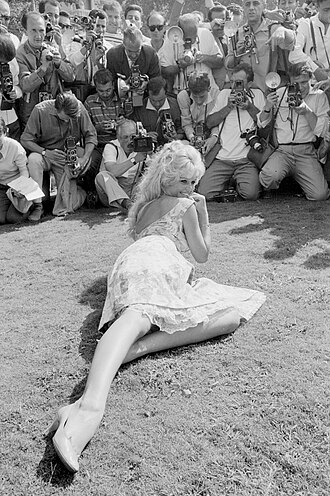
Celebrity is a condition of fame and broad public recognition of a person or group due to the attention given to them by mass media. The word is also used to refer to famous individuals. A person may attain celebrity status by having great wealth, participation in sports or the entertainment industry, their position as a political figure, or even their connection to another celebrity. 'Celebrity' usually implies a favorable public image, as opposed to the neutrals 'famous' or 'notable', or the negatives 'infamous' and 'notorious'.
Celebrity is a condition of fame and broad public recognition of a person or group due to the attention given to them by mass media. The word is also used to refer to famous individuals. A person may attain celebrity status by having great wealth, participation in sports or the entertainment industry, their position as a political figure, or even their connection to another celebrity. 'Celebrity' usually implies a favorable public image, as opposed to the neutrals 'famous' or 'notable', or the negatives 'infamous' and 'notorious'.
閱讀詳細介紹
Celebrity is a condition of fame and broad public recognition of a person or group due to the attention given to them by mass media. The word is also used to refer to famous individuals. A person may attain celebrity status by having great wealth, participation in sports or the entertainment industry, their position as a political figure, or even their connection to another celebrity. 'Celebrity' usually implies a favorable public image, as opposed to the neutrals 'famous' or 'notable', or the negatives 'infamous' and 'notorious'.
In his 2020 book Dead Famous: An Unexpected History Of Celebrity, British historian Greg Jenner uses the definition:
Celebrity (noun): a unique persona made widely known to the public via media coverage, and whose life is publicly consumed as dramatic entertainment, and whose commercial brand is made profitable for those who exploit their popularity, and perhaps also for themselves.
Although his book is subtitled "from Bronze Age to Silver Screen", and despite the fact that "Until very recently, sociologists argued that celebrity was invented just over 100 years ago, in the flickering glimmer of early Hollywood" and the suggestion that some medieval saints might qualify, Jenner asserts that the earliest celebrities lived in the early 1700s, his first example being Henry Sacheverell. Over time, the invention of more types of mass media has broadened the ways in which people have become famous.
Athletes in Ancient Greece were welcomed home as heroes, had songs and poems written in their honor, and received free food and gifts from those seeking celebrity endorsement. Ancient Rome similarly lauded actors and notorious gladiators, and Julius Caesar appeared on a coin in his own lifetime (a departure from the usual depiction of battles and divine lineage).
The cult of personality (particularly in the west) can be traced back to the Romantics in the 18th century, whose livelihood as artists and poets depended on the currency of their reputation. Lord Byron became a celebrity in 1812 after the publication of the first two cantos of Childe Harold's Pilgrimage. "I awoke one morning and found myself famous," he said. According to McGann: "He rapidly became the most brilliant star in the dazzling world of Regency London."
Establishing cultural hot spots became important in generating fame, such as in London and Paris in the 18th and 19th centuries. Newspapers started including "gossip" columns, and certain clubs and events became places to be seen to receive publicity. Madame Tussauds, a museum that displays waxworks of famous figures, was first established in Baker Street, London in 1835, with Punch in 1849 stating: "In these days, no one can be considered positively popular, unless he is admitted into the company of Madame Tussaud's celebrities in Baker Street". David Lodge called Charles Dickens the "first writer to feel the intense pressure of being simultaneously an artist and an object of unrelenting public interest and adulation", and Juliet John backed up the claim for Dickens "to be called the first self-made global media star of the age of mass culture."
Theatrical actors were often considered celebrities. Restaurants near theaters, where actors would congregate, began putting up caricatures or photographs of actors on celebrity walls in the late 19th century. The subject of widespread public and media interest, Lillie Langtry, made her West End theatre debut in 1881 causing a sensation in London by becoming the first socialite to appear on stage. The following year she became the poster-girl for Pears Soap, becoming the first celebrity to endorse a commercial product. In 1895, poet and playwright Oscar Wilde became the subject of "one of the first celebrity trials".
Another example of celebrities in the entertainment industry was in music, beginning in the mid-19th century. Never seen before in music, many people engaged in an immense fan frenzy called Lisztomania that began in 1841. This created the basis for the behavior fans have around their favorite musicians in modern society.
The movie industry spread around the globe in the first half of the 20th century, creating the first film celebrities. The term celebrity was not always tied to actors in films however, especially when cinema was starting as a medium. As Paul McDonald states in The Star System: Hollywood's Production of Popular Identities, "In the first decade of the twentieth century, American film production companies withheld the names of film performers, despite requests from audiences, fearing that public recognition would drive performers to demand higher salaries." Public fascination went well beyond the on-screen exploits of movie stars, and their private lives became headline news: for example, in Hollywood the marriages of Elizabeth Taylor and in Bollywood the affairs of Raj Kapoor in the 1950s. Like theatrical actors before them, movie actors were the subjects of celebrity walls in restaurants they frequented, near movie studios, most notably at Sardi's in Hollywood.
The second half of the century saw television and popular music bring new forms of celebrity, such as the rock star and the pop group, epitomised by Elvis Presley and the Beatles, respectively. John Lennon's highly controversial 1966 quote: "We're more popular than Jesus now", which he later insisted was not a boast, and that he was not in any way comparing himself with Christ, gives an insight into both the adulation and notoriety that fame can bring. Unlike movies, television created celebrities who were not primarily actors; for example, presenters, talk show hosts, and newsreaders. However, most of these are only famous within the regions reached by their particular broadcaster, and only a few such as Oprah Winfrey, Jerry Springer, or David Frost could be said to have broken through into wider stardom. Television also gave exposure to sportspeople, notably Pelé after his emergence at the 1958 FIFA World Cup, with Ba