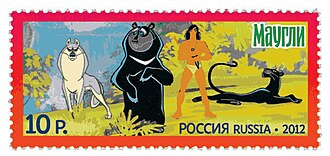
Adventures of Mowgli is an animated feature-length story originally released as five animated shorts of about 20 minutes each between 1967 and 1971 in the Soviet Union. It is based on Rudyard Kipling's The Jungle Book. They were directed by Roman Davydov and made by Soyuzmultfilm studio. In 1973, the five films were combined into a single 96-minute feature film. The Russian DVD release of the restored footage, distributed by "Krupnyy Plan" and "Lizard", separates the animation into the original five parts.
Adventures of Mowgli is an animated feature-length story originally released as five animated shorts of about 20 minutes each between 1967 and 1971 in the Soviet Union. It is based on Rudyard Kipling's The Jungle Book. They were directed by Roman Davydov and made by Soyuzmultfilm studio. In 1973, the five films were combined into a single 96-minute feature film. The Russian DVD release of the restored footage, distributed by "Krupnyy Plan" and "Lizard", separates the animation into the original five parts.
閱讀詳細介紹
Adventures of Mowgli (Russian: Маугли; also spelled Maugli) is an animated feature-length story originally released as five animated shorts of about 20 minutes each between 1967 and 1971 in the Soviet Union. It is based on Rudyard Kipling's The Jungle Book. They were directed by Roman Davydov and made by Soyuzmultfilm studio. In 1973, the five films were combined into a single 96-minute feature film. The Russian DVD release of the restored footage, distributed by "Krupnyy Plan" and "Lizard", separates the animation into the original five parts.
An English-language version made jointly by Soyuzmultfilm and Cyrillic Films was completed in 1996 and released direct-to-video on April 28, 1998 under the name Adventures of Mowgli. Charlton Heston is the narrator in the English version. Proceeds from the U.S. release were donated to The Audrey Hepburn Hollywood for Children Fund.
Style
Contrasting with Disney's adaptation of the Jungle Book, Adventures of Mowgli is generally more faithful to the epic and primal content of Kipling's original work. Soyuzmultfilm's adaptation appeared more adult and in spirit is closer to Kipling's book. There are scenes of mass fights and duels, blood and death are shown, there is charged atmosphere and suspense. Subjects of life and death, debt and feelings, heroism of the warrior and human essence arise:
Two episodes end with images of death, and these images are Kaa's dance and Akela's song. Kaa is the embodiment of absolute power, unhurried and at the same time inevitable. Dying in the finale of the fourth episode, Akela is the embodiment of the archetype of a warrior who worthily meets death in battle and leaves for the fields of happy hunting ... In other words, the authors told us that childhood ends when you find out that death exists, and youth — when a person close to you dies. If you like — when you realize that you will die yourself.
Episode 1: Raksha
The story starts with a golden jackal named Tabaqui walking towards his master, the dreaded tiger known as Shere Khan, who stretches himself and then walks to the spot of a camp with Tabaqui guiding him. Out of cruelty and hatred, Shere Khan leaps towards the campsite. Whilst doing so, he accidentally burns his right forepaw, forcing a young child, Mowgli, to wander into a wolf cave in the jungle. At that point, Shere Khan (accompanied by his servant Tabaqui) appears at the entrance and, unable to pass through the cave's aperture with his massive body, demands that the wolves give him his prey, but the wolf mother, Raksha refuses and drives him away. He taunts them and says that the wolf pack will decide as he skulks away, angered by her defiance. Meanwhile, Tabaqui runs around the whole jungle and tells all the animals that a wolf pack has adopted a human.
A moment later, Bagheera, the melanistic Indian leopard, is minding her business when Tabaqui appears to tell her the news. Bagheera scolds him for spreading malicious falsehoods, then puts up quite a display that causes Shere Khan
In this version, Bagheera is female (following the Russian translation by Nina Daruzes and largely because the word panther itself in Russian is feminine, similar to the word fox and character in the local translation of The Adventures of Pinocchio). She is also less willing to spoil Mowgli, as she spanks him after he refuses to apologize for landing on Baloo, saying "Mind your manners!". This scene has inexplicably been deleted for the English-language version made by Films by Jove, though it appears uncut in the Cyrillic Films English-language adaptation. She is voiced by the famous Tamer of Tigers star, actress Lyudmila Kasatkina. She also was one of the rare installations of a strong female character in the soviet animation.
Human characters like Messua and Buldeo are not present in this film.
Bagheera has three cubs in this film, one black and two gold. They are only mentioned in the book while Bagheera's mate is not.
While it is uncertain as to what bear species Baloo may be in the books, here he is an asiatic black bear.
In this film, the king's ankus is replaced with a dagger, the Iron Tooth. This is the same departure as in Disney's later film The Jungle Book.
Unlike most adaptations that show Tabaqui, this is loyal to the story and he is a golden jackal. In most adaptations like Jungle Book Shōnen Mowgli, The Jungle Book: Mowgli's Story and Mowgli: Legend of the Jungle, he is a hyena.
One of Hathi's sons shows similarities to the baby elephant Junior, from the Disney adaptation.
The ruins of the Forgotten City contain Buddha look-alike statues in Lotus position.
White Hood, the white cobra guarding the treasures in an old cave, has also been changed into a female named Mother Cobra. She is also much more vicious than her book counterpart.
Snake characters talk in a slow and hissy manner.
Most instances of physical violence, brutality, and lethality are implied but not shown. The scenes of Shere Khan slaying numerous humans and animals are not portrayed, instead Bagheera is constantly accusing him of being a "Manhunter! Murderer! Baby snatcher!" and so on. Also his evil deeds are described verbally in brief by the narrator. The scene of the Kaa's hunt is ended right at the moment when Kaa is about to proceed to feast on the hypnotized Bandar-log population. Baloo is taking Mowgli away, saying that "We'd better leave now. This is something you shouldn't see". Only scenes of actual violence, which are portrayed, occur when: 1) Baloo and Bagheera are fighting the Bandar-log crowd in order to free Mowgli; 2) Mowgli, triumphant after he obtained the Iron Tooth, wields and accidentally hurts a paw of his Grey Brother wolf with the dagger, and apologizes right thereafter; 3) the Pack confronts the Red dogs; 4) the final fight.
Shere Khan escapes the stampede and is eventually killed by the grown-up Mowgli in a bare-handed manner. The death of Shere Khan at the hands of Mowgli is implied by the next scene, which depicts Mowgli with the tiger's skin.