
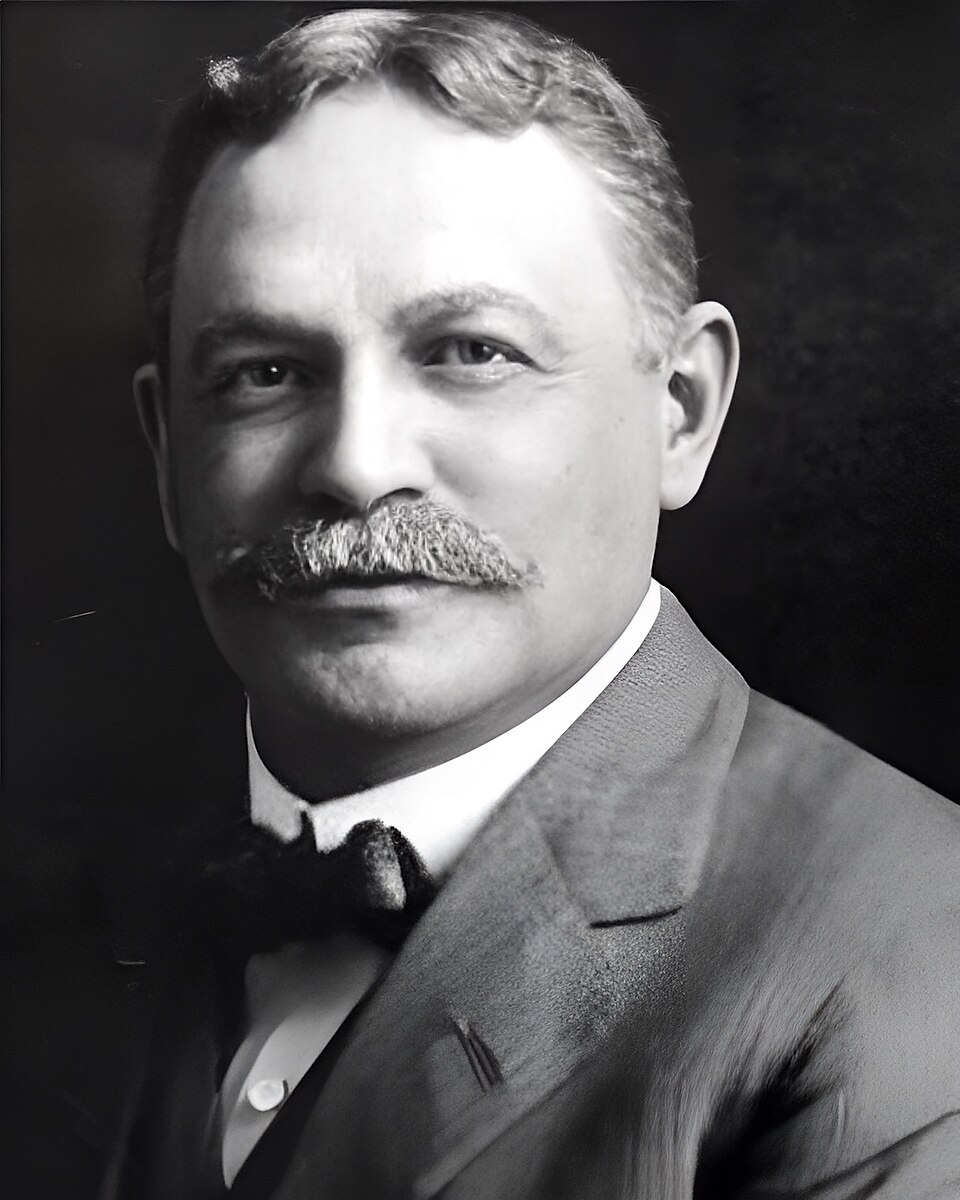
人物1864
威廉·塞利格
William Nicholas Selig
美國演員
在包含此條目的事件檔案中探索資訊與關係。
還沒有包含此條目的事件檔案。
從此條目開始調查等待第一則留言。
美國演員
William Nicholas Selig (March 14, 1864 – July 16, 1948) was a vaudeville performer and pioneer of the American motion picture industry. His stage billing as Colonel Selig would be used for the rest of his career, even as he moved into film production.
Born to immigrant parents living in Chicago, Selig apprenticed as an upholsterer, but got his start in vaudeville, touring the Midwest as a magician's assistant. Creating his own magic act, Colonel Selig toured the country and produced a touring vaudeville show, Selig’s Mastodon Minstrels, based in San Francisco.
In 1896, Selig created one of the first film production companies, Selig Polyscope Company of Chicago. He produced a string of commercially successful films in the early years of the film industry. His The Tramp and the Dog (1896) is considered the first narrative film set in Chicago. Selig may have made the first narrative film shot in Los Angeles, The Count of Monte Cristo (1908), and in 1909, in a corporate expansion established the first permanent L.A. studio, in Edendale, Los Angeles.
Selig also produced the first Wizard of Oz film in 1910, the first two-reeler (about 20 minutes) film, Damon and Pythias (1908), and the first true serial, The Adventures of Kathlyn (1913–1914).
William Nicholas Selig was born March 14, 1864, at 10 Kramer Street, Chicago, Illinois, to Antonia (née Linsky) and Joseph Franz Selig, a German-speaking immigrant family, in a predominantly Polish section of Chicago and attended primary school there.
William N. Selig entered show business as "Selig the Conjurer" and morphed into the impresario of "Selig's Mastodon Minstrels," which featured Bert Williams, along with "five whites, four blacks, and a Mexican' who drove the horse team and played trombone" and then into the owner of the Selig Polyscope Company that made and licensed projection equipment.
Selig started as a furniture upholsterer. Selig apprenticed to a magician, and, still a teen, toured the Midwest as a vaudeville performer in his own minstrel show. He later settled in San Francisco and toured the state as "Selig the Conjurer." One of the actors was Bert Williams, who went on to become a leading African-American entertainer.
As a magician, Selig called himself "Professor Selig", later awarding himself the title of Colonel.
A mechanic to whom Selig turned for help had unknowingly made a duplicate Cinématographe for a travelling Lumière operator, and Selig's camera and Polyscope projector were based on the drawings of the Lumière machine.
In 1894, at the Texas State Fair in Dallas, Texas, Selig met employees from Thomas Edison’s laboratory who were demonstrating the Kinetoscope. He returned to Chicago, opened a small photography studio and began investigating how he might make his own moving pictures without paying a patent fee to Edison's company. Selig reportedly found a metalworker who had unwittingly repaired a Lumière brothers motion picture camera and, with his help, developed a working system. With machinist Andrew Schutsek, he produced a similarity to the cinématographe. In 1896, Selig founded the Selig Polyscope Company in Chicago, producing not only motion pictures but also film equipment, as one of the first motion picture studios in America, making actuality shorts, travelogues and industrial films for Chicago businesses.
Multiscope and Film Company produced, in Burlington, Wisconsin, the first successful commercial 180-degree panoramic camera made in quantity, the Al-Vista, later a series of panoramic still cameras.
In November 1900, Selig incorporated the Selig Polyscope Company. By 1904, he focused on slapstick comedies and minstrel-comic scenes, and producing the first Westerns of Broncho Billy Anderson, the later co-founder of Essanay Studios. In 1909, Selig was the first producer to expand filmmaking operations to the West Coast, where he set up studio facilities in the Edendale area of Los Angeles with director Francis Boggs. Southern California's weather allowed outdoor filming for most of the year and offered varied geography and settings which could stand in for far-flung locations around the world. Los Angeles also seemed to offer geographical isolation from Edison's Motion Picture Patents Company (MPPC), a cartel which Selig later reluctantly joined. The Sergeant, a Western short shot in Yosemite and produced and directed by Boggs for the Selig Polyscope Company was released in September 1910.
In 1911, Boggs was murdered by a Japanese gardener employed by the company. Selig was shot and wounded in the arm while trying to defend him.
來源:William Selig (CC BY-SA)
結構化資訊、使用者意見與 AI 擷取的關係會分別標示。
Multiscope & Film Company gained a five year franchise in 1895 with the Edison Vitagraph Company of Chicago and New York to show the first moving pictures in the State of Minnesota and gained rights from the holder of Wisconsin’s franchisee to operate the first Vitagraph moving picture shows in Burlington and Elkhorn, making Burlington the first place outside of the largest metropolitan American cities in which the Vitascope was exhibited.
In 1896, in a loft, at 43 Peck Court in Burlington, Wisconsin, Selig co-founded his first film company, the Multiscope and Film Company, and his made first film, The Tramp and the Dog.
Selig also copied the productions of others, like other pioneer companies, for his sale, through his own catalogues, his activity brought the attention of the lawyers of Edison. Selig made films in the Southwest.