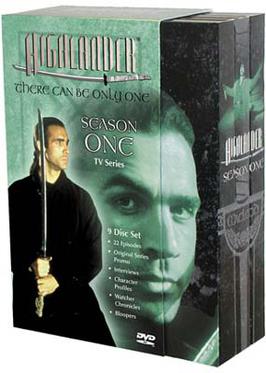
The first season of the international fantasy series Highlander: The Series, part of the Highlander franchise, consisted of 22 episodes produced between 1992 and 1993, and began airing on October 3, 1992 in broadcast syndication. Highlander: The Series follows the adventures of Duncan MacLeod, a 400-year-old Immortal who can only die if he is beheaded; conflict inevitably finds him because he is part of the Gathering, an ongoing battle in which all Immortals have to fight and behead each other until only one is left. The season was released on DVD as a nine-disc boxed set on November 12, 2002
The first season of the international fantasy series Highlander: The Series, part of the Highlander franchise, consisted of 22 episodes produced between 1992 and 1993, and began airing on October 3, 1992 in broadcast syndication. Highlander: The Series follows the adventures of Duncan MacLeod, a 400-year-old Immortal who can only die if he is beheaded; conflict inevitably finds him because he is part of the Gathering, an ongoing battle in which all Immortals have to fight and behead each other until only one is left. The season was released on DVD as a nine-disc boxed set on November 12, 2002
閱讀詳細介紹
The first season of the international fantasy series Highlander: The Series, part of the Highlander franchise, consisted of 22 episodes produced between 1992 and 1993, and began airing on October 3, 1992 in broadcast syndication. Highlander: The Series follows the adventures of Duncan MacLeod, a 400-year-old Immortal who can only die if he is beheaded; conflict inevitably finds him because he is part of the Gathering, an ongoing battle in which all Immortals have to fight and behead each other until only one is left. The season was released on DVD as a nine-disc boxed set on November 12, 2002 by Anchor Bay Entertainment. As of October 2025, It is also available on the streaming services Prime Video and Peacock.
The French leading production company Gaumont Television bought the rights to the series to have it produced in syndication in America with a local crew, a ground-breaking move at the time. The rights were acquired by producer Marla Ginsburg at the 1991 Cannes Film Festival. Highlander marked the first time a French production company was creatively involved in a show intended for the American market. The show was co-produced in syndication by international partners including Gaumont, RTL Plus (Germany), Rysher Distribution (United States), Reteitalia Productions (Italy), Amuse Video (Japan) and TF1 (France). The budget of the first season was US$26.1 million. Keith Samples, president of Rysher, stated that "about 75% of the guaranteed budget came from overseas sales." The remaining 25% came from United States sales and the producers retained the distribution rights, which allowed the show to produce $800,000 per episode only from international income, believed to be the top result of the 1992-1993 season. To secure an adequate share of European content, and as a result of the co-production agreement, each season was divided into two segments, the first segment was filmed in Vancouver, British Columbia, Canada (posing at the fictional location of Seacouver, Washington, United States), the second in Paris, France. The production of the first segment began in Vancouver on 13 July 1992, while the production of the second segment started in December 1992 in Paris and used the studios of French state production agency Société Française de Production (SFP) at Bry-sur-Marne near Paris.
Steven Maier demanded $100,000 per episode. For the first season, this represented $2.2 million, almost 10% of the projected budget. Obsessed with this number, Steven seemed more flexible in the distribution of profits, and Marc du Pontavice insisted that more than half of the series' filming be done in France, with a predominantly French crew, protecting Marla. The only remaining point to discuss was a clause regarding the opening credits. Du Pontavice argued in favor of Christian Charret and Ginsburg; to his surprise, his interlocutors yielded and agreed to give them a prominent place. In exchange, they demanded a place in the end credits, superimposed on the last image.
With the agreement signed, Marla could develop the creative side of the production. To win over the United States, American networks needed guarantees for control of the filming. To reassure them, they promised to film part of the series in Vancouver, Canada. They turned to Rysher Entertainment, which specialized in the first-run syndication market. The company, controlled by Keith Sample and Tim Helfet, rarely had the opportunity to get its hands on a series with that level of budget, usually reserved for the major networks. They put up almost a quarter of the total budget. The international partners included a conditional clause in their agreement, requiring Christopher Lambert to guest star in the first few episodes, as Peter Davis and Bill Panzer had already secured their agreement a few weeks earlier. However, with less than three months to go before filming, Davis called du Pontavice informing him that Lambert had changed his mind and didn't want to participate in a television series, especially not in the role he had played in the film. Du Pontavice tried to persuade Lambert's agent, but he wouldn't listen.
Ginsburg and du Pontavice managed to convince all the partners to drop Lambert, except for RTL, which threatened not to honor its contract if Lambert wasn't part of the cast. RTL's contribution was significant, representing over $8 million, about a third of the budget. With less than two months until filming began, and with so much money already committed, turning back seemed impossible. Informing Gaumont about the situation could lead to the project's cancellation, causing significant losses and damaging the group's confidence. With Charret's support, du Pontavice decided to negotiate directly with Lambert's American agent.
As the days passed, the agent's demands increased, causing great stress for du Pontavice. Charret looked away, and Ginsburg was busy with filming preparations. Du Pontavice felt alone, receiving calls from the agent in the middle of the night. One early morning, after Lambert's definitive refusal, du Pontavice collapsed, letting the bathwater overflow and flood the apartment. He ended up waking his wife, Alix de Maistre, to whom he explained the situation in an absurd way, which made them laugh uncontrollably, relieving the tension. Du Pontavice decided to try one last approach. He called his contact at RTL and asked if a single episode with Lambert would suffice. To his relief, the answer was affirmative. Ginsburg quickly adjusted the script so that the first episode would be the passing of the baton between Connor and Duncan MacLeod. Du Pontavice negotiated with Lambert's agent, offering $2 million for seven days of filming. After a brief silence, the agent accepted the offer. With the deal in place, Ginsburg was able to move forward with the networks. During the summer and fall, they developed the creative side.
The executive producers were Bill Panzer, Peter S. Davis, Gaumont Television president Christ