
條目
海盜
pirate
在海洋上为私人目的,对其他船舶或交通工具上的人员或财物施加非法暴力、扣押或掠夺行为的人
條目
pirate
在海洋上为私人目的,对其他船舶或交通工具上的人员或财物施加非法暴力、扣押或掠夺行为的人
在包含此條目的事件檔案中探索資訊與關係。
還沒有包含此條目的事件檔案。
從此條目開始調查正在查找與此條目有關的作品或人物。
海盜
正在尋找與它相連的內容。
等待第一則留言。
在海洋上为私人目的,对其他船舶或交通工具上的人员或财物施加非法暴力、扣押或掠夺行为的人
Piracy is an act of robbery or criminal violence by ship or boat-borne attackers upon another ship or a coastal area, typically intending to steal cargo and valuable goods, or take hostages. Those who conduct acts of piracy are called pirates, and vessels used for piracy are called pirate ships. The earliest documented instances of piracy date to the 14th century BC, when the Sea Peoples, a group of ocean raiders, attacked the ships of the Aegean and Mediterranean civilizations. Narrow channels which funnel shipping into predictable routes have long created opportunities for piracy, as well as for privateering and commerce raiding.
Historic examples of such areas include the waters of Gibraltar, the Strait of Malacca, Madagascar, the Gulf of Aden, and the English Channel, whose geographic structures facilitated pirate attacks. The term piracy generally refers to maritime piracy, although the term has been generalized to refer to acts committed on land, in the air, on computer networks, and (in science fiction) outer space. Piracy usually excludes crimes committed by the perpetrator on their own vessel (e.g., theft) as well as privateering, which implies authorization by a state government.
Piracy, or pirating, is the name of a specific crime under customary international law and also of many crimes under the municipal law of many states. In the 21st century, seaborne piracy against transport vessels remains a significant issue, with estimated worldwide losses of US$25 billion in 2023, increased from US$16 billion in 2004.
The waters between the Red Sea and the Indian Ocean, off the Somali coast and in the Strait of Malacca and Singapore have frequently been targeted by modern pirates armed with automatic firearms and occasionally explosive weaponry. They often use small motorboats to attack and board ships, a tactic that exploits the limited crew sizes on modern cargo and transport vessels. The international community is facing many challenges in bringing modern pirates to justice, as these attacks often occur in international waters. Nations have used their naval forces to repel and pursue pirates, and some private vessels use armed security guards, high-pressure water cannons, or sound cannons to repel boarders, and use radar to avoid potential threats.
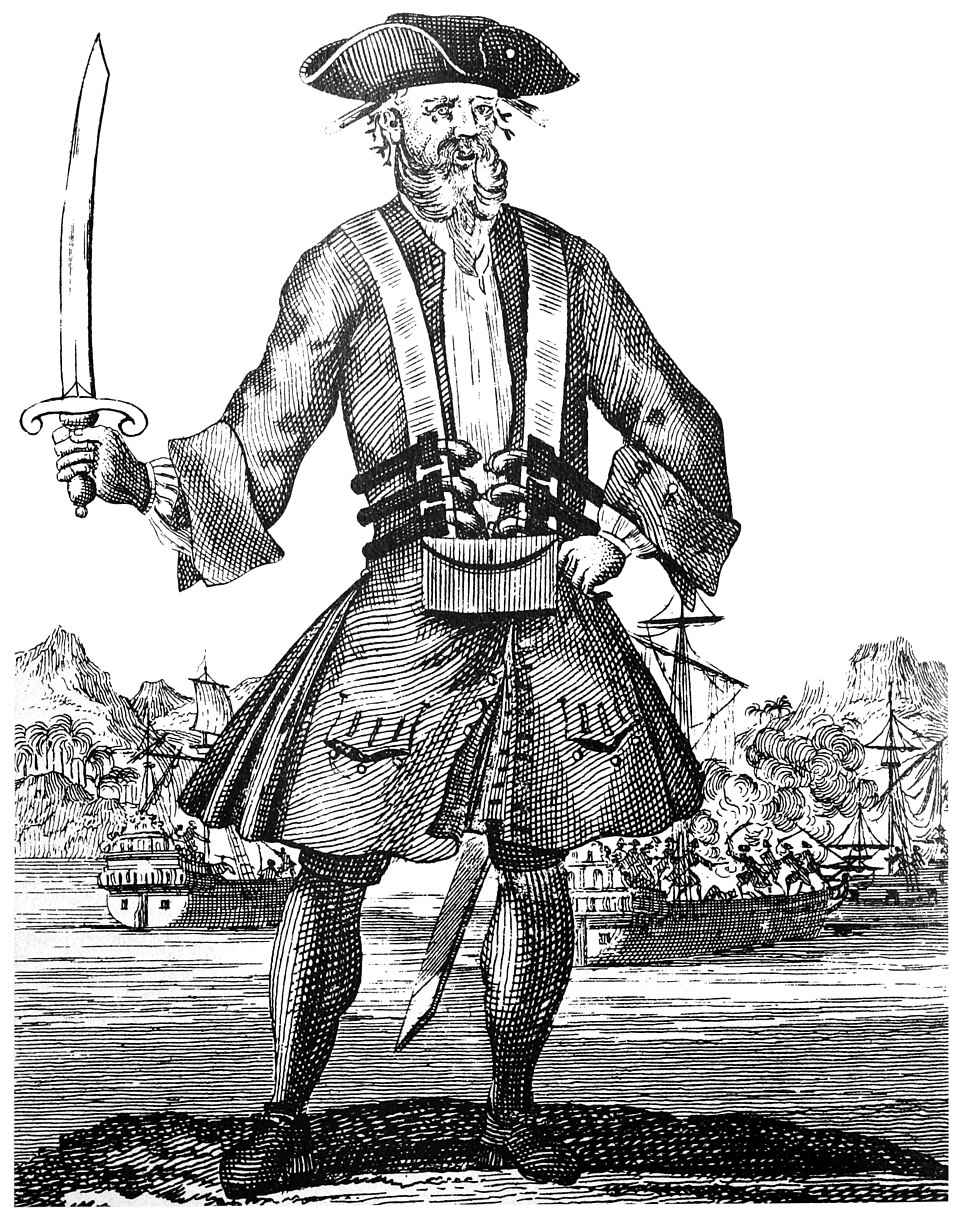
Romanticized accounts of piracy during the Age of Sail have long been a part of Western pop culture. The two-volume A General History of the Pyrates, published in London in 1724, is generally credited with bringing key piratical figures and a semi-accurate description of their milieu in the "Golden Age of Piracy" to the public's imagination. A General History inspired and informed many later fictional depictions of piracy, most notably the novels Treasure Island (1883) and Peter Pan (1911), both of which have been adapted and readapted for stage, film, television, and other media across over a century. More recently, pirates of the "golden age" were further stereotyped and popularized by the Pirates of the Caribbean film franchise, which began in 2003.
The earliest documented instances of piracy are the exploits of the Sea People who threatened ships sailing in the Aegean and Mediterranean in the 14th century BC. In classical antiquity, the Phoenicians, Illyrians and Tyrrhenians were known as pirates. In the pre-classical era, the ancient Greeks condoned piracy as a viable profession; it apparently was widespread and "regarded as an entirely honourable way of making a living". References are made to its perfectly normal occurrence in many texts, including Homer's Iliad and Odyssey, and abduction of women and children to be sold into slavery was common. By the era of Classical Greece, piracy was looked upon as a "disgrace" to have as a profession.
來源:Piracy (CC BY-SA)
結構化資訊、使用者意見與 AI 擷取的關係會分別標示。
The English word "pirate" is derived from the Latin pirata ("pirate, corsair, sea robber"), which comes from Greek πειρατής (peiratēs), "brigand", from πειράομαι (peiráomai), "I attempt", from πεῖρα (peîra), "attempt, experience". The meaning of the Greek word peiratēs literally is "anyone who attempts something". Over time, it came to be used to describe anyone who committed robbery or brigandage on land or at sea. The term first appeared in English c. 1300. Spelling did not become standardised until the eighteenth century, and spellings such as "pirrot", "pyrate" and "pyrat" occurred until this period.
The most widely recognized and far-reaching pirates in medieval Europe were the Vikings, seaborne warriors from Scandinavia who raided and looted mainly between the 8th and 12th centuries, during the
In the 3rd century BC, pirate attacks on Olympus in Lycia brought impoverishment. Among the most famous ancient pirating peoples were the Illyrians, who inhabited the western Balkan Peninsula. Constantly raiding the Adriatic Sea, the Illyrians caused many conflicts with the Roman Republic. It was not until 229 BC when the Romans decisively beat the Illyrian fleets that their threat was ended. During the 1st century BC, there were pirate states along the Anatolian coast, threatening the commerce of the Roman Empire in the eastern Mediterranean. On one voyage across the Aegean Sea in 75 BC, Julius Caesar was kidnapped and briefly held by Cilician pirates and held prisoner in the Dodecanese islet of Pharmacusa. The Senate invested the general Gnaeus Pompeius Magnus with powers to deal with piracy in 67 BC (the Lex Gabinia), and Pompey, after three months of naval warfare, managed to suppress the threat.
As early as 258 AD, the Gothic-Herulic fleet ravaged towns on the coasts of the Black Sea and Sea of Marmara. The Aegean coast suffered similar attacks a few years later. In 264, the Goths reached Galatia and Cappadocia, and Gothic pirates landed on Cyprus and Crete. In the process, the Goths seized enormous booty and took thousands into captivity. In 286 AD, Carausius, a Roman military commander of Gaulish origins, was appointed to command the Classis Britannica, and given the responsibility of eliminating Frankish and Saxon pirates who had been raiding the coasts of Armorica and Belgic Gaul. In the Roman province of Britannia, Saint Patrick was captured and enslaved by Irish pirates.