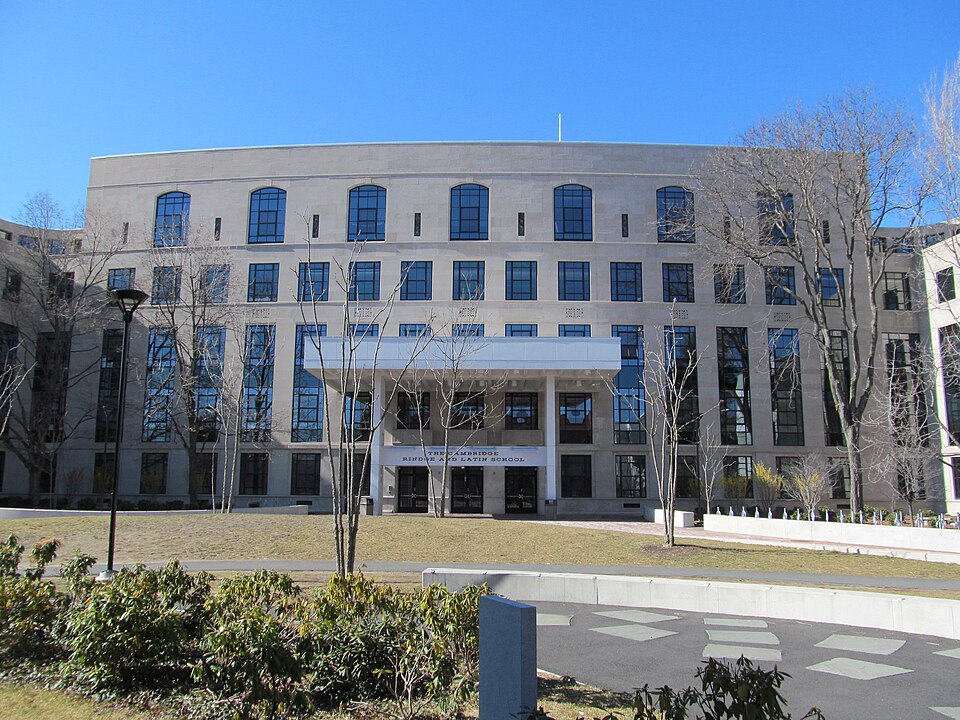
The Cambridge Rindge and Latin School is a public high school in Cambridge, Massachusetts, United States. It is a part of the Cambridge Public School District. In 1977, Cambridge Rindge and Latin was established as a merger of Rindge Technical, Cambridge High and Latin, and two alternative programs. The Pilot, Fundamental, and Rindge Technical and Vocational retained a small core of students, while the rest of school was randomly split into four houses: A, B, C, and D. The newly built high school at the time increased its capacity to more than 2,000 students in all four grades.
The Cambridge Rindge and Latin School is a public high school in Cambridge, Massachusetts, United States. It is a part of the Cambridge Public School District. In 1977, Cambridge Rindge and Latin was established as a merger of Rindge Technical, Cambridge High and Latin, and two alternative programs. The Pilot, Fundamental, and Rindge Technical and Vocational retained a small core of students, while the rest of school was randomly split into four houses: A, B, C, and D. The newly built high school at the time increased its capacity to more than 2,000 students in all four grades.
閱讀詳細介紹
The Cambridge Rindge and Latin School (also known as "CRLS" or "Rindge") is a public high school in Cambridge, Massachusetts, United States. It is a part of the Cambridge Public School District. In 1977, Cambridge Rindge and Latin was established as a merger of Rindge Technical, Cambridge High and Latin, and two alternative programs (called the Pilot and Fundamental). The Pilot, Fundamental, and Rindge Technical and Vocational retained a small core of students, while the rest of school was randomly split into four houses: A, B, C, and D. The newly built high school at the time increased its capacity to more than 2,000 students in all four grades.
Precursors
In 1642, the year Harvard College's first class of nine young men was graduated, the General Court made it the duty of Cambridge to require that parents and masters properly educate their children or be fined if they neglected to do so. In 1648, Cambridge set up a public grammar school, Master Elijah Corlett's "lattin schoole," making Cambridge the fifth town (after Boston, Charlestown, Dorchester, and Salem) in the Massachusetts Bay Colony to do so. Corlett's schoolhouse came into the possession of Old Cambridge in 1660, and over the next century was succeeded by several new buildings. The public school that evolved from Cortlett's original was a "grammar school" in a double sense: an English grammar school for Old Cambridge and a Latin grammar school (teaching the rudiments of Latin and Greek) for all Cambridge. The school generally aimed to prepare students for admission to college:
"And by the side of the colledge a faire GRAMMAR Schoole, for the training up of young Schollars, and fitting of them for ACADEMICALL LEARNING, that still as they are judged ripe, they may be received into the colledge of this Schoole. Master CORLETT is the Mr., who hath very well approved himselfe for his abilities, dexterity and painfulness in teaching and education of the youth under him."
Education during this period was open only to boys, though by 1832, public schools in Cambridge were open to girls as well. In 1838, Cambridgeport organized a public high school to serve all of Cambridge at the corner of Broadway and Windsor Streets. However, since the location was not easily accessible to either Old Cambridge or East Cambridge, most of the new high schools' students were drawn from Cambridgeport. In 1843, Old Cambridge set up the Female High School, and East Cambridge completed its Otis schoolhouse.
Current institution
Not until 1848 did plans to merge the high schools of the three competitive wards overcome sectional differences. This marked the origin of the Cambridge High School, which began in a new building erected at the corner of Amory and Summer streets and was immediately flooded with over 135 applicants.
The Cambridge High School was divided in 1886: its classical department became the Cambridge Latin School and its remaining departments the Cambridge English High School. The English High School was located at the corner of Broadway and Fayette Streets, while the Latin School was transferred to the Lee Street church, which had been renovated to receive it. At the time of the separation, the high school contained 515 pupils, and 16 teachers. Six teachers and 165 pupils went to the Latin school.
In 1979, Cambridge was one of the first cities to remedy de facto segregation in public schools using a system called "controlled choice": parents could choose their preference for schools, and the district will select a school for them while taking both that selection and the need for a diverse student population into account. In the 1980s, there began to be rumors that the different houses were separated by social and ethnic groups: a "preppy" group (with mostly white students), a group with mostly black "jocks", and a group focusing on bilingual education for mostly Haitian immigrant students. Soon, many white middle-class families began to request that their children would be assigned to the "preppy" group. There were also parental concerns about not being able to get into the smaller programs.
Robert Peterkin, the then-superintendent decided to answer to these concerns by creating two separate programs within the school: a STEM-focused "exam school" and school focused on arts. This caused protest from the school's staff. A group called Concerned Black Staff was worried that the "exam school" would mostly serve white middle-class students.
In 1987, in response to this concern, the school formed the Key Results Committee: a formal committee that set to research "exemplary schools" across the United States, decided against setting up the two schools. They instead (in their words) "proposed concrete measures to boost house identity." They also decided to rewrite the mission statement of the school, saying that:
From 1969 to 2000 the school hosted an experimental program known as The Pilot School, founded as a joint venture of the Cambridge public schools and the Harvard Graduate School of Education. The Pilot School was established to offer a small classroom experience including outside-of-school experiences. The program closed in June 2000 as part of an overall restructuring of the school.
In 2001 there was an attempt to restructure the Cambridge Rindge & Latin school under headmaster Paula Evans, which had found controversy. She resigned shortly afterwards. After her resignation she began efforts to create a charter school, which became the Community Charter School of Cambridge (CCSC). Colleen Walsh of the Boston Globe said that Evans's charter school efforts "touched off a firestorm" and that "many people" were upset at her because they perceived that she had abandoned Cambridge Rindge & Latin.
Beginning in 2003, the City of Cambridge set in motion an plan for CRLS: "the first major renovation and refurbishing of the 35-year-old [sic] high school building." The project continued to be pushed back, due to state funding issues and other obstructions along the way. In 2006, t