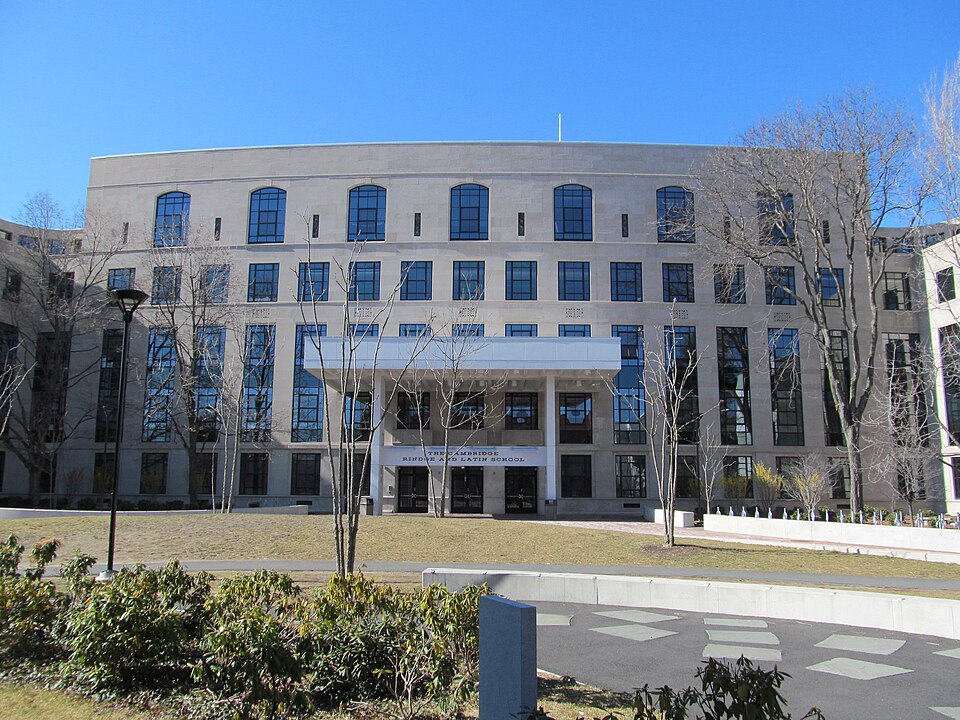
Not until 1848 did plans to merge the high schools of the three competitive wards overcome sectional differences. This marked the origin of the Cambridge High School, which began in a new building erected at the corner of Amory and Summer streets and was immediately flooded with over 135 applicants.
The Cambridge High School was divided in 1886: its classical department became the Cambridge Latin School and its remaining departments the Cambridge English High School. The English High School was located at the corner of Broadway and Fayette Streets, while the Latin School was transferred to the Lee Street church, which had been renovated to receive it. At the time of the separation, the high school contained 515 pupils, and 16 teachers. Six teachers and 165 pupils went to the Latin school.
In 1979, Cambridge was one of the first cities to remedy de facto segregation in public schools using a system called "controlled choice": parents could choose their preference for schools, and the district will select a school for them while taking both that selection and the need for a diverse student population into account. In the 1980s, there began to be rumors that the different houses were separated by social and ethnic groups: a "preppy" group (with mostly white students), a group with mostly black "jocks", and a group focusing on bilingual education for mostly Haitian immigrant students. Soon, many white middle-class families began to request that their children would be assigned to the "preppy" group. There were also parental concerns about not being able to get into the smaller programs.
Robert Peterkin, the then-superintendent decided to answer to these concerns by creating two separate programs within the school: a STEM-focused "exam school" and school focused on arts. This caused protest from the school's staff. A group called Concerned Black Staff was worried that the "exam school" would mostly serve white middle-class students.
In 1987, in response to this concern, the school formed the Key Results Committee: a formal committee that set to research "exemplary schools" across the United States, decided against setting up the two schools. They instead (in their words) "proposed concrete measures to boost house identity." They also decided to rewrite the mission statement of the school, saying that:
From 1969 to 2000 the school hosted an experimental program known as The Pilot School, founded as a joint venture of the Cambridge public schools and the Harvard Graduate School of Education. The Pilot School was established to offer a small classroom experience including outside-of-school experiences. The program closed in June 2000 as part of an overall restructuring of the school.