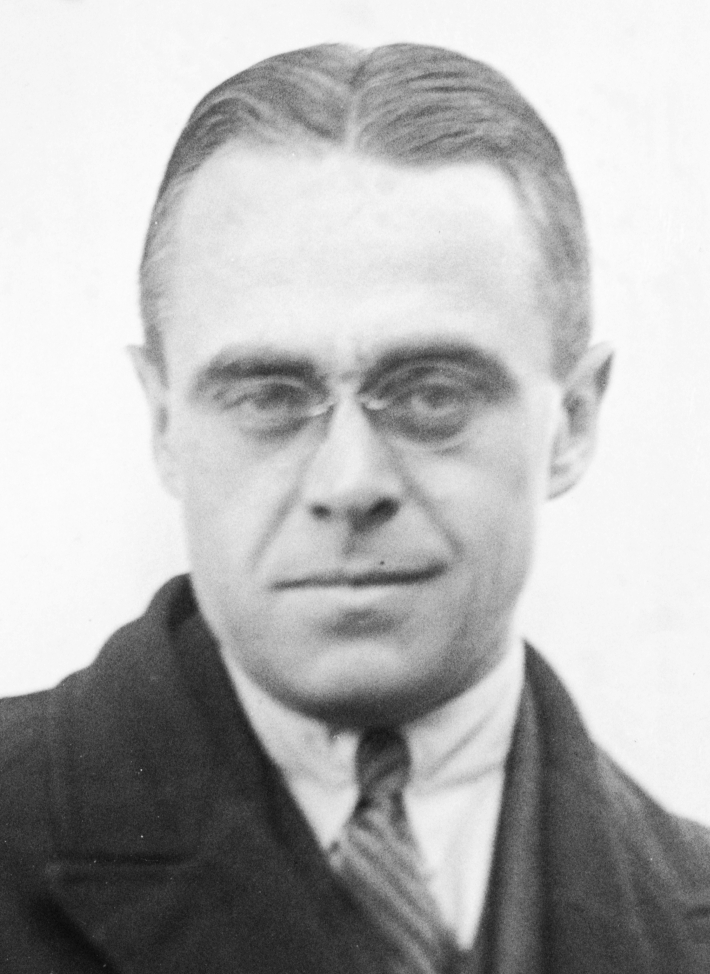
Basil Herbert Dean CBE was an English actor, writer, producer and director in the theatre and in cinema. He founded the Liverpool Repertory Company in 1911 and in the First World War, after organising unofficial entertainments for his comrades in the army, he was appointed to do so officially. After the war he produced and directed mostly in the West End. He staged premieres of plays by writers including J. M. Barrie, Noël Coward, John Galsworthy, Harley Granville-Barker and Somerset Maugham. He produced nearly 40 films, and directed 16, mainly in the 1930s, with stars including Gracie Fields.
Basil Herbert Dean CBE was an English actor, writer, producer and director in the theatre and in cinema. He founded the Liverpool Repertory Company in 1911 and in the First World War, after organising unofficial entertainments for his comrades in the army, he was appointed to do so officially. After the war he produced and directed mostly in the West End. He staged premieres of plays by writers including J. M. Barrie, Noël Coward, John Galsworthy, Harley Granville-Barker and Somerset Maugham. He produced nearly 40 films, and directed 16, mainly in the 1930s, with stars including Gracie Fields.
소개 자세히 읽기
Basil Herbert Dean CBE (27 September 1888 – 22 April 1978) was an English actor, writer, producer and director in the theatre and in cinema. He founded the Liverpool Repertory Company in 1911 and in the First World War, after organising unofficial entertainments for his comrades in the army, he was appointed to do so officially. After the war he produced and directed mostly in the West End. He staged premieres of plays by writers including J. M. Barrie, Noël Coward, John Galsworthy, Harley Granville-Barker and Somerset Maugham. He produced nearly 40 films, and directed 16, mainly in the 1930s, with stars including Gracie Fields.
Together with Leslie Henson, Dean set up and ran the Entertainments National Service Association, or ENSA, in 1939 to provide a wide range of entertainment for British armed forces personnel during the Second World War. After the war he resumed his West End career successfully but without regaining his pre-war dominance.
Early years
Dean was born on 27 September 1888 in Croydon, Surrey, the younger son and second of the four children of Harding Hewar Dean (1855–1942), a cigarette manufacturer, and his wife, Elizabeth Mary Winton. He was educated at Whitgift Grammar School, Croydon. According to his entry in Who's Who in the Theatre he was originally intended for a career in the diplomatic service, but he trained as an "analytical scientist" before working for two years on the London Stock Exchange.
After appearing in amateur theatricals, Dean made his first professional appearance on the stage at the Opera House, Cheltenham in September 1906, as Trip in The School for Scandal. He toured in Shakespeare and other plays and then he joined Annie Horniman's new repertory company in Manchester in 1907, remaining with it for four years in a wide range of plays from the 16th to the 20th centuries. During this period he made his first London appearance when the Horniman company gave a two-week repertory season at the Coronet Theatre in June 1909.
In 1911 Dean directed an experimental theatre season in Liverpool. That year he became the first director of the Liverpool Repertory Theatre (later the Playhouse), where he put on plays by John Galsworthy, Harold Brighouse, and Harley Granville-Barker. At the same time he was technical adviser for stage-construction at the Birmingham Repertory Theatre, which opened in 1913. In 1913 Sir Herbert Tree appointed him assistant stage director at His Majesty's Theatre, London. Tree observed, "This young man intends to get on, either by hook or by crook – it is to be hoped by the former".
In 1914, Dean married Esther Van Gruisen (1891–1983). The marriage, which lasted until 1925, when it was dissolved, produced three sons, one of them the musicologist Winton Dean; another became a judge. On the outbreak of the First World War in 1914, Dean joined the Cheshire Regiment. While based at Catterick Camp he took part in shows to entertain his comrades, and developed an arrangement under which each battalion in the camp contributed to the building and running of a single "garrison theatre" for the whole camp, on an impressive, near-professional scale.
He was gazetted captain in 1916, and in January 1917 he was transferred to the War Office in London to head the entertainment branch of the Navy and Army Canteen Board (later the Navy, Army and Air Force Institutes ), with control of fifteen theatres and ten touring companies.
After the war Dean launched himself as a producer in London, forming a syndicate, Reandean, with a business partner, Alec Lionel Rea. They leased the St Martin's Theatre, and after a poor start, with two failures, they achieved a strong success with Galsworthy's tragi-comedy The Skin Game. Reandean mounted a series of productions, including plays by Somerset Maugham, J. M. Barrie and Clemence Dane.
Among Dean's successes was a stage version of James Elroy Flecker's narrative poem Hassan, of which Dean was co-adapter for the stage as a spectacular exotic drama, with music by Frederick Delius and choreography by Léonide Massine. Dean had tried to interest Tree in staging the piece, but the costs were prohibitive. The eventual production, in 1923, made its mark, and Dean was called on to stage revivals in later years.
Another conspicuous success was The Constant Nymph (1926) by Margaret Kennedy, but Dean's handling of the casting was an example of the bullying and ruthlessness that made him many enemies in the theatrical profession. Having given the leading role to the young John Gielgud, but then finding that Noël Coward was available, Dean demoted Gielgud to understudy, despite the latter's unassailable contractual right to play the part. Dean's determination to have his own way made him, as The Times put it, "something of a byword in the West End through his dictatorial methods at rehearsal". Biographies of performers from Gielgud, Katharine Cornell and Vivien Leigh to Gracie Fields, Alan Napier and Barry Morse refer to Dean's bullying and cruelty and his unflattering nicknames: "Bloody Basil", "The Basilisk" and "Bastard Basil".
Gielgud's biographer, Jonathan Croall, wrote of Dean:
In 1924, Dean took on the joint managing directorship with Alfred Butt of the Theatre Royal, Drury Lane with the aim, much mocked at the time, of establishing a national theatre there. The opening production, London Life, by Arnold Bennett and Edward Knoblock, failed. One critic wrote that the play was unworthy of its authors and the production unworthy of Dean. A Midsummer Night's Dream, was successful, but, according to The Times, "did his reputation as a director of poetic drama no good". His colleagues' insistence on importing an American musical provoked his resignation within twelve months.
In 1925, Dean married Lady Mercy Greville (3 April 1904 - 21 November 1968; known by her acting name, Nancie Parsons), daughter of Francis Greville, 5th Earl of Warwick and his wife, the former Daisy Maynard. Dean and Parsons had one daughter, Frances Elizabeth T