
작품
그린 랜턴
Green Lantern
DC 코믹스 만화 시리즈
작품
Green Lantern
DC 코믹스 만화 시리즈
이 항목이 포함된 사건 파일에서 정보와 관계를 함께 살펴보세요.
이 항목이 포함된 사건 파일이 아직 없습니다.
이 항목으로 조사 시작하기아직 댓글이 없어요. 먼저 한마디 남겨 보세요.
DC 코믹스 만화 시리즈
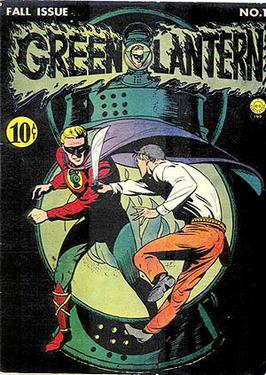
Green Lantern is an ongoing American comic-book series featuring the DC Comics heroes of the same name. The character's first incarnation, Alan Scott, appeared in All-American Comics #16 (July 1940), and was later spun off into the first volume of Green Lantern in 1941. After 38 issues, that series was cancelled in 1949. When the Silver Age Green Lantern, Hal Jordan, was introduced, the character starred in a new volume of Green Lantern starting in 1960.
Although Green Lantern is considered a mainstay in the DC Comics stable, the series has been cancelled and rebooted several times. When sales began slipping in the early 1990s, DC Comics instituted a controversial editorial mandate that turned Jordan into the supervillain Parallax and created a new protagonist named Kyle Rayner. This third volume ended publication in 2004, when the miniseries Green Lantern: Rebirth brought Hal Jordan back as a heroic character and made him the protagonist once again. After Rebirth's conclusion, writer Geoff Johns began a fourth volume of Green Lantern from 2005 to 2011, and a fifth volume which started immediately after, this time initially showcasing both Hal Jordan and Sinestro as Green Lantern.
Volume 1 was published from 1941 until 1949, spanning a total of 38 issues. The series featured Alan Scott, the first Green Lantern character, created by writer/artist Martin Nodell and writer Bill Finger. Alan's first appearance was in the anthology series, All-American Comics #16 (July 1940). The Green Lantern character received his own self-titled series in fall 1941. The first use of the Green Lantern oath was in issue #9 (late fall 1943). Artist Alex Toth did some of his earliest comics work on the title beginning with issue #28 (October–November 1947). A canine sidekick named Streak was introduced in #30 (February–March 1948) and the dog proved so popular that he became the featured character on several covers of the series starting with #34. The series was cancelled with #38 (May–June 1949). Although several subsequent Green Lantern revival projects have started over the years, this remains the only ongoing series to date to spotlight the Alan Scott character.
출처: Green Lantern (comic book) (CC BY-SA)
확인된 구조화 정보, 사용자 의견, AI가 찾은 관계를 구분해 표시해요.
The Silver Age Green Lantern was created by John Broome and Gil Kane in Showcase #22 (October 1959) at the behest of editor Julius Schwartz. Volume 2 of Green Lantern began publication in August 1960. The series spotlighted the Silver Age Green Lantern, Hal Jordan and introduced the expansive mythology surrounding Hal's forebears in the Green Lantern Corps. The supervillain Sinestro was introduced in #7 (July–August 1961). In 2009, Sinestro was ranked IGN's 15th Greatest Comic Book Villain of All Time. Hal Jordan's love interest, Carol Ferris, became the Star Sapphire in issue #16. Black Hand, a character featured prominently in the "Blackest Night" storyline in 2009–2010, debuted in issue #29 (June 1964). A substitute Green Lantern, Guy Gardner first appeared in the story "Earth's Other Green Lantern!" in issue #59 (March 1968).
Green Arrow joined Hal Jordan in the main feature of the title in an acclaimed series of stories by writer Dennis O'Neil and artist Neal Adams beginning with issue #76 (April 1970) and ending with issue #89 (April–May 1972) that dealt with various social and political issues in which Green Arrow spoke for radical change while Green Lantern was an establishment liberal figure, wanting to work within existing institutions of government and law. Where Oliver Queen advocated direct action, Hal Jordan wanted to work within the system; where Oliver advocated social change, Jordan was more concerned about dealing with criminals. Each would find their beliefs challenged by the other. Oliver convinced Jordan to see beyond his strict obedience to the Green Lantern Corps, to help those who were neglected or discriminated against. As O'Neil explained: "He would be a hot-tempered anarchist to contrast with the cerebral, sedate model citizen who was the Green Lantern." The duo embarked on a quest to find America, witnessing the problems of corruption, racism, pollution, and overpopulation confronting the nation. O'Neil took on then-current events, such as the Manson Family cult murders, in issue #78 where Black Canary falls briefly under the spell of a false prophet who advocates violence.
During this period, the most famous Green Arrow story appeared, in Green Lantern vol. 2, #85–86, when Green Arrow's ward Speedy was revealed to be addicted to heroin. In his zeal to save America, Oliver Queen had failed in his personal responsibility to Speedy — who would overcome his addiction with the help of Black Canary, Green Arrow's then-love interest. This story prompted a congratulatory letter from the mayor of New York City, John Lindsay. Another backup Green Lantern, John Stewart, was introduced in #87. The series did not match commercial expectations and Neal Adams had trouble with deadlines, causing issue #88 to be an unscheduled reprint issue; the series was cancelled with issue #89 (April–May 1972). Four months later, Green Lantern began a backup feature in The Flash #217 (Aug.–Sept. 1972) and appeared in most issues through The Flash #246 (Jan. 1977) until his own solo series was revived.
The Green Lantern title returned with issue #90 (Aug.–Sept. 1976) and continued the Green Lantern/Green Arrow team format. O'Neil continued to write the stories, which were drawn by artists such as Mike Grell and Alex Saviuk, while muting the social and political themes that had characterized the stories that had been drawn by Neal Adams. Julius Schwartz, who had edited the title for most of its run since 1960, left the series as of issue #103 (April 1978). In issue #123 (December 1979), Hal Jordan resumed the title spotlight and Green Arrow left the series. On the advice of artist Joe Staton, editor Jack C. Harris gave British artist Brian Bolland his first assignment for a U.S. comics publisher, the cover for Green Lantern #127 (April 1980). Writer Ma