
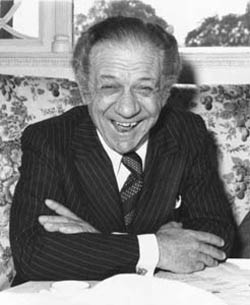
인물1913
Sid James
Sidney James was a South African–British actor and comedian whose career encompassed radio, television, stage and screen. Noted for his distinctive laugh, he was best known for numerous roles in the Carry On film series.
인물1913
Sidney James was a South African–British actor and comedian whose career encompassed radio, television, stage and screen. Noted for his distinctive laugh, he was best known for numerous roles in the Carry On film series.
이 항목이 포함된 사건 파일에서 정보와 관계를 함께 살펴보세요.
이 항목이 포함된 사건 파일이 아직 없습니다.
이 항목으로 조사 시작하기아직 댓글이 없어요. 먼저 한마디 남겨 보세요.
관계가 언제 생기고 바뀌었는지 날짜순으로 모았습니다. 소식 글과 출처에 적힌 날짜를 기준으로 합니다.
Sid James 국가 영국
Sidney James was a South African–British actor and comedian whose career encompassed radio, television, stage and screen. Noted for his distinctive laugh, he was best known for numerous roles in the Carry On film series.
Sidney James (born Solomon Joel Cohen; 8 May 1913 – 26 April 1976) was a South African–British actor and comedian whose career encompassed radio, television, stage and screen. Noted for his distinctive laugh, he was best known for numerous roles in the Carry On film series.
Born to a middle-class Jewish family in South Africa, James started his career in his native country before finding his greatest success in the UK. Beginning his screen career playing bit parts in films from 1947, he was cast in numerous small and supporting roles into the 1950s. He appeared in the film The Lavender Hill Mob in 1951, starring Alec Guinness.
His profile was raised as Tony Hancock's co-star in Hancock's Half Hour, firstly in the radio series and later when it was adapted for television and ran from 1954 to 1960. After this he became known as a regular performer in the Carry On films, appearing in 19 films of the series, top-billed in all but two.
His leading roles in television sitcoms continued. He starred in the 1970s sitcom Bless This House until his death in 1976.
James, born Solomon Joel Cohen on 8 May 1913 in Johannesburg, South Africa, was the second son of London-born Jewish vaudeville performers Reina (née Solomon; 1892–1965) and Lazarus Joel "Laurie" Cohen (1884–1948). His elder brother, Maurice, was born in 1911. Known affectionately as "Sollie" in childhood, he later changed his name to Sidney James following confusion with a similarly named cousin at his school, taking his new surname from his parents' stage names.
The family lived at the home of his maternal grandmother, Flora Solomon, on Hancock Street in Hillbrow, Johannesburg. In 1919, the Cohens left their sons in the care of Laurie's brother and sister-in-law, Abraham and Esther Cohen, in Newcastle, Natal after being offered a tour of Australia with their vaudeville act. By the time the tour ended in 1921 they were beginning divorce proceedings. Laurie remained in Australia with relatives, while Reina moved to her mother's new home in Joubert Park with their sons.
출처: Sid James (CC BY-SA)
확인된 구조화 정보, 사용자 의견, AI가 찾은 관계를 구분해 표시해요.
James claimed various previous occupations, including diamond cutter, dance tutor and boxer, but his main employment had been as a hairdresser at the salon owned by his mother and her siblings, where he had trained. It was at a hairdressing salon in Kroonstad, Orange Free State, that he met his first wife. His father-in-law, Johannesburg businessman Joseph Delmont, bought James a hairdressing salon in the basement of the prestigious Carlton Hotel, but within a year James announced that he wanted to become an actor and joined the Johannesburg Repertory Players. Through this group he gained work with the South African Broadcasting Corporation.
During World War II he served as a lieutenant in the Union Defence Force Entertainment Unit in South Africa's army, and subsequently took up acting as a career. He moved to the United Kingdom in December 1946, financed by his service gratuity. Initially he worked in repertory, before being spotted for the nascent British post-war film industry.
James made his first credited film appearances in Night Beat and Black Memory in 1947, both crime dramas. He played the alcoholic hero's barman in Powell and Pressburger's The Small Back Room in 1949. The Lavender Hill Mob in 1951 was his first comedy film, ranked 17th out of the 100 best British films by the British Film Institute: with Alfie Bass, he made up the bullion robbery gang headed by Alec Guinness and Stanley Holloway. He also appeared in Lady Godiva Rides Again and The Galloping Major, both films were released in 1951, and as Harry Hawkins in The Titfield Thunderbolt (1953), and also had a lead role in The Wedding of Lilli Marlene. He featured in another Alec Guinness film, Father Brown (US: The Detective, 1954) and in Trapeze (1956) as Harry the snake charmer, a circus film which was one of the most successful films of its year, and he played Master Henry in "Outlaw Money" (also 1956), an episode of The Adventures of Robin Hood. He also appeared in a 1956 episode of the TV series The Buccaneers 'The Hand of the Hawk', starring Robert Shaw.
James had a supporting part as a TV advertisement producer in Charlie Chaplin's A King in New York, a non-comic supporting role as a journalist in the science-fiction film Quatermass 2, and he performed in Hell Drivers (all 1957), a film with Stanley Baker. This was one of many appearances James made for the Rank Organisation.
The next year, James starred with Miriam Karlin in East End, West End by Wolf Mankowitz, a half-hour comedy series for the ITV company Associated Rediffusion. Set within the Jewish community of London's East End, the series of six episodes was transmitted in February and March 1958, but plans for further episodes were abandoned after a disappointing response. For a while though, it had looked as if his commitment elsewhere might end his work with Tony Hancock, one of the most popular television comedians of the time.
He had begun working with Tony Hancock in 1954, in his BBC Radio series Hancock's Half Hour. Having seen him in The Lavender Hill Mob, it was the idea of Hancock's writers, Galton and Simpson, to cast James. He played a character called Sid James (but having the invented middle name Balmoral) who was a petty criminal and would usually manage to con Hancock in some way, although the character eventually ceased to be Hancock's adversary. With the exception of James, the other regular cast members of the radio series were dropped when the series made the transition to television. His part in the show now greatly increased, and many viewers came to think of Hancock and James as a double act.
Feeling the format had become exhausted, Hancock decided to end his professional relationship with James at the end of the sixth television series in 1960. Although the two men remained friends, James was upset at his colleague's decision. The experience led to a shift away from the kind of roles for which he had become best known.