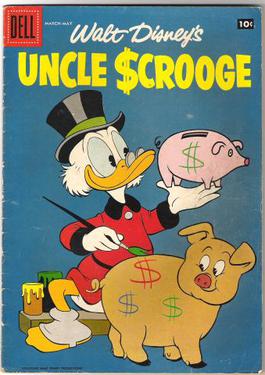
Uncle Scrooge is a Disney comic book series starring Scrooge McDuck, his nephew Donald Duck, and grandnephews Huey, Dewey, and Louie, and revolving around their adventures in Duckburg and around the world. It was first published in Four Color Comics #386, as a spin-off of the popular Donald Duck series and is still presently ongoing. It has been produced under the aegis of several different publishers, including Western Publishing, Gladstone Publishing, Disney Comics, Gemstone Publishing, Boom! Studios, and IDW Publishing. The series has maintained the same numbering throughout its life, with
Uncle Scrooge is a Disney comic book series starring Scrooge McDuck, his nephew Donald Duck, and grandnephews Huey, Dewey, and Louie, and revolving around their adventures in Duckburg and around the world. It was first published in Four Color Comics #386, as a spin-off of the popular Donald Duck series and is still presently ongoing. It has been produced under the aegis of several different publishers, including Western Publishing, Gladstone Publishing, Disney Comics, Gemstone Publishing, Boom! Studios, and IDW Publishing. The series has maintained the same numbering throughout its life, with
소개 자세히 읽기
Uncle Scrooge (stylized as Uncle $crooge) is a Disney comic book series starring Scrooge McDuck ("the richest duck in the world"), his nephew Donald Duck, and grandnephews Huey, Dewey, and Louie, and revolving around their adventures in Duckburg and around the world. It was first published in Four Color Comics #386 (March 1952), as a spin-off of the popular Donald Duck series and is still presently ongoing. It has been produced under the aegis of several different publishers, including Western Publishing (initially in association with Dell Comics and later under its own subsidiary, Gold Key Comics and their Whitman imprint), Gladstone Publishing, Disney Comics, Gemstone Publishing, Boom! Studios, and IDW Publishing. The series has maintained the same numbering throughout its life, with IDW Publishing's series resetting to issue #1 alongside a secondary legacy numbering.
Besides Scrooge and his family, recurring characters include Gyro Gearloose, Gladstone Gander, Emily Quackfaster, and Brigitta MacBridge. Among the adversaries who make repeat appearances are the Beagle Boys, Magica De Spell, John D. Rockerduck and Flintheart Glomgold. Uncle Scrooge is one of the core titles of the "Duck universe".
Its early issues by famed writer/artist (and creator of Scrooge McDuck) Carl Barks formed the inspiration for the syndicated television cartoon DuckTales in the late 1980s. Several stories written by Barks and published in Uncle Scrooge were adapted as episodes of DuckTales.
Writers and artists
The first 70 issues mostly consisted of stories written and drawn by Carl Barks. The 71st issue had a story written by Barks and drawn by Tony Strobl. Subsequent Gold Key Comics issues combined reprints of earlier Barks tales with new material by creators such as Strobl, Vic Lockman, Phil DeLara, Jack Manning, and Pete Alvarado.
When Gladstone Publishing relaunched the title in 1986, a new generation of American creators began contributing to the title, including Don Rosa, William Van Horn, John Lustig, Pat McGreal, Dave Rawson, and Michael T. Gilbert. As before, their work was intermingled with Carl Barks reprints, as well as with translations of European Disney comics by such creators as Daan Jippes, Fred Milton and Romano Scarpa originally published by Oberon, Egmont (originally Gutenberghus) and Disney Italy/Mondadori.
IDW Publishing: 2015–2020 (IDW #1-56, with "legacy" issue numbers 405–460 in brackets)
Fantagraphics: 2025- (Fantagraphics #1-, with "legacy" issue numbers 461- in brackets)
Scrooge made his first appearance in the Donald Duck story "Christmas on Bear Mountain" as a curmudgeonly man who decides to test Donald and his nephews to see if they are worthy of inheriting his wealth. Barks found the character and his wealth a useful springboard for stories and re-used him in a number of subsequent Donald Duck one-shot adventures and ten pagers appearing in Walt Disney's Comics and Stories. By 1952 the popularity of the character convinced Dell to give Scrooge a try-out as a lead character in the seminal "Only a Poor Old Man" in Dell's Four Color anthology series, a story Barks expert Michael Barrier has termed a masterpiece. After two further Four Color appearances Scrooge was granted his own title starting with issue number 4 (counting the try-out issues as one through three).
The series continued uninterrupted (though not always on a monthly schedule) until 1984, when Western Publishing (the parent company of Gold Key/Whitman, who were publishing the title at the time) withdrew from the comic book business. Western had held the Disney comic book license since the late 1930s, and their withdrawal left the license, and Uncle Scrooge, in limbo for two years, when Another Rainbow, who had been publishing hardbound compilations of Carl Barks's work for several years, acquired it and launched Gladstone Publishing, resuming the title where Whitman had left off.
Gladstone continued publishing Uncle Scrooge until their license expired in 1990. At that point, the series shifted over to Disney Comics with little change in editorial direction. It was one of only three monthly titles to survive the "Disney implosion" of 1991 (the others being Walt Disney's Comics and Stories and Donald Duck Adventures), and continued to be published by Disney Comics until 1993, when Disney Comics folded and the license was reacquired by Gladstone Publishing. Gladstone went through their own implosion in 1998, and Uncle Scrooge was briefly converted into a double-sized (64 page), "prestige" format series, before Gladstone ended publication entirely later that year.
No further issues were published until 2003, when Gemstone Publishing (whose editorial staff included several former employees of Gladstone) acquired the license and resumed publication of Uncle Scrooge. Gemstone maintained the prestige format previously adopted by Gladstone, and continued to publish the series until November 2008. Financial difficulties at Gemstone ended its run then, and the license was acquired by Boom! Studios, who reverted to the standard 32 page format when they began publication in late 2009. Boom's run ended in 2011, when the Walt Disney Company's acquisition of Marvel Entertainment lead to the consolidation of all Disney comics licenses under Marvel Comics.
In January 2015, IDW Publishing announced that they would be publishing the title, starting in April 2015. Apart from the single issues of the comic book, IDW Publishing also publishes the run in trade paperback collections compiling three issues each, but did also at one point collect the issues in hardcover coll