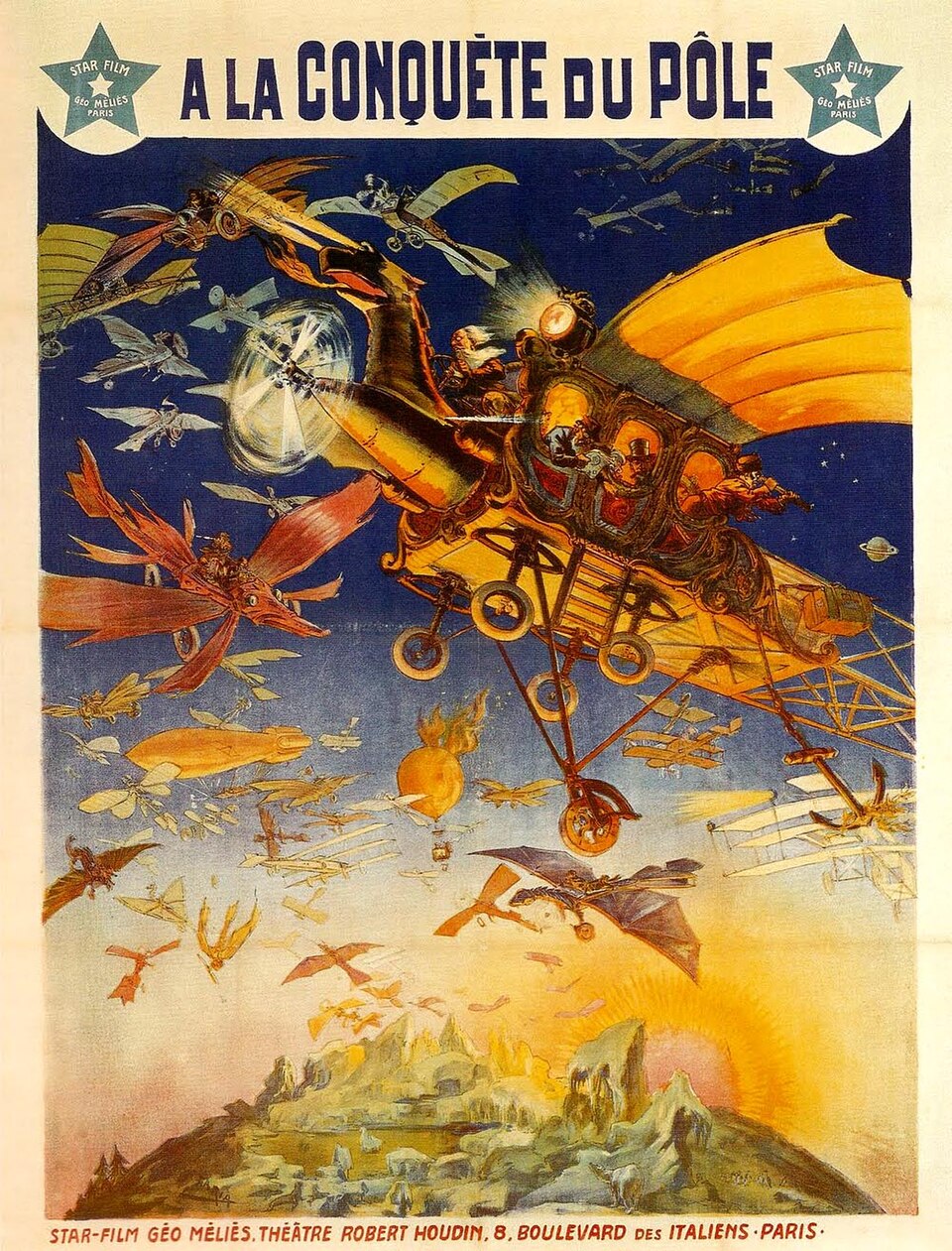
The Conquest of the Pole is a 1912 French silent science fantasy trick film directed by and starring Georges Méliès. The film, loosely inspired by contemporary events and by Jules Verne's Voyages Extraordinaires, follows the comic misadventures of an international group of explorers on an expedition to the North Pole, where they encounter a man-eating frost giant and a dangerous magnetic needle.
The Conquest of the Pole is a 1912 French silent science fantasy trick film directed by and starring Georges Méliès. The film, loosely inspired by contemporary events and by Jules Verne's Voyages Extraordinaires, follows the comic misadventures of an international group of explorers on an expedition to the North Pole, where they encounter a man-eating frost giant and a dangerous magnetic needle.
소개 자세히 읽기
The Conquest of the Pole (French: À la conquête du pôle) is a 1912 French silent science fantasy trick film directed by and starring Georges Méliès. The film, loosely inspired by contemporary events and by Jules Verne's Voyages Extraordinaires, follows the comic misadventures of an international group of explorers on an expedition to the North Pole, where they encounter a man-eating frost giant and a dangerous magnetic needle.
The film, one of Méliès's last cinematic works, was released by Pathé Frères to critical acclaim in France and the United Kingdom, but was a box-office failure and contributed to Méliès's mounting financial difficulties. It continues to be seen as one of his masterpieces and is sometimes named as his greatest work.
Plot
At an International Congress at an Aero Club, explorers from around the world argue about the best way to fly to the North Pole. All are in disagreement until the congress's president, the engineer Maboul of France, explains his plans for an "Aero-Bus," an airplane with a passenger car and a huge figurehead in the shape of a bird head. The proceedings are interrupted by a group of militant suffragettes, who announce their intention to go to the Pole themselves. When they have been chased off, the Congress nominates an international group of experts to accompany Maboul to the Pole: Run-Ever of England, Bluff-"Allo"-Bill of America, Choukroutman of Germany, Cerveza of Spain, Tching-Tchun of China, and Ka-Ko-Ku of Japan. Maboul takes his colleagues to his office to study the model of his invention, and then to the electricity-powered factory where the real thing is being constructed. The leader of the suffragettes moves on with her own plans to get to the Pole, building a machine fitted with propellers and a multitude of toy balloons, but it fails to get off the ground.
Inspirations
Although the film's story is treated in a vein of fantasy, it took much of its inspiration from current affairs. Robert E. Peary and his team had set foot on the North Pole on 6 April 1909, and Roald Amundsen had made it to the South Pole on 14 December 1911, four months before Méliès started filming. The claims of the rival explorer Frederick Cook, who tried unsuccessfully to prove that he had beaten Peary to the North Pole, were also a thematic inspiration. Méliès later recalled:
Production
Georges Méliès is widely regarded as the first person to recognize the potential of narrative film, and his A Trip to the Moon (1902), The Kingdom of the Fairies (1903), and The Impossible Voyage (190
The completed Aero-Bus lifts off to great acclaim, though it meets with two difficulties; first the suffragette leader tries to board with the expedition at the last moment, and then the explorer Tching-Tchun, arriving late, is accidentally left behind. The race to the Pole attracts many other adventurers, who depart in their own machines; soon the sky is full of aircraft of every shape and size. Both Tching-Tchun and the suffragette leader attempt to make it to the Pole in a balloon, but again meet with failure. (The explorer falls a short distance to the ground and gives up; the suffragette, having held on longer, falls onto a church steeple and explodes.) Meanwhile, the Aero-Bus continues through the sky unimpeded, passing various planets and constellations.
The aircraft skims down over the ice of the Arctic and finally crash-lands. The delegates make it out of the wreck, safe and sound. Almost immediately, however, they run into an obstacle: the Giant of the Snows, a pipe-smoking, man-eating frost giant who has to be scared off with cannon fire. They come at last to the pole proper, where they find a huge magnetic needle. Stuck by magnetic attraction to the needle, which breaks under their weight and plunges them into the icy waters, they signal for help and are picked up by a passing airship. Penguins, seals, and Arctic birds wave goodbye. The explorers return in triumph to the Aero Club, where they bow to all assembled.
I intervened in the controversy between Cook and Peary. Both pretended to have reached the Pole. In fact I don't think either one did. I said to myself, I'm going to go there.
The presence of suffragettes in the film was another nod to recent events; the women's suffrage movement was highly present in the news at the time, and would remain a contemporary issue in France until the Second World War, when women were granted the right to vote. (Indeed, the leader of the suffragettes was conceived as a caricature of the well-known British suffrage campaigner Emmeline Pankhurst.) Even the scene in which a suffragette attempts to join the aviation race was topical in France; Thérèse Peltier had recently made headlines as the first woman aviator to fly solo, and Raymonde de Laroche became the first woman in the world to receive an airplane pilot's licence in 1910.
Although many contemporary write-ups about the film suggested a connection with Jules Verne's works (see the Release and reception section below), the film is not an adaptation of any of his famous Voyages Extraordinaires novels; rather, it is a parodic, satiric homage to the entire Voyages Extraordinaires series, in something of the same style as Albert Robida's Verne-spoofing comic novel Voyages très extraordinaires de Saturnin Farandoul (1879–1880). If anything, the film may be said to be inspired very loosely by Verne's The Adventures of Captain Hatteras or his The Sphinx of the Ice Fields.
Other possible sources came from the theatre and the cinema. Pif Paf Pouf, a spectacular féerie staged in 1906 at the Théâtre du Châtelet, included a Giant of the Pole operated by wires as well as a powerful magnet at the Pole, two elements borrowed for the film. The eleven-scene film Voyage of the Arctic, or How Captain Kettle Discovered the North Pole, directed by the pioneering British filmmaker Robert W. Paul in 1903, features a Polar giant, strongly suggesting a direct influence on Méliès. Méliès may also have remembered that the Lumière Brothers had filmed a staged reenactment of Polar exploration, The Explorer Andrée at the North Pole, in 1897.