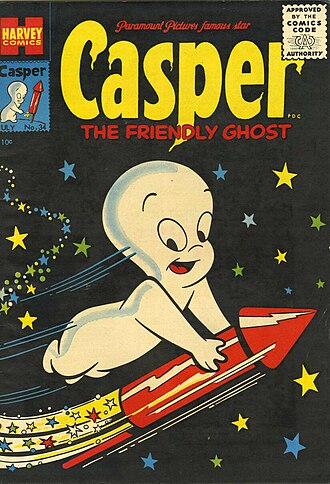
Casper the Friendly Ghost is a fictional character who appeared in animated short films produced by Paramount Pictures' Famous Studios. He is a translucent ghost who is personable and keen to socialize with living beings, much to the chagrin of his three wicked uncles, the Ghostly Trio.
Casper the Friendly Ghost is a fictional character who appeared in animated short films produced by Paramount Pictures' Famous Studios. He is a translucent ghost who is personable and keen to socialize with living beings, much to the chagrin of his three wicked uncles, the Ghostly Trio.
詳しい紹介を読む
Casper the Friendly Ghost is a fictional character who appeared in animated short films produced by Paramount Pictures' Famous Studios. He is a translucent ghost who is personable and keen to socialize with living beings, much to the chagrin of his three wicked uncles, the Ghostly Trio.
The character was featured in 55 theatrical cartoons titled The Friendly Ghost from 1945 to 1959. The character has been featured in comic books published by Harvey Comics since 1952, and Harvey purchased the character outright in 1959. Casper became one of Harvey's most popular characters, headlining several comic book titles.
Following Harvey's purchase of the character, he appeared in five television series: Matty's Funday Funnies (1959–1961), The New Casper Cartoon Show (1963–1970), Casper and the Angels (1979), The Spooktacular New Adventures of Casper (1996–1998) and Casper's Scare School (2009–2012). The character made his theatrical film debut in a live-action adaptation of the series by Universal Pictures: Casper (1995), to where he became the first computer-generated character to star in a film. He would later appear in four direct-to-video and made-for-TV follow-up films.
The Apollo 16 Command and Service Module was given the call sign "Casper", since its pilot Ken Mattingly thought, "there are enough serious things in this flight, so I picked a non-serious name."
Creation
The origins of Casper are disputed, with both Seymour Reit and Joe Oriolo claiming to be the character's creator. According to Oriolo, Casper was created on a Halloween night to assuage his four-year-old daughter Joan's fear of the dark. He made a cardboard cutout of a friendly ghost and hung it in the backyard tree to show her that not all ghosts are bad.
Though Joan has corroborated this story, Seymour Reit maintains that Casper was born with a short story which he conceived and wrote entirely by himself and gave to Oriolo to illustrate. Reit concluded, "Joe [Oriolo] created the actual cartoon of the character - but the concept, series, idea and plotline were mine, prior to Joe's involvement. Joe played an important part, but I was Casper's legit 'Poppa'." [emphasis in original]
Reit and Oriolo intended to sell the story to either Fleischer Studios (where they were both employed as animators) or to a children's storybook publisher, and they eventually lined up a deal with Grosset & Dunlap. When Reit was away on military service during World War II before the book was released, Oriolo sold the rights to the book to Paramount Pictures' Famous Studios, Fleischer Studios' successor, for a total of $175. This one-time payment was all that he received, missing out on a share of the revenue earned from the films, comic books and merchandise to come. For his part, Reit received no payment for the book at all.
In the original Famous cartoons, Casper is standing next to a grave inscribed with "Casper", indicating him to be deceased. Originally, stories have shown that his visibility is due to wearing a sheet. In the Casper live-action film, this is not shown and it is implied that he is naturally visible to humans as a white creature.
The Friendly Ghost, the first Noveltoons short to feature Casper, was released by Paramount in May 1945 with a few differences from the book. In the cartoon adaptation, Casper is a cute ghost-child with a New York accent who inhabits a haunted house along with a community of adult ghosts who delight in scaring the living. Casper, in contrast, would prefer to make friends with people. He packs up his belongings and goes out into the world, hoping to find friends. However, the animals that he meets (a rooster, a mole, a cat, a mouse named Herman, and a group of hens) take one horrified look at him, scream: "A ghost!" and run off in the other direction. Distraught, Casper attempts suicide (apparently forgetting that he is already dead) by lying down on a railway track before an oncoming train, before he meets two children named Bonnie and Johnny who become his friends. The children's mother, apparently widowed and impoverished, is frightened of Casper. She later welcomes him into the family after he unintentionally frightens off a greedy landlord, who, unwilling to own a "haunted" house, tears up the mortgage and gives her the house outright. The short ends with the mother kissing Bonnie, Johnny, and Casper as she sends them off to school, with Casper wearing clothing as if he were a living child.
Casper appeared in two more Noveltoons shorts, There's Good Boos To-Night and A Haunting We Will Go, released in 1948 and 1949 respectively, even though Famous Studios's president and general manager Sam Buchwald had already given approval for Casper to have his own series. In these cartoons Casper's appearance was cuter and more infantile than in his debut cartoon; head animator Myron Waldman has claimed credit for the redesign. There's Good Boos To-Night differs wildly from later Casper cartoons: although the theme of Casper trying to find a friend and failing in these attempts before succeeding also occurs in later cartoons, the tone of this short turns remarkably dark when a hunter and his dogs appear, chasing the little fox cub named Ferdie that Casper has befriended. Although Casper scares the hunter and dogs away, Casper discovers Ferdie dead after a harrowing chase scene. Ferdie returns as a ghost to join his friend Casper in the afterlife.
These three cartoons were initially billed as Noveltoon shorts before Paramount started the official Casper the Friendly Ghost series in 1950, which ran until 1959. Most of the entries in the series were relatively the same: Casper (now slightly thinner than the pudgy figure that appeared in the earlier cartoons) escapes from the afterlife of a regular ghost because he finds that scaring people can be tiresome year after year, tries to find friends but inadvertently scares almost everyone, and finally finds a (cute little) friend, whom he saves from some sort of fate, leading to