
場所
アレグザンダー・ターンブル図書館
Alexander Turnbull Library
ニュージーランド国立図書館の一部
場所
Alexander Turnbull Library
ニュージーランド国立図書館の一部
この項目を含む事件ファイルで情報と関係を見てみましょう。
この項目を含む事件ファイルはまだありません。
この項目から調査する最初のコメントをお待ちしています。
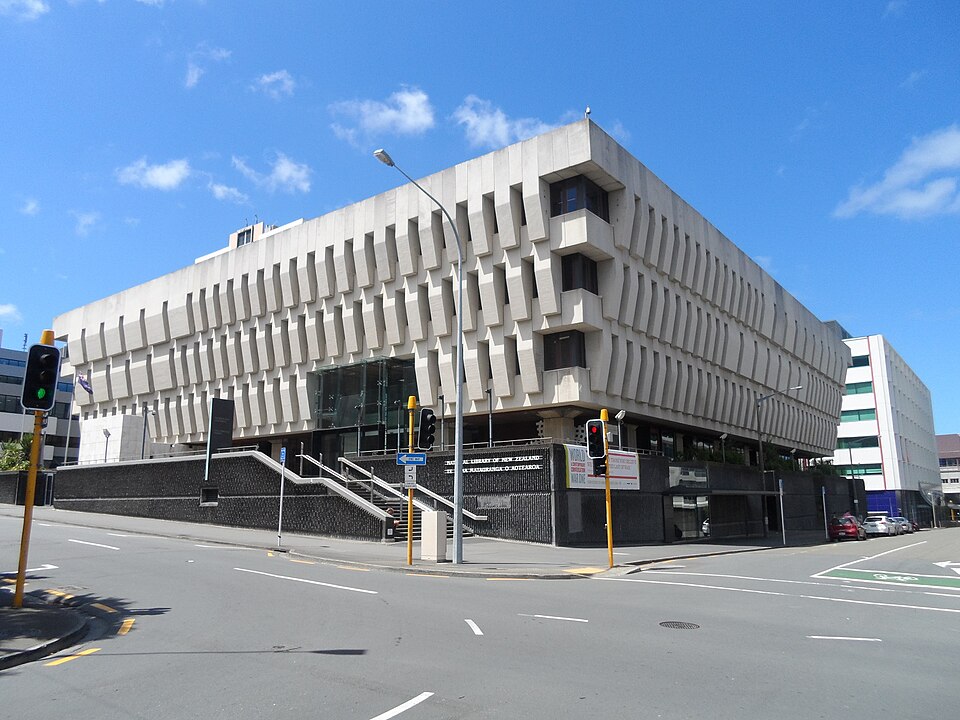
The National Library of New Zealand (Māori: Te Puna Mātauranga o Aotearoa) is New Zealand's national library, headquartered in Wellington on the corner of Aitken and Molesworth Streets, close to other national government buildings such as the New Zealand Parliament Buildings and the Court of Appeal. Under the National Library of New Zealand (Te Puna Mātauranga) Act 2003, the library's purpose is to "enrich the cultural and economic life of New Zealand and its interchanges with other nations." The Act also enumerates other duties for the library, including collecting, preserving and protecting New Zealand's documentary heritage, supporting other libraries in New Zealand, and collaborating with peer institutions abroad.
The National Library is New Zealand's legal deposit library, and the Legal Deposit Office is the country's agency for ISBN and ISSN. The library supports schools through its Services to Schools business unit, which has curriculum and advisory branches around New Zealand.
The National Library of New Zealand was formed in 1965 when the General Assembly Library, the Alexander Turnbull Library, and the National Library Service were brought together by the National Library Act 1965.
The National Library of New Zealand originated from money funds appropriated by Parliament in 1856. It developed into a major national institution, described as "a magnificent national treasure house in a splendid building." From its establishment, until its formal designation as the National Library, it combined parliamentary information services, including collections of documents and newspapers, with an extensive library of international research and literature.
The Alexander Turnbull Library was founded in 1920 and grew to hold a "comprehensive collection" of primarily New Zealand culture and history, Māori and non-Māori. The National Library Service, established in 1945, was made up of four divisions: the Country Library Service, the School Library Service, a National Library centre and Library School in Wellington.
In 1974, the Archive of New Zealand Music was established at the suggestion of New Zealand composer Douglas Lilburn.
In 1976 Mary Ronnie became the first female national librarian in the world, due to becoming New Zealand's first female National Librarian, at the National Library of New Zealand.
In 1985, the General Assembly Library returned to become part of the Parliamentary Service, changing its name in 1987 to the Parliamentary Library. When it separated from the National Library, the National Library then took guardianship of hundreds of thousands of international volumes previously acquired by the General Assembly Library, and the National Library continued to curate the traditional international library.
In 1987, staff and collections from 14 different sites around Wellington were centralised in a new National Library building, officially opened in August. The architecture of the building is said to have been heavily influenced by the design of the Boston City Hall.
In 1988, the National Library became an autonomous government department where previously it had been administered by the Department of Education. The same year, the Library took on the te reo Māori name Te Puna Mātauranga o Aotearoa, which translated means: the wellspring of knowledge, of New Zealand.
In early 1998 an ambitious $8.5 million computer project was scrapped.
The National Library building was to be expanded and upgraded in 2009–2011, but the incoming Fifth National Government greatly scaled down the scope of the work, reducing the budget for it and delaying the commencement, arguing concerns about the cost of the project and the reduction in the accessibility of collections and facilities during the construction work. The building closed for two years, reopening in June 2012, while refurbishment continued.
In 2015, the National Library signalled the beginning of a review process of their international collections, comprising the General Assembly international library in its guardianship of General Assembly collections and substantial post-1965 acquisitions. The National Library classified these collections as "overseas published collections". This was done in consultation with New Zealand's li
出典: National Library of New Zealand (CC BY-SA)
構造化された情報、ユーザーの意見、AIが抽出した関係を区別して表示します。
On 25 March 2010 the Minister of State Services announced that Archives New Zealand and the National Library of New Zealand would be subsumed under the Department of Internal Affairs.
In June 2018 a National Archival and Library Institutions Ministerial Group (NALI) was announced. The purpose of NALI was to examine the structure and role of the National Library, Archives New Zealand and Ngā Taonga Sound & Vision, the position of the Chief Archivist and National Librarian, and the future of collecting, preserving and providing access to New Zealand's documentary heritage, particularly digital preservation and access. Before and since NALI was set up concern has been expressed about the National Library being part of the Department of Internal Affairs.
Though the Department of Internal Affairs had initially planned to move the National library along with Archives New Zealand and Ngā Taonga Sound & Vision to a new purpose-built facility at the Horowhenua Business Park in Levin, the project was not fully funded in later Budget bids and eventually cancelled by April 2024.
In February 2022 Internal Affairs Minister Jan Tinetti, Archives NZ chief archivist Stephen Clarke and Māori iwi (tribe) Taranaki Whānui Te Āti Awa confirmed that the Government would build a new archives building on the site of the former Defence House on Wellington's Aitken Street between the present Archives NZ and National Library buildings. The new NZ$290 million building will also host archives repository and specialist facilities for the National Library, Archives New Zealand and Ngā Taonga Sound & Vision.
In October 2026, the National Library and Archives New Zealand confirmed plans to lay off 45 jobs, amounting to 11 percent of their workforce.