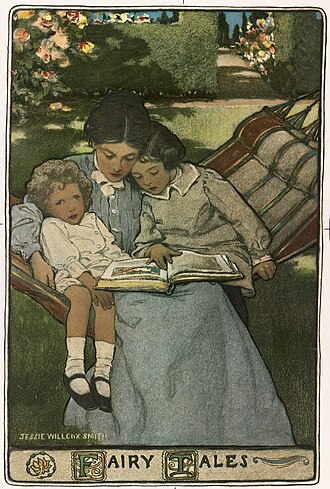
Early children's literature consisted of spoken stories, songs, and poems, used to educate, instruct, and entertain children.
It was only in the eighteenth century, with the development of the concept of childhood, that a separate genre of children's literature began to emerge, with its own divisions, expectations, and canon. The earliest of these books were educational books, books on conduct, and simple ABCs—often decorated with animals, plants, and anthropomorphic letters.
In 1962, French historian Philippe Ariès argued in his book Centuries of Childhood that the modern concept of childhood only emerged in recent times. He explains that children were in the past not considered as fundamentally different from adults and were not given significantly different treatment.
As evidence for this position, he notes that, apart from instructional and didactic texts for children written by clerics like the Venerable Bede and Ælfric of Eynsham, there was a lack of any genuine literature aimed specifically at children before the 18th century.