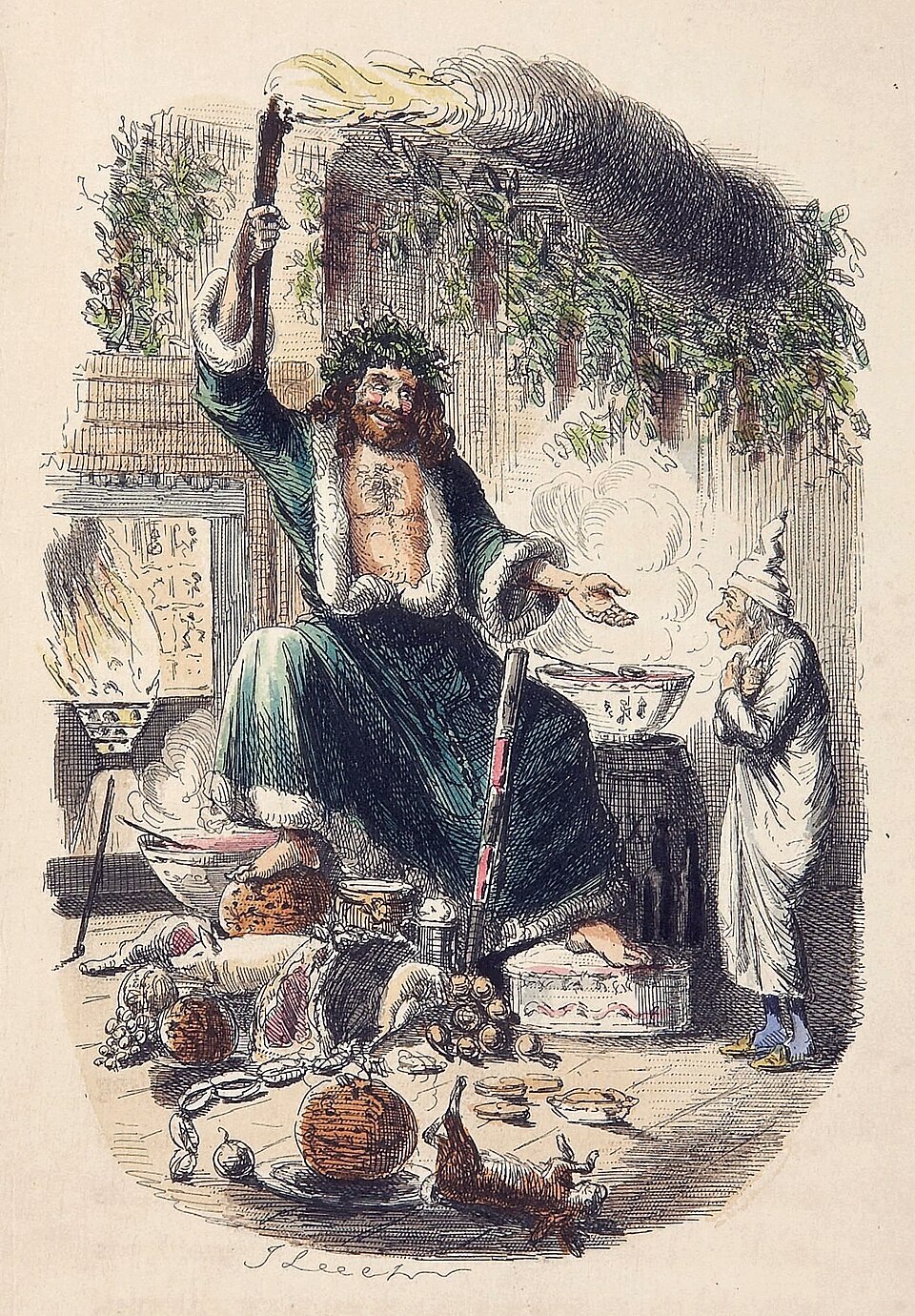
The Ghost of Christmas Present is a fictional character in Charles Dickens' 1843 novella A Christmas Carol. The Ghost is one of three spirits that appear to miser Ebenezer Scrooge to offer him a chance of redemption.
The Ghost of Christmas Present is a fictional character in Charles Dickens' 1843 novella A Christmas Carol. The Ghost is one of three spirits that appear to miser Ebenezer Scrooge to offer him a chance of redemption.
詳しい紹介を読む
The Ghost of Christmas Present is a fictional character in Charles Dickens' 1843 novella A Christmas Carol. The Ghost is one of three spirits that appear to miser Ebenezer Scrooge to offer him a chance of redemption.
Following a visit from the ghost of his deceased business partner, Jacob Marley, Scrooge receives nocturnal visits from three Ghosts of Christmas, each representing a different period in Scrooge's life. The Ghost of Christmas Present is concerned with Scrooge's current life and the present Christmas Day.
The Ghost of Christmas Present is presented as a personification of the Christmas spirit, and in the novella's first edition hand-coloured drawing by John Leech resembles early-Victorian images of Father Christmas. The spirit first appears to Scrooge on a throne made of traditional Christmas foodstuffs that would have been familiar to Dickens's more prosperous readers.
The spirit becomes the mouthpiece for Dickens's view on social reform and Christian charity: generosity and goodwill to all men – especially to the poor – and celebration of Christmas Day.
Background
By early 1843 Dickens had been affected by the treatment of the poor and, in particular, the treatment of the children of the poor after witnessing children working in appalling conditions in a tin mine and following a visit to a ragged school. Indeed, Dickens experienced poverty as a boy when he was forced to work in a blacking factory after his father's imprisonment for debt. Originally intending to write a political pamphlet titled, An Appeal to the People of England, on behalf of the Poor Man's Child, he changed his mind and instead wrote A Christmas Carol which voiced his social concerns about poverty and injustice.
Dickens's friend and biographer John Forster said that Dickens had 'a hankering after ghosts', while not actually having a belief in them himself, and his journals Household Words and All the Year Round regularly featured ghost stories, with the novelist publishing an annual ghost story for some years after his first, A Christmas Carol, in 1843. In this novella, Dickens was innovative in making the existence of the supernatural a natural extension of the real world in which Scrooge and his contemporaries lived. Dickens making the Christmas Spirits a central feature of his story is a reflection of the early-Victorian interest in the paranormal.
Origins
The Ghost of Christmas Present is described as "a jolly Giant", and Leech's hand-coloured illustration of the friendly and cheerful Spirit, his hand open in a gesture of welcome confronted by the amazed Scrooge has been described by Jane Rabb Cohen as elegantly combining "the ideal, real, and supernatural" with humour and sympathy. It is clear that the Spirit is based on Father Christmas, the ancient patriarchal figure associated with the English Christmas holiday, traditionally a bearded pagan giant depicted in a fur-lined evergreen robe wearing a crown of holly while holding mistletoe. Father Christmas, or Old Christmas, was often represented as surrounded by plentiful food and drink and started to appear regularly in illustrated magazines of the 1840s.
The American Santa Claus commemorated in the 1822 poem A Visit from St. Nicholas (better known as The Night Before Christmas) by Clement Clarke Moore is derived from his pagan English counterpart and the gift-giving Saint Nicholas of Myra, but the Ghost of Christmas Present should not be confused with the American version, who was little known in England before the early 1850s.
Significance to the story
As predicted by Jacob Marley, the second Spirit, the Ghost of Christmas Present, appears as the bell strikes one. While Scrooge is waiting to meet the second of the Spirits, 'nothing between a baby and a rhinoceros would have astonished him very much'. However, the appearance of the Spirit takes him by surprise, with its vision of opulence and the good things of Christmas, a vision of how Scrooge with all his wealth could be living, but chooses not to:
The moment Scrooge's hand was on the lock, a strange voice called him by his name, and bade him enter. He obeyed...
Heaped up on the floor, to form a kind of throne, were turkeys, geese, game, poultry, brawn, great joints of meat, sucking-pigs, long wreaths of sausages, mince-pies, plum-puddings, barrels of oysters, red-hot chestnuts, cherry-cheeked apples, juicy oranges, luscious pears, immense twelfth-cakes, and seething bowls of punch, that made the chamber dim with their delicious steam. In easy state upon this couch there sat a jolly Giant, glorious to see; who bore a glowing torch, in shape not unlike Plenty's horn, and held it up, high up, to shed its light on Scrooge as he came peeping round the door.
"Come in!" exclaimed the Ghost. "Come in! and know me better, man!"
Scrooge entered timidly, and hung his head before this Spirit. He was not the dogged Scrooge he had been; and, though the Spirit's eyes were clear and kind, he did not like to meet them.
"I am the Ghost of Christmas Present," said the Spirit. "Look upon me!"
Scrooge reverently did so. It was clothed in one simple deep green robe, or mantle, bordered with white fur. This garment hung so loosely on the figure, that its capacious breast was bare, as if disdaining to be warded or concealed by any artifice. Its feet, observable beneath the ample folds of the garment, were also bare; and on its head it wore no other covering than a holly wreath, set here and there with shining icicles. Its dark brown curls were long and free; free as its genial face, its sparkling eye, its open hand, its cheery voice, its unconstrained demeanour, and its joyful air. Girded round its middle was an antique scabbard; but no sword was in it, and the ancient sheath was eaten up with rust.
"You have never seen the like of me before!" exclaimed the Spirit.
Scrooge is more chastened in this Spirit's company than he was in the presence of the Ghost of Christmas Past and expresses his willingness to learn from any lesson the Spirit will show him. The Spirit