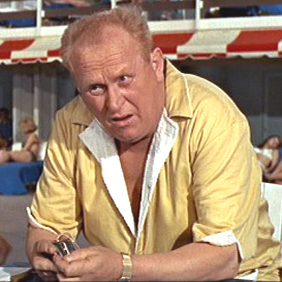
Auric Goldfinger is a fictional character and the main antagonist in Ian Fleming's 1959 seventh James Bond novel, Goldfinger, and the 1964 film it inspired. His first name, Auric, is an adjective meaning "of gold". Fleming chose the name to commemorate the architect Ernő Goldfinger, who had built his home in Hampstead next door to Fleming's; he disliked Goldfinger's style of architecture and destruction of Victorian terraces and decided to name a memorable villain after him. According to a 1965 Forbes article and The New York Times, the Goldfinger persona was based on gold-mining magnate Charl
Auric Goldfinger is a fictional character and the main antagonist in Ian Fleming's 1959 seventh James Bond novel, Goldfinger, and the 1964 film it inspired. His first name, Auric, is an adjective meaning "of gold". Fleming chose the name to commemorate the architect Ernő Goldfinger, who had built his home in Hampstead next door to Fleming's; he disliked Goldfinger's style of architecture and destruction of Victorian terraces and decided to name a memorable villain after him. According to a 1965 Forbes article and The New York Times, the Goldfinger persona was based on gold-mining magnate Charl
詳しい紹介を読む
Auric Goldfinger is a fictional character and the main antagonist in Ian Fleming's 1959 seventh James Bond novel, Goldfinger, and the 1964 film it inspired (the third in the James Bond series). His first name, Auric, is an adjective meaning "of gold". Fleming chose the name to commemorate the architect Ernő Goldfinger, who had built his home in Hampstead next door to Fleming's; he disliked Goldfinger's style of architecture and destruction of Victorian terraces and decided to name a memorable villain after him. According to a 1965 Forbes article and The New York Times, the Goldfinger persona was based on gold-mining magnate Charles W. Engelhard, Jr.
In 2003, the American Film Institute declared Auric Goldfinger the 49th-greatest villain in the past 100 years of film. In a poll on IMDb, Auric Goldfinger was voted the most sinister James Bond villain, beating (in order) Ernst Stavro Blofeld, Dr. Julius No, Max Zorin and Emilio Largo. Goldfinger's oft-quoted line "No, Mr. Bond, I expect you to die," (after Bond asked him while tied to a table in front of a laser, "Do you expect me to talk?") was voted the number-one best moment in the James Bond film franchise in a 2013 Sky Movies poll.
Auric Goldfinger was played by German actor Gert Fröbe. Fröbe, who did not speak English well, was dubbed in the film by Michael Collins, an English actor. In the German version, Fröbe dubbed himself back again.
Goldfinger was banned in Israel after it was revealed that Fröbe had been a member of the Nazi Party. However, he left the party before the outbreak of World War II. After several years, the ban was lifted, as it was found that Fröbe saved the lives of two Jews by hiding them in his basement during the war.
Operation Grand Slam
In the novel, Goldfinger captures Bond and threatens to cut him in half with a circular saw as Oddjob tortures him using his pressure points. Bond offers to work for Goldfinger in exchange for his life, but Goldfinger refuses to spare him, and he blacks out.
Bond wakes to find that Goldfinger is going to take him up on his offer after all, and makes him his prisoner and secretary. While working at this job, Bond discovers that Goldfinger is plotting to rob the United States Bullion Depository at Fort Knox, Kentucky, in an action codenamed "Operation Grand Slam".
Goldfinger plans to contaminate the water supply at Fort
In the novel Goldfinger, Auric Goldfinger is a 42-year-old from Riga, Latvia, who emigrated to Britain in 1937 at the age of 20. He is five feet (1.52 m) tall, has blue eyes, red hair, and a passion for his tan.
Goldfinger's name was borrowed from Ian Fleming's neighbour in his Hampstead home, architect Ernő Goldfinger, and his character bears some resemblance. Ernő Goldfinger consulted his lawyers when the book was published, prompting Fleming to suggest renaming the character "Goldprick", but Goldfinger eventually settled out of court in return for his legal costs, six copies of the novel, and an agreement that the character's first name 'Auric' would always be used. James Bond and Junius Du Pont think that, despite Goldfinger having a typically German-Jewish surname, he is not Jewish; Bond's surmise that he is a Balt proves correct when Goldfinger is revealed to be a Latvian émigré.
Following naturalisation as a British citizen in Nassau, in the Bahamas, Goldfinger has become the richest man in England, although his wealth is not in English banks, nor does he pay taxes on it, as it is spread as gold bullion in many countries. Goldfinger is the treasurer of SMERSH, a Soviet counterintelligence agency, which is Bond's nemesis. Goldfinger fancies himself an expert pistol shot who never misses, and always shoots his opponents through the right eye. He tells Bond at the end of the novel he has done so with four Mafia heads.
Goldfinger is obsessed with gold, going so far as to keep a yellow-bound copy of an erotic novel in his nightstand and have his lovers painted head to toe in gold so that he can make love to gold. (He leaves an area near the spine unpainted, but painting this area also is what kills Jill Masterton, as in the film.) He is also a jeweller, a metallurgist, and a smuggler.
When Goldfinger first meets Bond in Miami, he claims that he is agoraphobic; a ploy to allow him to cheat Junius du Pont, a previous acquaintance of Bond's (from Casino Royale), at a game of two-handed Canasta. Bond figures out how Goldfinger is managing this and blackmails him by forcing him to admit his deception. This incident also establishes Goldfinger as boundlessly greedy, as whatever sums he can gain by this elaborate cheating are negligible compared with what he already has in his possession.
Goldfinger is also an avid golfer, but is known at his club for being a smooth cheater there, also. When Bond contrives to play against Goldfinger with $10,000 at stake, he out-cheats Goldfinger by switching the latter's Dunlop 1 golf ball with a Dunlop 7 he had found while playing. Goldfinger loses the final hole and the match for playing a ball that does not belong to him.
In both the novel and film, Goldfinger is aided in his crimes by his manservant Oddjob, a monstrously strong Korean who ruthlessly eliminates any threat to his employer's affairs.
Goldfinger is the owner of "Enterprises Auric A.G." in Switzerland, maker of metal furniture which is purchased by many airlines, including Air India. Twice a year, Goldfinger drives his vintage Rolls-Royce Silver Ghost car from England to Enterprises Auric. Bond learns that Goldfinger makes dead drops of gold bars for SMERSH along the way, and that his car's bodywork is 18-carat (75%), solid white gold under the ploy that the added weight is armour plating. Once at Enterprises Auric, the bodywork is stripped off, melted and made into airplane seats for a company that Enterprises Auric is heavily invested in. The plane(s) are then flown to India where the seats are melted down again into gold bars and sold for a much higher rate—100 to 200 per cent profit.