
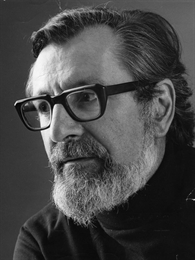
人物1925
Tristram Cary
Tristram Ogilvie Cary, OAM, was a pioneering English-Australian composer. He was also active as a teacher and music critic.
人物1925
Tristram Ogilvie Cary, OAM, was a pioneering English-Australian composer. He was also active as a teacher and music critic.
この項目を含む事件ファイルで情報と関係を見てみましょう。
この項目を含む事件ファイルはまだありません。
この項目から調査する最初のコメントをお待ちしています。
Tristram Ogilvie Cary, OAM, was a pioneering English-Australian composer. He was also active as a teacher and music critic.
Tristram Ogilvie Cary, OAM (14 May 1925 – 24 April 2008), was a pioneering English-Australian composer. He was also active as a teacher and music critic.
Cary was born in Oxford, England, and educated at the Dragon School in Oxford and Westminster School in London. He was the third son and child of a pianist and the Ulster-born novelist Joyce Cary, author of Mister Johnson. While working as a radar engineer for the Royal Navy during World War II, he independently developed his own conception of electronic and tape music, and is regarded as being amongst the earliest pioneers of these musical forms.
Following World War II, he created one of the first electronic music studios, later travelling around Europe to meet the small numbers of other early pioneers of electronic music and composition. He studied arts at the University of Oxford and went on to study composition, conducting, piano, viola and horn at Trinity College London.
With Peter Zinovieff and David Cockerell, he founded Electronic Music Studios (London) Ltd, which created the first commercially available portable synthesiser, the EMS VCS 3, and was then involved in the production of such distinctive EMS products as the EMS Synthi 100.
In 1967 he created an electronic music studio at the Royal College of Music. This led to an invitation from the University of Melbourne in 1973 for a lecture tour, which in turn led to an invitation to become the Visiting Composer at the University of Adelaide in 1974. He remained there as a lecturer until 1986. He also wrote music criticism for The Australian.
His concert works of note include a Sonata for guitar (1959), Continuum for tape (1969), a cantata Peccata Mundi (1972), Contours and Densities at First Hill for orchestra (1972), a Nonet (1979), String Quartet No. 2 (1985) and The Dancing Girls for orchestra (1991).
Cary is also particularly well known for his film and television music. He wrote music for the science fiction television series Doctor Who (including the first Dalek story), as well as the score for the Ealing comedy The Ladykillers (1955). Later film scores included The Boy Who Stole a Million (1960); The Prince and The Pauper (1962); Sammy Going South (1963); Quatermass and the Pit (1967) and Blood from the Mummy's Tomb (1971), both for Hammer. He also composed the score for the ABC TV animated version of A Christmas Carol. and the children's animated special Katya and the Nutcracker.
Cary was one of the first British composers to work in musique concrète. In 1967 he created the first electronic music studio of the Royal College of Music. He built another at his home in Fressingfield, Suffolk which he transported to Australia when he emigrated there, and incorporated it into the where he worked as a lecturer until 1986.
Cary died in Adelaide, South Australia, on 24 April 2008, aged 82.
Cary won the 1977 Albert H. Maggs Composition Award. He was awarded the Medal of the Order of Australia in 1991 in recognition of service to music. He also received the 2005 lifetime achievement award from the Adelaide Critics' Circle for his contribution to music in England and Australia.
Divertimento (1973) – for Olivetti machines, 16 singers and jazz drummer (1973) (10') Commissioned by Olivetti for the opening of a new training centre at Haslemere, England (designed by the world-famous architect James Stirling) as (a) part of a 'Venetian' concert conducted by Cary himself, and (b) the sound track of a film. Described by Cary as "friendly, undemanding music" which nevertheless he was nervous about performing, since the audience was composed of VIPs and included Yehudi Menuhin. The text of the piece consists of cardinal numbers in four languages. The performance: Premiered 21 June 1973 at Haslemere HQ of Olivetti, though the film version had already been previously recorded. Performed again in Adelaide 1974. Cary also extracted a piece from it without vocals – "Tracks from Divertimento" – in 1978. It is published on a disc – "Full Spectrum" (MOVE Records MS3027). The original Haslemere personnel were the Ambrosian Singers and Chris Karan (drums).
Two Nativity Songs from the Piae Cantiones (arr.) (1979)
I Am Here Soprano and Tape (1980)
Earth Hold Songs Soprano and Piano (1993)
Songs for Maid Marian Soprano, Piano (1959/98)
出典: Tristram Cary (CC BY-SA)
構造化された情報、ユーザーの意見、AIが抽出した関係を区別して表示します。
He provided the visual design for the EMS VCS3 synthesizer.