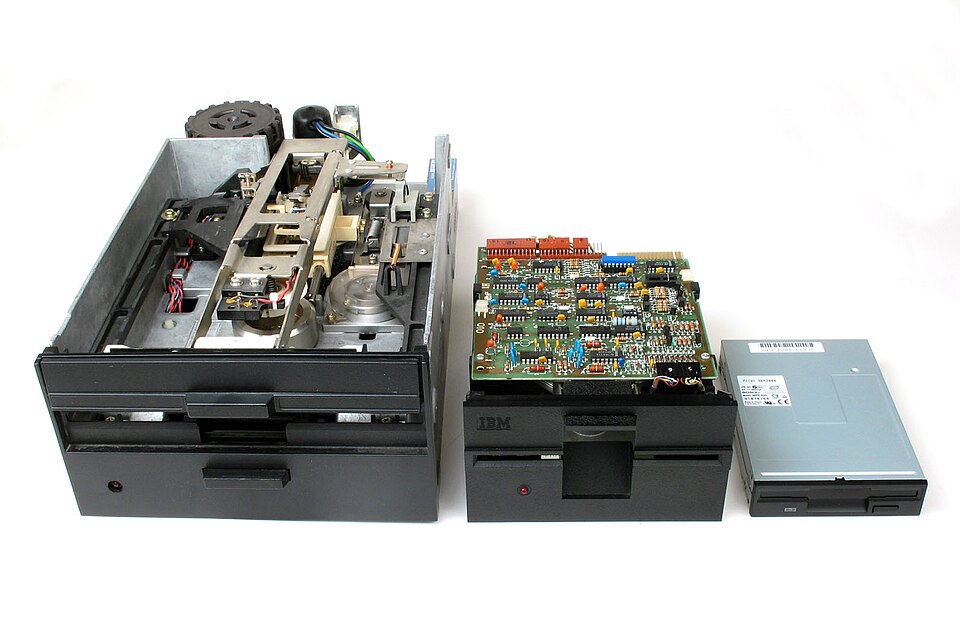
A floppy disk, diskette, or floppy diskette is a type of disk storage made from a thin, flexible disk coated with a magnetic storage medium. It is enclosed in a square or nearly square plastic shell lined with fabric to help remove dust from the spinning disk. Floppy disks store digital data, which can be read or written when inserted into a floppy disk drive (FDD) connected to or built into a computer or other device. The three most popular formats of floppy disks are the 8-inch, 5¼-inch, and 3½-inch versions.
A floppy disk, diskette, or floppy diskette is a type of disk storage made from a thin, flexible disk coated with a magnetic storage medium. It is enclosed in a square or nearly square plastic shell lined with fabric to help remove dust from the spinning disk. Floppy disks store digital data, which can be read or written when inserted into a floppy disk drive (FDD) connected to or built into a computer or other device. The three most popular formats of floppy disks are the 8-inch, 5¼-inch, and 3½-inch versions.
詳しい紹介を読む
A floppy disk, diskette, or floppy diskette is a type of disk storage made from a thin, flexible disk coated with a magnetic storage medium. It is enclosed in a square or nearly square plastic shell lined with fabric to help remove dust from the spinning disk. Floppy disks store digital data, which can be read or written when inserted into a floppy disk drive (FDD) connected to or built into a computer or other device. The three most popular formats of floppy disks (and their drives) are the 8-inch, 5¼-inch, and 3½-inch versions.
The first floppy disks, invented and made by IBM in 1971, had a disk diameter of 8 inches (200 mm). Subsequently, the 5¼-inch (130 mm) and then the 3½-inch (90 mm) became a ubiquitous form of data storage and data transfer into the first years of the 21st century. By the end of the 1980s, 5¼-inch (130 mm) disks had been superseded by 3½-inch (90 mm) disks. During this time, PCs frequently came equipped with drives of both sizes. By the mid-1990s, 5¼-inch drives had virtually disappeared, the 3½-inch disk became the dominant format. The advantages of the 3½-inch (90 mm) disk were its higher capacity, smaller physical size, and its rigid case which provided better protection from dirt and other environmental risks.
Floppy disks were so common in late 20th-century culture that many electronic and software programs continue to use save icons that look like floppy disks well into the 21st century, as a form of skeuomorphic design. While floppy disk drives still have some limited uses, especially with legacy industrial computer equipment, they have been superseded by data storage methods with much greater data storage capacity and data transfer speed, such as USB flash drives, memory cards, optical discs, and storage available through local computer networks and cloud storage.
Categories
Industry observers categorize floppy disks and floppy disk drives according to size and capacity with four major categories being 8 inches (200 mm), 5.25 inches (130 mm), 3.5 inches (90 mm) and high-capacity floppy disks and floppy disk drives.
There were in addition, variant products that did not fit these categories. The distinguishing characteristic between the high-capacity products and their lower capacity brethren, frequently categorized as standard floppies, was the use of servomechanisms to increase the number of tracks and thereby increase capacity.
The four categories each represented generations; from the beginning each generation had substantially greater market success and ultimately succeeded the previous one, but the high-capacity floppy generation, although having some success, was never as successful as the prior 3½-inch (90 mm) generation, and became essentially obsolete by 2011.
8-inch
The first commercial floppy disks, developed in the late 1960s, were 8 inches (200 mm) in diameter; they became commercially available in 1971 as a component of IBM products and both drives and disks were then sold separately starting in 1972 by Memorex and others. These disks and associated drives were produced and improved upon by IBM and other companies such as Memorex, Shugart Associates, and Burroughs Corporation. The term "floppy disk" appeared in print as early as 1970, and although IBM announced its first media as the Type 1 Diskette in 1973, the industry continued to use the terms "floppy disk" or "floppy".
Floppy disks of the first standard are 8 inches (200 mm) in diameter, protected by a flexible plastic jacket. It was a read-only device used by IBM as a way of loading microcode. Read/write floppy disks and their drives became available in 1972, but it was IBM's 1973 introduction of the 3740 data entry system that began the establishment of floppy disks, called by IBM the Diskette 1, as an industry standard for information interchange. Diskettes formatted for this system stored 242,944 bytes. Early microcomputers used for engineering, business, or word processing often used one or more 8-inch disk drives for removable storage; the CP/M operating system was developed for microcomputers with 8-inch drives.
5¼-inch
In 1976, Shugart Associates introduced the 5.25-inch (130 mm) floppy disk drive. By 1978, there were more than ten manufacturers producing such drives. There were competing floppy disk formats, with hard- and soft-sector versions and enc
While the original IBM 8-inch (200 mm) disk was actually so defined, the other sizes are defined in millimeters, their names being but rough approximations.
Different sizes of floppy disks are mechanically incompatible, and disks can fit only one size of drive. Drive assemblies with both 3.5 inches (90 mm) and 5.25 inches (130 mm) slots were available during the transition period between the sizes, but they contained two separate drive mechanisms. As computer platforms began to form, attempts were made at interchangeability. Apple's later 1.44 MB high-density 3.5 inches (90 mm) drives (marketed as the SuperDrive) could read, write, and format IBM PC–compatible floppy disks. However, few IBM-compatible computers were able to read or write Apple-formatted floppy disks. The limitation was due not to the 3.5 inches (90 mm) drive mechanism itself, but to the disk controller and its lack of support for Apple's GCR (Group Coded Recording) encoding used on 400 kB and 800 kB Macintosh disks.
8 in (200 mm), 5.25 in (130 mm) and 3.5 in (90 mm) drives were manufactured in a variety of sizes, most to fit standardized drive bays. Alongside the common disk sizes were non-classical sizes for specialized systems.
The family of 8-inch (200 mm) disks and drives increased over time and later versions could store up to 1.2 MB; many microcomputer applications did not need that much capacity on one disk, so a smaller size disk with lower-cost media and drives was feasible. The 5.25-inch (130 mm) drive succeeded the 8-inch (200 mm) in many applications, and developed to the same storage capacity as the larger 8-inch (200 mm) size, using higher-density media and recording techniques.