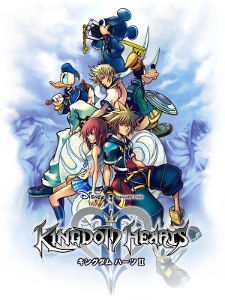
Kingdom Hearts II is a 2005 action role-playing game developed and published by Square Enix in collaboration with Buena Vista Games for the PlayStation 2. The game is a sequel to Kingdom Hearts, and like the original game, combines characters and settings from Disney films with those of Square Enix's Final Fantasy series. An expanded re-release of the game featuring new and additional content, Kingdom Hearts II Final Mix, was released exclusively in Japan in March 2007. The Final Mix version of the game was later remastered in high definition and released globally as part of the Kingdom Hearts
Kingdom Hearts II is a 2005 action role-playing game developed and published by Square Enix in collaboration with Buena Vista Games for the PlayStation 2. The game is a sequel to Kingdom Hearts, and like the original game, combines characters and settings from Disney films with those of Square Enix's Final Fantasy series. An expanded re-release of the game featuring new and additional content, Kingdom Hearts II Final Mix, was released exclusively in Japan in March 2007. The Final Mix version of the game was later remastered in high definition and released globally as part of the Kingdom Hearts
詳しい紹介を読む
Kingdom Hearts II is a 2005 action role-playing game developed and published by Square Enix in collaboration with Buena Vista Games for the PlayStation 2. The game is a sequel to Kingdom Hearts, and like the original game, combines characters and settings from Disney films with those of Square Enix's Final Fantasy series. An expanded re-release of the game featuring new and additional content, Kingdom Hearts II Final Mix, was released exclusively in Japan in March 2007. The Final Mix version of the game was later remastered in high definition and released globally as part of the Kingdom Hearts HD 2.5 Remix collection for the PlayStation 3, PlayStation 4, Xbox One, Windows, and Nintendo Switch.
Kingdom Hearts II is the second main installment in the Kingdom Hearts series, and the third game overall, taking place one year after the events of Kingdom Hearts: Chain of Memories. Sora, the protagonist of the first two games, returns to search for his lost friends while battling the sinister Organization XIII, a group of antagonists previously introduced in Chain of Memories. Like previous games, Kingdom Hearts II features a large cast of characters from Disney and Square Enix properties.
Concepts for Kingdom Hearts II began during the end of development of Kingdom Hearts Final Mix, with the game entering full development in 2003 and being announced at Tokyo Game Show 2003. Most of the first game's development team returned, including director Tetsuya Nomura, with the game being developed concurrently with Chain of Memories. In developing Kingdom Hearts II, the development team sought to address user feedback from the first game, give the player more freedom and options in combat and present a deeper and more mature plot.
The game was released to a very positive reaction from critics; earning several awards upon release. Reviewers praised the visuals, soundtrack, voice acting, and emotional weight, but assessments of the gameplay and narrative were mixed. In both Japan and North America, it shipped more than one million copies within weeks of its release, with over four million worldwide by April 2007. It has been cited as one of the greatest video games of all time.
Gameplay
The gameplay of Kingdom Hearts II is similar to the action RPG and hack and slash gameplay of the first Kingdom Hearts game, though developers made an effort to address some of the complaints of no map and camera bugs with the previous game. The player directly controls Sora from a third-person camera angle, though it is possible to switch to a first-person perspective by pressing the Select button. Most of the gameplay occurs on interconnected field maps where battles take place. The game is driven by a linear progression from one story event to the next, usually told via cutscenes, though there are numerous side-quests available that provide bonuses to characters.
Drive Gauge
One of the new features is a meter known as the "Drive Gauge". which has two functions: to transform Sora into a "Drive Form" or to summon a special character. While in a Drive Form, Sora bonds with party members to become more powerful and acquire different attributes; all but two Forms also allow the use of two Keyblades. When a Drive is executed, Sora's combat statistics are heightened. Drive Forms also give Sora new abilities that can be used in normal form, called "Growth Abilities". Sora's first two Drive Forms only combine power with one party member; later-obtained Drive Forms require him to bond with both party members. When allies are used in a Drive, they are temporarily removed from battle for its duration. Unlike the HP and MP gauges, the Drive Gauge is not refilled at save points.
Like in the first game, Sora can summon a Disney character to aid him in battle. Summons will replace the two computer-controlled characters and fight alongside Sora for as long as the Drive Gauge allows, or until Sora's HP runs out. In
Like many traditional role-playing video games, Kingdom Hearts II features an experience point system which determines character development. As enemies are defeated, the player and allies gain experience to "level up", allowing them to grow stronger and gain access to new abilities.
Combat in Kingdom Hearts II takes place in real-time and involves hack and slash elements with button presses which initiate attacks by the on-screen character. A role-playing game menu on the screen's bottom left, similar to those found in Final Fantasy games, provides other combat options, such as using magic or items, summoning beings to assist in battle, or executing combination attacks with other party members. A new feature is the "Reaction Command", special enemy-specific attacks that are triggered when the player presses the triangle button at the correct time during battle. Reaction Commands can be used to defeat regular enemies or avoid damage, and are sometimes necessary to complete a boss battle. In addition to the main character, two party members are usually present who also participate in combat. Although these characters are computer-controlled, the player is allowed to customize their behavior to a certain extent through the menu screen, such as attacking the same enemy Sora targets.
In response to criticism, the "Gummi Ship" feature of the first game was re-imagined to be "more enjoyable". Although retaining its basic purpose of travel, the system was completely redone to resemble a combination of rail shooter and "Disney theme park ride". In the world map, the player now controls the Gummi Ship from a top-down view to fly to the world they wish to enter. Worlds are no longer open from the beginning—the player must unlock the routes to them by entering a new level, controlling the ship from a third-person point of view, and battling enemy ships. After the route is opened, travel to the world is unimpeded, unless it is blocked again due to a plot-related event. The player may also gain new Gummi Ships from completing routes, which is also a new feature.