
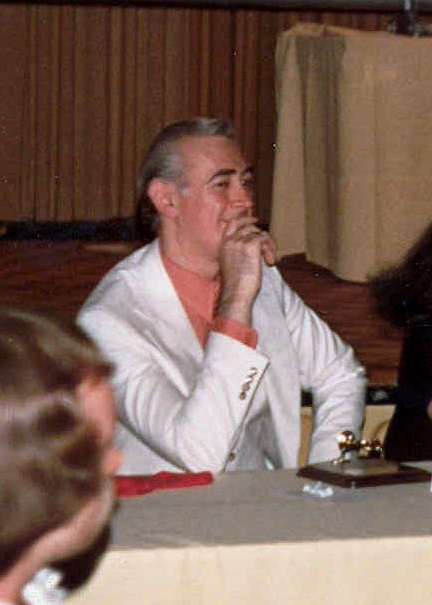
人物1926
ギル・ケイン
Gil Kane
Gil Kane was an American comics artist whose career spanned the 1940s to the 1990s and virtually every major comics company and character.
人物1926
Gil Kane
Gil Kane was an American comics artist whose career spanned the 1940s to the 1990s and virtually every major comics company and character.
この項目を含む事件ファイルで情報と関係を見てみましょう。
この項目を含む事件ファイルはまだありません。
この項目から調査する最初のコメントをお待ちしています。
Gil Kane was an American comics artist whose career spanned the 1940s to the 1990s and virtually every major comics company and character.
Gil Kane (; born Eli Katz , Latvian: Elija Kacs; April 6, 1926 – January 31, 2000) was an American comics artist whose career spanned the 1940s to the 1990s and virtually every major comics company and character.
Kane co-created the modern-day versions of the superheroes Green Lantern and the Atom for DC Comics, and co-created Iron Fist and Adam Warlock with Roy Thomas for Marvel Comics. He was involved in the anti-drug storyline in The Amazing Spider-Man #96–98, which, at the behest of the U.S. Department of Health, Education, and Welfare, bucked the then-prevalent Comics Code Authority to depict drug abuse, and ultimately spurred an update of the Code. Kane additionally pioneered an early graphic novel prototype, His Name Is... Savage, in 1968, and a seminal graphic novel, Blackmark, in 1971.
In 1997, he was inducted into both the Will Eisner Comic Book Hall of Fame and the Harvey Award Jack Kirby Hall of Fame.
In the late 1950s, freelancing for DC Comics precursor National Comics, Kane illustrated works in what fans and historians call the Silver Age of Comic Books, creating character designs for the modern-day version of the 1940s superhero Green Lantern, for which he pencilled most of the first 75 issues of the reimagined character's comic. Comics historian Les Daniels praised Kane's work on the character, stating "The design was part of an approach that emphasized grace as well as strength, an approach especially notable in Kane's flying scenes ... Green Lantern appeared to soar effortlessly across the cosmos." DC Comics writer and executive Paul Levitz noted in 2010 that Kane "modeled the Guardians on Israeli founding father David Ben-Gurion, even as the human figures in the cast tended to mimic Kane's own tall, elongated build." Kane and writer John Broome's stories for the Green Lantern series included transforming Hal Jordan's love interest, Carol Ferris, into the Star Sapphire in issue #16. Black Hand, a character featured prominently in the "Blackest Night" storyline in 2009–2010, debuted in issue #29 (June 1964) by Broome and Kane. The creative team created Guy Gardner in the story "Earth's Other Green Lantern!" in issue #59 (March 1968).
Kane similarly co-created an updated version of the Atom with writer Gardner Fox. Kane — who by 1960 was living in Jericho, New York, on Long Island — also drew the youthful superhero team the Teen T
出典: Gil Kane (CC BY-SA)
構造化された情報、ユーザーの意見、AIが抽出した関係を区別して表示します。
Gil Kane was born Eli Katz (Latvian: Elija Kacs) on April 6, 1926, in Latvia to a Jewish family who immigrated to the U.S. in 1929, settling in Brooklyn, New York City. His father was a struggling poultry merchant. Kane attended high school at Manhattan's School of Industrial Art, but left in his senior year when he saw an opportunity to work at MLJ Comics (later Archie Comics). He recalled in a 1996 interview,
[F]rom the time I was 15, I was going up to the comics offices. ... My first job came the next year at 16. During my summer vacation [between years of high school], I went up and got a job working at MLJ in 1942 ... I was in my last year in high school [when I left]. I was 16 and I'd already started my last year but I'd already gotten my job the summer before at MLJ, so I didn't want to give up my job. I quit school in the last grade.
Until being fired after three weeks, Kane worked in production, "putting borders on pages. The letterers would only put in the lettering, not the balloons, so I would put in the borders, balloons, and I'd finish up artwork—whatever had to be done on a lesser scale." Within "a couple of days" of being let go, "I got a job with Jack Binder's agency. Jack Binder had a loft on Fifth Avenue and it just looked like an internment camp. There must have been 50 or 60 guys up there, all at drawing tables. You had to account for the paper that you took." Kane began penciling professionally there, but, "They weren't terribly happy with what I was doing. But when I was rehired by MLJ three weeks later, not only did they put me back into the production department and give me an increase, they gave me my first job, which was 'Inspector Bentley of Scotland Yard' in Pep Comics, and then they gave me a whole issue of The Shield and Dusty, one of their leading books". He would also do spot illustrations for other studios.
His earliest known credit is inking Carl Hubbell on the six-page Scarlet Avenger superhero story "The Counterfeit Money Code" in MLJ's Zip Comics #14 (cover-dated May 1941), on which he signed the name "Gil Kane". Other early credits include some issues of the company's Pep Comics, sometimes under pseudonyms including Stack Til and Stacktil, and, in conjunction with artist Pen Shumaker, Pen Star. He even used his birth name on rare occasions, including on at least one story each in the Temerson / Helnit / Continental publishing group's Terrific Comics and Cat-Man Comics.
In 1944 he did his first work for the future Marvel Comics, as one of two inkers on the 28-page "The Spawn of Death" in the wartime kid-gang comic Young Allies #11 (March 1944), and the future DC Comics, as the uncredited ghost artist for Jack Kirby on the Sandman superhero story "Courage a la Carte" in Adventure Comics #91 (May 1944). That same year Kane either was drafted or enlisted in the Army and served in the World War II Pacific theater of operations. After 19 months in the service, he returned to in December 1945. All-American Publications editor Sheldon Mayer hired him in 1947, for a stint that lasted six months. He contributed again to the "Sandman" feature in Adventure Comics and, as penciler Gil Stack and inker Phil Martel, to the "Wildcat" feature in Sensation Comics. Around this time, he said, he "worked with director Garson Kanin when he was involved in TV", drawing storyboards.
In 1949, Kane began a longtime professional relationship with Julius Schwartz, an editor at National Comics, the future DC Comics. Kane drew stories for several DC series in the 1950s including All-Star Western and The Adventures of Rex the Wonder Dog.