
項目
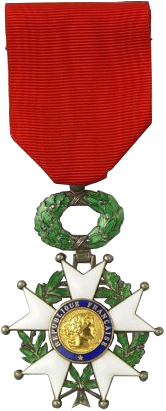
レジオンドヌール勲章シュヴァリエ
Knight of the Legion of Honour
レジオンドヌール勲章の最下位
項目
Knight of the Legion of Honour
レジオンドヌール勲章の最下位
この項目を含む事件ファイルで情報と関係を見てみましょう。
この項目を含む事件ファイルはまだありません。
この項目から調査する最初のコメントをお待ちしています。
レジオンドヌール勲章の最下位
The National Order of the Legion of Honour (French: Ordre national de la Légion d'honneur [ɔʁdʁ nɑsjɔnal d(ə) la leʒjɔ̃ dɔnœʁ] ), formerly the Imperial Order of the Legion of Honour (Ordre impérial de la Légion d'honneur), is the highest and most prestigious French national institution, both military and civil. It consists of five classes and was originally established in 1802 by Napoleon Bonaparte. The order has been retained, with occasional minor alterations, by all subsequent French governments and regimes.
The order's motto is Honneur et Patrie ("Honour and Fatherland"); its seat is the Palais de la Légion d'Honneur next to the Musée d'Orsay, on the left bank of the Seine in Paris. Since 1 February 2023, the Order's grand chancellor has been retired general François Lecointre.
The order is divided into five degrees of increasing distinction: Chevalier (Knight), Officier (Officer), Commandeur (Commander), Grand officier (Grand Officer) and Grand-croix (Grand Cross).
While prestigious, the Legion of Honour has sometimes been controversial. The order of merit has been awarded to Harvey Weinstein, Mohammed bin Nayef, Vladimir Putin, Bashar al-Assad, and Manuel Noriega. In 2010, the order's rules were changed to revoke Noriega's award after his extradition to France due to his conviction for money laundering. In 2017, further reforms to the award were made.
Notable individuals who have refused the award include Marjane Satrapi, Albert Camus, and Jean-Paul Sartre.
During the French Revolution, all of the French orders of chivalry were abolished and replaced with weapons of honour. It was the wish of Napoleon Bonaparte, the First Consul, to create a reward to commend civilians and soldiers. From this wish was instituted a Légion d'honneur, a body of men that was not an order of chivalry, for Napoleon believed that France wanted a recognition of merit rather than a new system of nobility. However, the Légion d'honneur did use the organization of the old French orders of chivalry, for example, the Ordre de Saint-Louis. The insignia of the Légion d'honneur bear a resemblance to those of the Ordre de Saint-Louis, which also used a red ribbon.
In a decree issued on the 10 Pluviôse XIII (30 January 1805), a grand decoration was instituted. This decoration, a cross on a large sash and a silver star with an eagle, symbol of the Napoleonic Empire, became known as the Grand aigle (Grand Eagle), and later in 1814 as the Grand cordon (big sash, literally "big ribbon"). After Napoleon crowned himself Emperor of the French in 1804 and established the Napoleonic nobility in 1808, award of the Légion d'honneur gave right to the title of "Knight of the Empire" (Chevalier de l'Empire). The title was made hereditary after three generations of grantees.
Napoleon had dispensed 15 golden collars of the Légion d'honneur among his family and his senior ministers. This collar was abolished in 1815.
Although research is made difficult by the loss of the archives, it is rumoured that three women who fought with the army were decorated with the order: Virginie Ghesquière, Marie-Jeanne Schelling and a nun, Sister Anne Biget.
The Légion d'honneur was prominent and visible in the French Empire. The Emperor always wore it, and the fashion of the time allowed for decorations to be worn most of the time. The king of Sweden therefore declined the order; it was too common in his eyes. Napoleon's own decorations were captured by the Prussians and were displayed in the Zeughaus (armoury) in Berlin until 1945. Today, they are in Moscow.
Louis XVIII changed the appearance of the order, but it was not abolished. To have done so would have angered the 35,000 to 38,000 members. The images of Napoleon and his eagle were removed and replaced by the image of King Henry IV, the popular first king of the Bourbon line. Three Bourbon fleurs-de-lys replaced the eagle on the reverse of the order. A king's crown replaced the imperial crown. In 1816, the grand cordons were renamed grand crosses and the legionnaires became knights. The king decreed that the commandants were now commanders. The Légion d'honneur beca
出典: Legion of Honour (CC BY-SA)
構造化された情報、ユーザーの意見、AIが抽出した関係を区別して表示します。
Napoleon originally created this award to ensure political loyalty. The organization would be used as a façade to give political favours, gifts, and concessions. The Légion d'honneur was loosely patterned after a Roman legion, with legionaries, officers, commanders, regional "cohorts" and a grand council. The highest rank was not a Grand Cross but a Grand aigle (Grand Eagle), a rank that wore the insignia common to a Grand Cross. The members were paid, the highest of them extremely generously:
5,000 francs to a grand officier,
2,000 francs to a commandeur,
1,000 francs to an officier,
250 francs to a légionnaire.
Napoleon famously declared, "You call these baubles, well, it is with baubles that men are led... Do you think that you would be able to make men fight by reasoning? Never. That is good only for the scholar in his study. The soldier needs glory, distinctions, rewards." This has been often quoted as "It is with such baubles that men are led." Napoleon was also occasionally noted after a battle to ask who the bravest man in a regiment was, and upon the regiment declaring the individual, the Emperor would take the Legion d'honneur from his own coat and pin it on the chest of the man.
The order was one of the first modern orders of merit. Under the monarchy, such orders were often limited to Roman Catholics, all knights had to be noblemen, and military decorations were restricted to officers. The Légion d'honneur, however, was open to men of all ranks and professions; only merit or bravery counted. The only similar modern order, open to everyone, to predate it was the Swedish Order of Vasa. The new legionnaire had to be sworn into the Légion d'honneur. All previous orders were Christian, or shared a clear Christian background, whereas the Légion d'honneur is a secular institution. The badge of the Légion d'honneur has five arms.
つながりがいつ生まれ、いつ変わったかを日付順に並べています。お知らせ投稿と出典の日付から作ります。
レジオンドヌール勲章シュヴァリエ 受賞者・作品 ハーヴェイ・ワインスタイン
レジオンドヌール勲章シュヴァリエ 受賞者・作品 ハーヴェイ・ワインスタイン