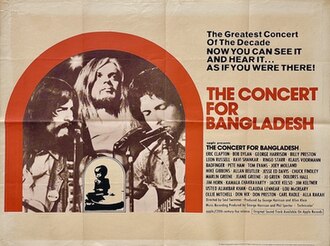
The Concert for Bangladesh is a film directed by Saul Swimmer and released in 1972. The film documents the two benefit concerts that were organised by George Harrison and Ravi Shankar to raise funds for refugees of the Bangladesh Liberation War, and were held on Sunday, 1 August 1971 at Madison Square Garden in New York City. As well as notable performances from Harrison and Shankar, the film includes "main performer" contributions from Harrison's fellow ex-Beatle Ringo Starr, Billy Preston and Leon Russell, and a surprise walk-on from Bob Dylan. Other contributing musicians include Ali Akbar
The Concert for Bangladesh is a film directed by Saul Swimmer and released in 1972. The film documents the two benefit concerts that were organised by George Harrison and Ravi Shankar to raise funds for refugees of the Bangladesh Liberation War, and were held on Sunday, 1 August 1971 at Madison Square Garden in New York City. As well as notable performances from Harrison and Shankar, the film includes "main performer" contributions from Harrison's fellow ex-Beatle Ringo Starr, Billy Preston and Leon Russell, and a surprise walk-on from Bob Dylan. Other contributing musicians include Ali Akbar
詳しい紹介を読む
The Concert for Bangladesh is a film directed by Saul Swimmer and released in 1972. The film documents the two benefit concerts that were organised by George Harrison and Ravi Shankar to raise funds for refugees of the Bangladesh Liberation War, and were held on Sunday, 1 August 1971 at Madison Square Garden in New York City. As well as notable performances from Harrison and Shankar, the film includes "main performer" contributions from Harrison's fellow ex-Beatle Ringo Starr, Billy Preston and Leon Russell, and a surprise walk-on from Bob Dylan. Other contributing musicians include Ali Akbar Khan, Eric Clapton, the band Badfinger, Klaus Voormann, Jesse Ed Davis, Jim Horn and Jim Keltner.
The film was the final part of Harrison's "pioneering" aid project for the people of former East Pakistan, following his "Bangla Desh" charity single, the UNICEF benefit concerts, and a triple live album of the event credited to "George Harrison and Friends". The Concert for Bangladesh was produced by The Beatles' Apple Films; after delays caused by problems with inadequate footage from the event, it opened in US cinemas in the spring of 1972. The film was released on DVD in 2005 accompanied by a newly created documentary feature, The Concert for Bangladesh Revisited with George Harrison and Friends, which included recollections from many of the project's participants and contextual input from then UN secretary-general Kofi Annan, US Fund for UNICEF president Charles Lyons and Live Aid founder Bob Geldof.
As with the live album, sales of the DVD release of the film continue to benefit the George Harrison Fund for UNICEF.
Production
Saul Swimmer's Concert for Bangladesh documentary combined footage from both of the Madison Square Garden shows held on 1 August 1971, using George Harrison's preference of the performances of the songs. Harrison later explained that much of the concert footage was unusable, as a camera on the right-hand side of the venue was faulty and out of focus throughout, while the one opposite, down the left side, had cables hanging down in front of it. The compromised quality would result in some brutal edits in the released movie – Eric Clapton, for instance, appears to change jackets and guitar part-way through a song (Leon Russell's medley in particular). In an interview accompanying the 2005 DVD release of the film, Swimmer would cite the audio syncing and the frame-by-frame conversion to 70mm format (from the original 16mm) as other challenging, labour-intensive tasks. With work almost completed on the Concert for Bangladesh live album, Harrison is said to have begun editing the footage on 6 September; at some stage during the next few months, he was joined in this lengthy process by Bob Dylan.
A clip of Harrison's performance of "My Sweet Lord" was previewed during his appearance on ABC-TV's The Dick Cavett Show on 23 November, but the movie would not be ready for release until the following spring.
The opening of the movie features footage from the New York press conference, held at Allen Klein's ABKCO offices five days before the concerts, during which Harrison and Ravi Shankar discuss the upcoming shows. Harrison is asked by a reporter: "With all the enormous problems in the world, how did you happen to choose this one to do something about?" "Because I was asked by a friend if I would help, you know – that's all," is his reply.
The scene then shifts to inside Madison Square Garden, showing musicians and support crew preparing for the first show. In voiceover, Harrison provides a brief explanation of how the project came together.
The concert begins with Harrison taking to the stage alone and addressing the audience, his comment "We've got a good show lined up – well, I hope so anyway ..." alluding to the speed with which the event was organised. He then introduces the first group of musicians, led by Shankar, who, like Harrison, attempts to convey the intricacies of Indian classical music to the audience, as well as outlining the reason for this "special benefit concert". Shankar and Ali Akbar Khan proceed to tune their instruments and then stop after about 30 seconds. The audience, apparently believing they have heard an entire piece, respond with enthusiastic applause, to which Shankar replies: "Thank you, if you appreciate the tuning so much, I hope you will enjoy the playing more." The four musicians then launch into a fifteen-minute dhun.
A brief interlude ensues, consisting of behind-the-scenes footage that shows Phil Spector, Harrison and other performers making their way to the stage. Harrison starts off the rock portion of the concert with a string of songs from his hit album All Things Must Pass. He is backed by a large band, including two drummers, Ringo Starr and Jim Keltner, pianist Leon Russell, organist Billy Preston, Klaus Voormann on bass, two other lead guitarists, Eric Clapton and Jesse Ed Davis, the four members of Badfinger on rhythm guitars and tambourine, a six-piece horn section in matching blue patterned shirts, and a small choir of backing vocalists, a few of whom are also playing percussion. Harrison then turns the concert over to his friends briefly.
Towards the end of Billy Preston's song, "That's the Way God Planned It", Preston gets up from his stool and dances across the stage and back again – much to Harrison's delight. (Like most of the concert visuals and audio, this footage is taken from the evening performance on 1 August.) Starr sings his hit song "It Don't Come Easy" scatting some of the lyrics. Harrison then returns to the spotlight for two of his own numbers, with "While My Guitar Gently Weeps" finishing with a shared Clapton / Harrison solo. Before this, Harrison introduces many of the musicians around him.
With a slight change in personnel, Russell delivers a rock and roll medley of the songs "Jumpin' Jack Flash" and "Young Blood" before Harrison performs an intimate version of another of his Beatles-era songs, "Here Comes the Sun". Harrison now