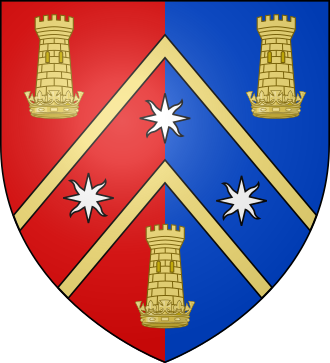
King's College, known informally as King's, is an independent Anglican secondary boarding and day school in New Zealand. It educates over 1,000 pupils aged 13 to 18 years. King's was originally founded as a single-sex boys' school, but has admitted girls in the Sixth and Seventh forms since 1980, and in the Fifth form since 2015.
King's College, known informally as King's, is an independent Anglican secondary boarding and day school in New Zealand. It educates over 1,000 pupils aged 13 to 18 years. King's was originally founded as a single-sex boys' school, but has admitted girls in the Sixth and Seventh forms since 1980, and in the Fifth form since 2015.
詳しい紹介を読む
King's College (Latin: Collegium Regis; Māori: Kīngi Kāreti), known informally as King's, is an independent Anglican secondary boarding and day school in New Zealand. It educates over 1,000 pupils aged 13 to 18 years. King's was originally founded as a single-sex boys' school, but has admitted girls in the Sixth and Seventh forms (Years 12 and 13) since 1980, and in the Fifth form (Year 11) since 2015.
The college was founded on 11 February 1896 by Graham Bruce. Originally situated in the suburb of Remuera, Auckland at a residence known as "The Towers", the school outgrew its grounds and relocated in 1922 to its present site at Middlemore in the South Auckland suburb of Ōtāhuhu. The primary school department remained at the Remuera site, evolving into King's School, Remuera.
Pre-History and Amalgamation (1842–1913)
The deep roots of King's College are linked to early Anglican education in New Zealand through a complex series of school foundations and mergers:
1842: Bishop George Selwyn establishes St John's College at Waimate North.
1845: St John's College moves to West Tamaki with 27–30 pupils under the framework of the Anglican Theological College.
1855: The Church of England Grammar School is founded in Parnell by the Rev. John Kinder, starting with 80 boys.
1882–1883: St John's Collegiate School is opened in West Tamaki with 12 boarders and 42 day boys. By 1883, it becomes a private venture managed by Mr. King with a roll of 80 boys.
1891–1893: Reverend Percy Scott Smallfield becomes Headmaster and proprietor of St John's Collegiate School in 1891. Concurrently, the Church of England Grammar School in Parnell closes down in 1893, and its remaining sale proceeds are transferred into the St John's College Trust.
The Middlemore Migration and Growth (1914–1947)
In 1914, King's College was structured into a public company formed by Auckland citizens, establishing its permanent Board of Governors with Major Charles Thomas Major appointed as Headmaster.
By the end of World War I, severe overcrowding at the Remuera campus prompted action. In 1917, the Board purchased 43 acres of farmland next to the Southern railway line from the Auckland Golf Club. In 1922, the senior school officially moved to this Middlemore site in Ōtāhuhu, while the preparatory school section remained at Remuera to become King's School.
The school roll reached 246 boys by 1927, but the onset of the Great Depression forced structural tightening, dropping the roll back to 161 boys by 1936. The campus rebounded under J.N. Peart, who oversaw the building of the school swimming pool before volunteering for active service in World War II. During the war, the roll climbed sharply to 449 under H.B. Lusk due to heavy wartime demand for quality schooling. A total of 102 Old Collegians lost their lives in World War II, sparking the post-war campaign to build a dedicated Memorial Library.
Post-War Era to Present (1947–present)
The post-war era saw massive infrastructural expansion under G.N.T. Greenbank, who served for a record 26 years. The physical layout of the campus was modernised through the building of five new facilities, including a dedicated science block, physics wing, and new boarding houses.
Co-education was introduced in 1980 under Headmaster I.P. Campbell, starting with an initial intake of 15 senior girls. This required the opening of Middlemore House as a dedicated girls' boarding facility in 1984. Under J. Taylor, the roll grew dynamically to 861 by 2001, supported by a centennial construction drive that added the iconic 300-seat Lecture Theatre. Continued sports and technological developments defined the headmasterships of R. Kelley and B. Fenner into the 21st century.
Academic Curriculum and Pathways
King's College operates a dual-track academic qualification system for senior students. In Year 11, students complete either foundational NCEA Level 1 courses or the International General Certificate of Secondary Education (IGCSE) through Cambridge International Education (CIE). In Years 12 and 13, students choose between the localized National Certificate of Educational Achievement (NCEA) pathway (Levels 2 and 3) or the international Cambridge International pathway (AS and A Levels).
Academic departments cross-track across both pathways, offering specialized curriculum options:
The Arts & Humanities: Courses include Visual Arts (Design, Painting, Photography, Sculpture), Art History, Classical Studies, History, Media Studies, Drama, and Dance.
Languages: Instruction is provided in English Literature, French, Spanish, Latin, and Te Reo Māori.
Sciences: Senior pathways offer specialization in Biology, Chemistry, Physics, and Marine Science, alongside Psychology.
Commerce & Technology: Courses comprise Accounting, Business Studies, Economics, Computer Science, Coding, and Financial Education.
Mathematics: The school offers specialized secondary tracking through localized streams, Statistics, and Accelerated Mathematics (Calculus).
Outdoor Education and Adventure Challenge
A mandatory component of the junior school curriculum is the Adventure Challenge, structured to develop personal resilience, self-reliance, and team problem-solving skills. The outdoor education infrastructure spans three cornerstone expeditions:
Puhoi Adventure Camp: A 7-night wilderness initiative program emphasizing bushcraft, navigation, ropes courses, and river walking.
Steinlager II Expedition: A 3-night blue-water sailing program conducted aboard Steinlager II, Sir Peter Blake's hist
1896: Graham Bruce opens King's College as a separate entity on 11 February 1896 at "The Towers" in Remuera with 78 boys (including 23 boarders) and 5 staff.
1901–1902: Graham Bruce dies at the age of 38, causing the King's College roll to decline significantly. Meanwhile, the St John's College land lease expires, forcing Rev. Smallfield to move his school to a 50-acre property in Onehunga known as "The Pah" (Pah Road), renaming it St John's Collegiate School.
1913: King's College and St John's Collegiate School officially amalgamate on the Remuera site, merging their student bodies and traditions. St John's House at King's College preserves this heritage link.