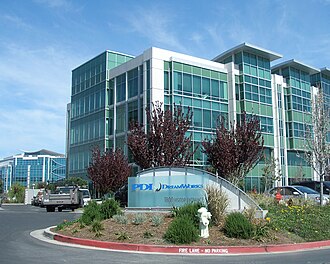
Pacific Data Images (PDI) was an American computer animation and visual effects production company based in Redwood City, California, that was bought by DreamWorks SKG in 2000. It was renamed PDI/DreamWorks and was owned by DreamWorks Animation.
Pacific Data Images (PDI) was an American computer animation and visual effects production company based in Redwood City, California, that was bought by DreamWorks SKG in 2000. It was renamed PDI/DreamWorks and was owned by DreamWorks Animation.
詳しい紹介を読む
Pacific Data Images (PDI) was an American computer animation and visual effects production company based in Redwood City, California, that was bought by DreamWorks SKG in 2000. It was renamed PDI/DreamWorks and was owned by DreamWorks Animation.
Founded in 1980 by Carl Rosendahl, PDI was one of the pioneers of computer animation, it produced more than 700 commercials, contributed visual effects to more than 70 feature films, and produced and contributed to many of DreamWorks Animation's films, beginning with DreamWorks's first film, Antz, in 1998. PDI's final animated film before its closure on January 22, 2015, was Penguins of Madagascar, released on November 26, 2014.
1987–1990: transition
Pacific Data Images's early focus was on network TV productions, for they captured more than 50% of that market in 1985. However, in 1990, PDI introduced the digital film scanning process. This process was used to popularize automated rig removal and image touch-up. PDI was also instrumental in introducing performance animation for theme parks, ads and movies. This started with a joint project in 1988 with Jim Henson's Creature Shop on a real-time performance character named Waldo C
PDI was founded in 1980 by Carl Rosendahl with a $25,000 loan from his father. He was joined in 1981 by Richard Chuang, and in 1982 by Glenn Entis. Richard and Glenn wrote the foundation of the in-house computer animation software that was to be used for the next two decades. They started work on 3D software at 1981's end, and 3D production started in fall 1982. The initial goal of the company was "Entertainment using 3D computer animation".
The first computer at PDI was a DEC PDP 11/44, with 128 kilobytes of memory. This was a lot of memory, given that the computer had only 64 kilobytes (16-bits) of address space. It had a 20 megabyte disc. Attached was a $65,000 framebuffer that had a resolution of 512×512 and was 32 bits deep.
The first 3D image rendered at PDI was done March 12, 1982. The image was simply a 4 by 4 by 4 grid of spheres of varying colors. The spheres were not polygonal; they were implicitly rendered and were fully anti-aliased. The resulting image was 512 by 480 by 24 (8 bits for red, green and blue channels), which took two minutes to render.
The PDP-11 was soon replaced by a DEC VAX-11/780, and PDI shifted to another superminicomputer called the Ridge 32 from Ridge Computers. This machine was 2-to-4 times faster than the VAX-11/780, at a fraction of the cost.
The original in-house software evolved to a large suite of tools that included a polygon scan-line renderer (called p2r), an interactive animation program (called e-motion), an animation scripting and scene-description language (called script), and a lighting tool (called led). All of these tools were written in C and deployed on a variety of machines running various flavors of Unix.
The initial investment to start the company was $250,000 (equivalent to $977,000 in 2025). Its original offices were in Sunnyvale, California, working from a garage owned by Carl's father. PDI moved to its first real offices in 1985, to its second offices in 1995, and to its last location in Redwood City at the Pacific Shores Center in 2002. The growth of the company was financed solely through profit. The company was run as an open book; monthly financial reviews were shared with the entire company, and a detailed monthly financial report was released. Money was never taken out of the company, which maintained a 7% investment in research and development. PDI was debt-free when acquired by DreamWorks in 2000.
Pacific Data Images's first client was Rede Globo, Brazil's largest TV network, owned by Grupo Globo through its current Globo division. This gave PDI the major client it needed to fund the creation of most of its early software. This also sent PDI into the business of TV motion graphics and logo animation. PDI designed some early show openings and other special projects for Rede Globo. The software written was also given to Rede Globo and is the only time the in-house software was given to another company. The contract ended in the mid-1980s, but Rede Globo continued to use the software until 1989.
Most of the 1980s were spent creating broadcast graphics for many television networks around the world. PDI was working concurrently for ABC, A&E, CBS, NBC, HBO, Cinemax, MTV, PBS, VH1, TNT, WOR-TV, Nine Network Australia, Sky One, Showtime and USA Network. PDI focused on direct-to-video production, as opposed to film output being done at other early studios. PDI modified the interface to a Sony BVH-2000 using parts put together from a trip to a toy store to do single-frame recording. All the rendering was done on fields at 60 or 50 frames per second (depending on the video broadcasting standard used locally).
As one of the first mass producers of computer animation, Pacific Data Images controlled a large percentage of this market during this time. One year producing two major networks' graphics packages meant specifically rendered images for over 400 local television stations. Some of the early production contracts included Globo, Entertainment Tonight (produced for Harry Marks), ABC Sports 84 Olympic promos, and NBC News.
Pacific Data Images worked with Atari, also in Sunnyvale, in the early 1980s on a couple of projects. In 1982, Rosendahl was hired to set up and calibrate Atari's computer animation film recorder system that would be used for video game footage in Superman III.
Pacific Data Images proposed a feature-length CG animation film in 1985, but they were unable to raise the funding needed to produce it.
Pacific Data Images outlived all the other computer graphics studios that existed in the early 1980s. One of the reasons for this is that PDI never went into significant debt by purchasing expensive hardware. While other studios purchased or leased supercomputers, PDI bought cheaper hardware, treating it as a commodity which would soon be replaced, enabling lower operating costs.