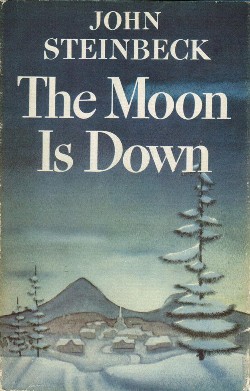
The Moon Is Down is a 1942 novel by American writer John Steinbeck. The book is about the military occupation of a small town in Northern Europe by an unnamed army. Steinbeck wrote it as propaganda intended to fuel resistance movements in occupied countries during World War II. The book was widely bootlegged and adapted for the stage in Europe. The Moon Is Down was adapted into a film by Irving Pichel in 1943.
The Moon Is Down is a 1942 novel by American writer John Steinbeck. The book is about the military occupation of a small town in Northern Europe by an unnamed army. Steinbeck wrote it as propaganda intended to fuel resistance movements in occupied countries during World War II. The book was widely bootlegged and adapted for the stage in Europe. The Moon Is Down was adapted into a film by Irving Pichel in 1943.
詳しい紹介を読む
The Moon Is Down is a 1942 novel by American writer John Steinbeck. The book is about the military occupation of a small town in Northern Europe by an unnamed army. Steinbeck wrote it as propaganda intended to fuel resistance movements in occupied countries during World War II. The book was widely bootlegged and adapted for the stage in Europe. The Moon Is Down was adapted into a film by Irving Pichel in 1943.
The novel's scenario echoed the occupation of Norway by Germany during World War II. Norway awarded Steinbeck the King Haakon VII Freedom Cross for the novel.
Plot summary
Taken by surprise, a small coastal town is overrun by an invading army with little resistance. The town is important because it is a port that serves a large coal mine. Colonel Lanser, the head of the invading battalion, along with his staff establishes their headquarters in the house of Orden, the democratically elected and popular mayor.
Title
The title of the book is a line from William Shakespeare's tragedy Macbeth. As Act II begins, Banquo asks his son Fleance, "How goes the night, boy?" Fleance replies, "The moon is down; I have not heard the clock." Macbeth soon arrives on his way to kill King Duncan. Fleance's simple observation foreshadows the evil that is about to occur. Steinbeck's allusion encapsulated the spiritual darkness of life under Nazi occupation.
The Moon Is Down is also a typical Steinbeck title with its two strongly accented words, as in The Grapes of Wrath or Sea of Cortez. The moon was a powerful, recurring symbol in Steinbeck's fiction.
Invaders
Colonel Lanser: the head of the occupying force; a World War I veteran.
Captain Bentick: old, Anglophile; loves dogs, Christmas and "pink children". Is killed by Alex Morden in a fit of rage while trying to protect Captain Loft.
Major Hunter: the engineer; has a model railroad at home.
Captain Loft: young, ambitious; he lives and breathes the military.
Lieutenant Prackle: apparently a good artist; had several blonde sisters.
Lieutenant Tonder: a poet described as a "dark romantic", is killed by Molly Morden after flirting with her. Dreams of a romantic death in war.
"the Leader": only referred to and never named; modeled on Adolf Hitler.
Townspeople
George Corell: previously popular storekeeper, traitor, and spy who aids the invaders. The character is modeled on Vidkun Quisling, and in galley proofs sent to critics, he was still called Curseling.
Mayor Orden: a man in his sixties, the long-time mayor of the town. He refuses to tell his people to cooperate with the invaders, knowing that they will not.
Dr. Winter: the town doctor and an old friend and adviser of the mayor.
Madame (Sarah): the mayor's wife; often fusses over his appearance.
Joseph: the mayor's servant; frequently witnesses events in the mayor's house.
Annie: the mayor's cook; active in the resistance, but not suspected because of her age.
Alex Morden: kills Captain Bentick in a fit of rage with a pick-axe when he is ordered to work. Meant to attack Captain Loft but Captain Bentick saves Loft. First of the townspeople to be executed. Husband of Molly Morden.
Molly Morden: his wife; leads on and kills Lieutenant Tonder after Alex's death.
Writing
Before the United States entered World War II, John Steinbeck was concerned that Nazi propaganda was too effective. In the summer of 1940, he mused about setting up a propaganda office and discussed the idea with President Franklin D. Roosevelt. He also suggested dropping counterfeit money on the enemy to depress their currency.
Through his work in the Office of the Coordinator of Information (COI), Steinbeck met refugees who shared their experience about life under Nazi occupation. In September 1
As the reality of occupation sinks in and the weather turns bleak, with the snows beginning earlier than usual, the "simple, peaceful people" of the town are angry and confused. Colonel Lanser, a veteran of many wars, tries to operate under a veil of civility and law, but in his heart he knows that "there are no peaceful people" amongst those whose freedom has been taken away by force. The calm is soon torn apart when Alexander Morden, an erstwhile alderman and "a free man", is ordered to work in the mine. He strikes out at Captain Loft with a pickaxe, but Captain Bentick steps into its path and dies of it. After a showtrial, Morden is executed by a firing squad. This incident catalyzes the people of the town and they settle into "a slow, silent, waiting revenge." Sections of the railroad linking the port with the mine get damaged regularly, the machinery breaks down often, and the dynamo of the electricity generators gets short circuited. Whenever a soldier relaxes his guard, drinks or goes out with a woman, he is killed. Mayor Orden stands by his people, and tries to explain to Colonel Lanser that his goal – "to break man's spirit permanently" – is impossible.
The cold weather and the constant fear weighs heavy on the occupying force, many of whom wish the war to end so that they can return home. They realize the futility of the war and describe their victories as "the flies have conquered the flypaper." Some members of the resistance escape to England and ask the English for explosives so that the townspeople can intensify their efforts. English planes parachute-drop small packages containing dynamite sticks and chocolates all around the town. After the collaborator Corell receives an order from Lanser's superiors, the invaders take the mayor and his friend Dr. Winter, the town doctor and historian, hostage and lets it be known that any rebellious action will lead to their execution. Mayor Orden refuses to ask his people to stop active resistance, and feels that nothing can stop his people and that his death is imminent. He tells his wife that while he can be killed, the idea of freedom and democracy is beyond the reach of any army. Before his execution, Mayor Orden reminds Dr. Winter of the dialogues of Socrates in the Apology and Phaedo and tells him to make sure that the resistance continues.