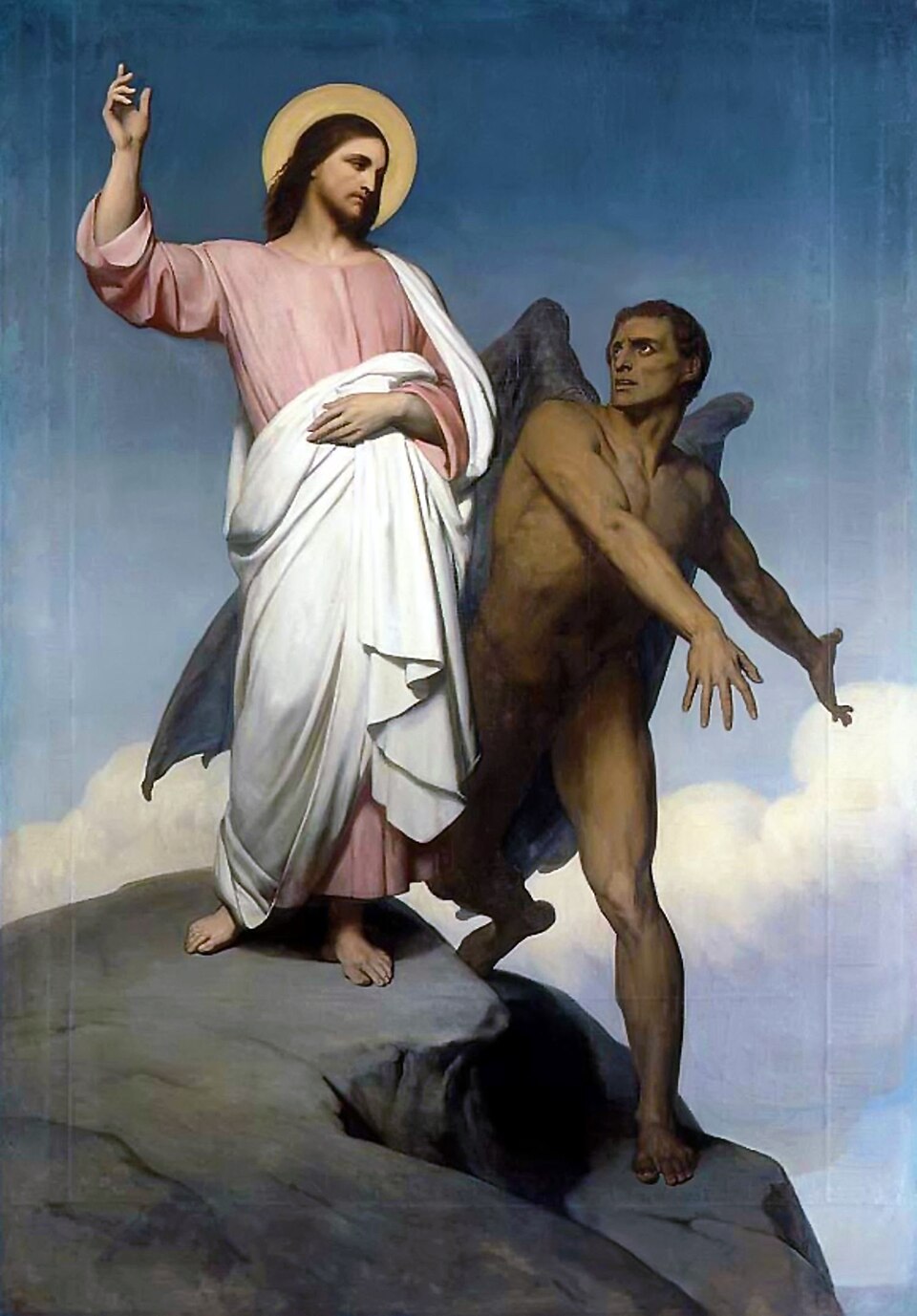
In philosophy, religion, and psychology, "good and evil" is a common dichotomy. In religions with Manichaean and Abrahamic influence, evil is perceived as the dualistic antagonistic opposite of good, in which good should prevail and evil should be defeated.
In philosophy, religion, and psychology, "good and evil" is a common dichotomy. In religions with Manichaean and Abrahamic influence, evil is perceived as the dualistic antagonistic opposite of good, in which good should prevail and evil should be defeated.
詳しい紹介を読む
In philosophy, religion, and psychology, "good and evil" is a common dichotomy. In religions with Manichaean and Abrahamic influence, evil is perceived as the dualistic antagonistic opposite of good, in which good should prevail and evil should be defeated.
Evil is often used to denote profound immorality. Evil has also been described as a supernatural force. Definitions of evil vary, as does the analysis of its motives. However, elements that are commonly associated with evil involve unbalanced behavior involving expediency, selfishness, ignorance, or negligence.
The principal study of good and evil (or morality) is ethics, of which there are three major branches: normative ethics concerning how we ought to behave, applied ethics concerning particular moral issues, and metaethics concerning the nature of morality itself.
History and etymology
Every language has a word expressing good in the sense of "having the right or desirable quality" (ἀρετή) and bad in the sense "undesirable". A sense of moral judgment and a distinction "right and wrong, good and bad" are cultural universals.
Ancient world
The philosopher Zoroaster simplified the pantheon of early Iranian gods into two opposing forces: Ahura Mazda (Illuminating Wisdom) and Angra Mainyu (Destructive Spirit) which were in conflict.
This idea developed into a religion which spawned many sects, some of which embraced an extreme dualistic belief that the material world should be shunned and the spiritual world should be embraced. Gnostic ideas influenced many ancient religions which teach that gnosis (variously interpreted as enlightenment, salvation, emancipation or 'oneness with God') may be reached by practising philanthropy to the point of personal poverty, sexual abstinence (as far as possible for hearers, total for initiates) and diligently searching for wisdom by helping others.
Similarly, in ancient Egypt, there were the concepts of Ma'at, the principle of justice, order, and cohesion, and Isfet, the principle of chaos, disorder, and decay, with the former being the power and principles which society sought to embody where the latter was such that undermined society. This correspondence can also be seen reflected in ancient Mesopotamian religion as well in the conflict between Marduk and Tiamat.
Classical world
In Western civilisation, the basic meanings of κακός and ἀγαθός are "bad, cowardly" and "good, brave, capable", and their absolute sense emerges only around 400 BC, with pre-Socratic philosophy, in particular Democritus. Morality in this absolute sense solidifies in the dialogues of Plato, together with the emergence of monotheistic thought (notably in Euthyphro, which ponders the concept of piety (τὸ ὅσιον) as a moral absolute). The idea was further developed in Late Antiquity by Neoplatonists, Gnostics, and Church Fathers.
This development from the relative or habitual to the absolute is also evident in the terms ethics and morality both being derived from terms for "regional custom", Greek ήθος and Latin mores, respectively (see also siðr).
Medieval period
According to the classical definition of Augustine of Hippo, sin is "a word, deed, or desire in opposition to the eternal law of God."
Many medieval Christian theologians both broadened and narrowed the basic concept of Good and evil until it came to have several, sometimes complex definitions such as:
a personal preference or subjective judgment regarding any issue which might be earn praise or punishment from the religious authorities
religious obligation arising from Divine law leading to sainthood or damnation
a generally accepted cultural standard of behaviour which might enhance group survival or wealth
natural law or behaviour which induces strong emotional reaction
statute law imposing a legal duty
Modern ideas
Today the basic dichotomy often breaks down along these lines:
Good is a broad concept often associated with life, charity, continuity, happiness, love, or justice.
Evil is often associated with conscious and deliberate wrongdoing, discrimination designed to harm others, humiliation of people designed to diminish their psychological needs and dignity, destructiveness, and acts of unnecessary or indiscriminate violence.
The modern English word evil (Old English yfel) and its cognates such as the German Übel and Dutch euvel are widely considered to come from a Proto-Germanic reconstructed form of *ubilaz, comparable to the Hittite huwapp- ultimately from the Proto-Indo-European form *wap- and suffixed zero-grade form *up-elo-. Other later Germanic forms include Middle English evel, ifel, ufel, Old Frisian evel (adjective and noun), Old Saxon ubil, Old High German ubil, and Gothic ubils.
Chinese moral philosophy
In Confucianism and Taoism, there is no direct analogue to the way good and evil are opposed, although references to demonic influence is common in Chinese folk religion. Confucianism's primary concern is with correct social relationships and the behavior appropriate to the learned or superior man. Evil would thus correspond to wrong behavior. Still less does it map into Taoism, in spite of the centrality of dualism in that system, but the opposite of the basic virtues of Taoism (compassion, moderation, and humility) can be inferred to be the analogue of evil in it.
Pyrrhonism
Pyrrhonism holds that good and evil do not exist by nature, meaning that good and evil do not exist within the things themselves. All judgments of good and evil are relative to the one doing the judgi
The nature of being good has been given many treatments; one is that the good is based on the natural love, bonding, and affection that begins at the earliest stages of personal development; another is that goodness is a product of knowing truth. Differing views also exist as to why evil might arise. Many religious and philosophical traditions claim that evil behavior is an aberration that results from the imperfect human condition (e.g. "The Fall of Man"). Sometimes, evil is attributed to the existence of free will and human agency. Some argue that evil itself is ultimately based in an ignorance of truth (i.e., human value, sanctity, divinity). A variety of thinkers have alleged the opposite, by suggesting that evil is learned as a consequence of tyrannical social structures.