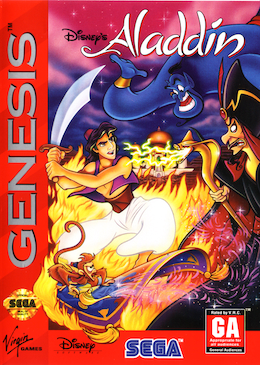
Disney's Aladdin is a 1993 side-scrolling platformer video game developed by Virgin Games and published by Sega for the Genesis. The game is based on the 1992 Walt Disney Animation Studios film of the same name, and features the titular Aladdin navigating settings and scenarios from the film.
Disney's Aladdin is a 1993 side-scrolling platformer video game developed by Virgin Games and published by Sega for the Genesis. The game is based on the 1992 Walt Disney Animation Studios film of the same name, and features the titular Aladdin navigating settings and scenarios from the film.
詳しい紹介を読む
Disney's Aladdin is a 1993 side-scrolling platformer video game developed by Virgin Games and published by Sega for the Genesis. The game is based on the 1992 Walt Disney Animation Studios film of the same name, and features the titular Aladdin navigating settings and scenarios from the film.
The game's development represented Disney's first direct participation in video game production; following sub-standard video game adaptations of their work, they were motivated to produce an adaptation that matched the film's high artistic quality. After an initial attempt with BlueSky Software was abandoned, Disney partnered with Virgin Games, whose digitization techniques for hand-drawn animation enabled the incorporation of over a thousand frames created by Disney animators. This process faithfully reproduced the film's style within the technical limits of 16-bit hardware. The project adhered to a compressed six-month schedule to align with the film's home video release.
Disney's Aladdin received widespread critical praise, particularly for its animation, which reviewers described as unprecedented in cartridge-based games and closely resembling the source film's cartoon fluidity. It achieved strong commercial success, selling over four million copies and becoming one of the best-selling Sega Genesis games. Its accolades and retrospective assessments affirmed it as one of the finest platformers and licensed titles of its era. The quality of the game's graphics prompted Nintendo and Rare's competitive development of Donkey Kong Country (1994), reviving the Donkey Kong franchise.
Gameplay
Disney's Aladdin is a side-scrolling platform game in which the player controls Aladdin throughout settings and a storyline based on the namesake film. Aladdin can slash at enemies at short-range with a scimitar and collect apples throughout the levels to pelt for long-range attacks. Aladdin's health is represented by a trail of smoke emanating from the Genie's lamp on the top-left corner of the screen. The trail shortens whenever Aladdin takes damage from an enemy or environmental hazard. Health can be restored by collecting blue Genie Hearts scattered throughout the levels. If Aladdin runs out of health, a life will be lost. Blue vases within the levels act as checkpoints from which Aladdin will be revived if he had passed one before losing a life. Extra lives can be received by collecting golden icons in the shape of Aladdin's head hidden in the levels. If Aladdin's last life is lost, the player gets a game over. The amount of lives and apples Aladdin is equipped with at the start of the game is determined by the difficulty setting, which can be adjusted in the main menu. Aside from apples, Aladdin can collect gems, which can be traded with the Peddler in each level for extra lives and "wishes." The latter allow the player to continue the game from the current level after losing their last life instead of having to start over from the beginning. On occasion, an area of effect in the form of Jafar's lamp can be found and triggered, which will eliminate all on-screen enemies.
BlueSky Software
Disney's Aladdin, a collaboration among Walt Disney Feature Animation, Virgin Games, and Sega of America, marked Disney's first direct involvement in video game development. Disney wanted to improve the quality of its licensed games after dissatisfaction over prior adaptations like the poorly received Fantasia (1991). Aladdin, Disney's 31st animated feature, was a critical and commercial success, grossing over $200 million and introducing a contemporary, cross-generational appeal with humor and references aimed at adults. Disney sought to replicate this quality in its video game adaptation, requiring a developer capable of matching the film's distinctive aesthetic.
Sega and Capcom respectively licensed Aladdin for the Sega Genesis and SNES following the film's theatrical release. BlueSky Software, who had previously developed Ariel the Little Mermaid (1992), was tasked with developing the Sega version. BlueSky's team of approximately eight began work while the film was in theaters, aiming to capitalize on its popularity. However, their progress was hindered by a focus on Jurassic Park (1993), a higher-priority project with a larger team. Disney producer Patrick Gilmore, who was overseeing the license, found BlueSky's progress inadequate, particularly in capturing the film's curvilinear art style, inspired by caricaturist Al Hirschfeld and lead animator Eric Goldberg's work on the Genie. Only one semi-completed level was produced before Disney canceled the project, citing its failure to meet expectations; BlueSky's effort was considered competent but not exceptional. Afterwards, BlueSky added an Easter egg in Jurassic Park as a reference to their role in Aladdin: a Genie's lamp disguised as a mountain range in the in-game map.
Virgin Games
Disney sought a partner with advanced technology and a commitment to quality animation. At the Consumer Electronics Show (CES), Virgin Games impressed Gilmore with Global Gladiators (1992) and a demo for DynoBlaze, an unprodu
If the player collects one or more Genie Tokens and clears a level, the player will be taken to the "Genie's Bonus Machine," a luck-based minigame in which pressing a button rewards the player with a random prize consisting of a gem, five apples or an extra life. The amount of Genie Tokens collected in a level determines the amount of rounds that can be played in the minigame. When the player runs out of Genie Tokens or if they land on a picture of Jafar, the minigame will end. If the player picks up an Abu Token in two levels, a bonus level featuring Aladdin's pet monkey Abu as the player character will start after the Genie's Bonus Machine. In these levels, the player must maneuver Abu left and right to collect gems, apples, and extra lives that fall to the ground while avoiding pots, rocks, fish, Iago's cousins, palace guards, and other hazards. If Abu comes into contact with a hazard, the bonus level ends.