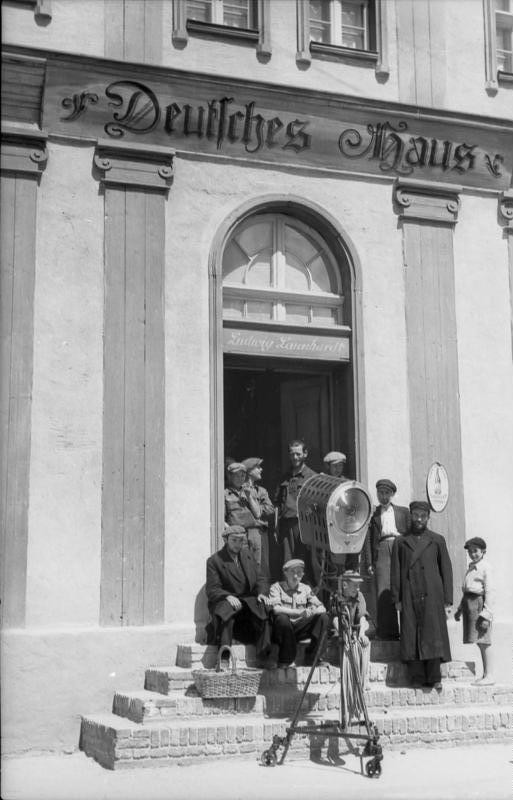
Homecoming is a 1941 Nazi German anti-Polish propaganda film directed by Gustav Ucicky. Filled with heavy-handed caricature, it justifies extermination of Poles with a depiction of relentless persecution of ethnic Germans, who escape death only because of the German invasion.
Homecoming is a 1941 Nazi German anti-Polish propaganda film directed by Gustav Ucicky. Filled with heavy-handed caricature, it justifies extermination of Poles with a depiction of relentless persecution of ethnic Germans, who escape death only because of the German invasion.
詳しい紹介を読む
Homecoming (German: Heimkehr) is a 1941 Nazi German anti-Polish propaganda film directed by Gustav Ucicky. Filled with heavy-handed caricature, it justifies extermination of Poles with a depiction of relentless persecution of ethnic Germans, who escape death only because of the German invasion.
Plot
In the Wołyń Voivodeship in eastern Poland, the German minority is oppressed by the Polish majority. The physician Dr. Thomas does not have any hospital available and his daughter Marie, who teaches at a German school, and needs an important operation, watches when her school is seized by Polish authorities and demolished by an angry mob. Dr. Thomas protests to the mayor, noting the constitutionally guaranteed minority rights; however his protest falls on deaf ears. Marie and her fiancé, Dr. Fritz Mutius, drive to the provincial capital, in order to put their protest to the Voivode (governor), but they are not even received there either. Deciding to stay in the capital in order to call on the court the next day, that evening they go to the cinema. They are accompanied there by her friend Karl Michalek, who has been pressed into service by the Polish Army. When they refuse to sing the Polish national anthem Mazurek Dąbrowskiego with the rest of the audience, Fritz gets grievously hurt by the furious Polish crowd. Marie tries to take her betrothed to a hospital, but he is refused admission and succumbs to his injuries.
Back home, the acts of violence against the German minority continue to increase: Marie's father too becomes the victim of a Polish attack and is blinded as a result; the wife of innkeeper Ludwig Launhardt, Martha, dies after being struck by stones thrown by Poles. When during the Invasion of Poland the German villagers meet secretly in a barn, in order to hear Hitler's speech of 1 September 1939 before the Reichstag, they are discovered, arrested and imprisoned. Marie keeps up their spirits with the promise that they will escape, that Germans are deeply concerned about them, and that they will be able to return home and hear neither Yiddish nor Polish, but only German. They are abused by the prison guards, but escape through an underground cellar and, scarcely avoiding a massacre, are saved by invading Wehrmacht soldiers. The German escapees ready for their resettlement into the "homeland", while widowed Ludwig Launhardt asks for Marie's hand. At the end of the film the German trek crosses the border into the Reich. The conclusion shows an enormous picture of Hitler set up at the checkpoint.
Casting for the minor parts played by Jewish and Polish actors was done by Igo Sym, who during the filming was shot in his Warsaw apartment by members of the Polish Union of Armed Struggle resistance movement. After the war, the Polish performers were punished (ranging from official reprimand to prison sentence) for collaboration in an anti-Polish propaganda undertaking.
Historical context
Hitler intended Poland to serve as the Lebensraum for the German people, and declared that only the soil, not the people, could be Germanized. This did not mean a total extermination of all people there, as Eastern Europe was regarded as having people of Aryan/Nordic descent, particularly among their leaders. Germanisation began with the classification of people suitable as defined on the Nazi Volksliste, and treated according to their categorisation. Those unfit for Germanisation were to be expelled from the areas marked out for German settlement; those who resisted Germanization were to be sent to concentration camps or executed.
Production
Gustav Ucicky and Gerhard Menzel were inspired to make Homecoming after receiving accounts of Volhynian Germans coming to Germany from Soviet-occupied Poland. Ucicky and Menzel previously made Refugees.
The set locations were chosen in late August and early September 1940 by a Wien-Film delegation, which toured occupied Poland in the company of Lieutenant Wilhelm Hosenfeld, an Abwehr operative at the Warsaw garrison. Production started in September 1940, and cost 4.02 million ℛℳ (equivalent to $17,2
To foment support, Nazi propaganda presented the annexation as necessary to protect the German minorities there. Alleged massacres of Germans, such as Bloody Sunday were used in such propaganda, and Homecoming drew on such attempts although allowing the Volksdeutsche characters depicted to survive. The introduction explicitly states that hundreds of thousands of Germans in Poland suffered likewise. Many terror tactics depicted were those used by the Nazis themselves against minorities.
Similar treatment was given to anti-Serbian propaganda, in Menschen im Sturm.
Baltic Germans were also to be settled into this land. The secret supplementary protocol to the 1939 Molotov–Ribbentrop Pact included a resettlement plan by which approximately 60,000 ethnic Germans were resettled into the Reich. Nazi propaganda included using scare tactics about the Soviet Union, and led to tens of thousands leaving. After racial evaluation, they were divided into groups: A, Altreich, who were to be settled in Germany and allowed neither farms nor business (to allow for closer watch), S Sonderfall, who were used as forced labor, and O Ost-Falle, the best classification, to be settled in the Eastern Wall—the occupied regions, to protect German from the East—and allowed independence. Similar support therefore was fomented with the use of film to depict Baltic and Volga Germans as persecuted by the Bolshevists, such as the films Frisians in Peril, Flüchtlinge, and The Red Terror.