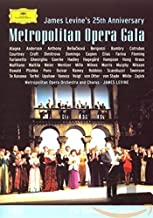
James Levine's 25th Anniversary Metropolitan Opera Gala
James Levine's 25th Anniversary Metropolitan Opera Gala was a concert lasting approximately eight hours, that the Metropolitan Opera staged in 1996 in honour of its then principal conductor and artistic director. Excerpts from the gala were released by Deutsche Grammophon on a 72-minute CD, a 161-minute VHS videocassette and a 161-minute double Laserdisc in 1996, and on a 293-minute double DVD in 2005.
James Levine's 25th Anniversary Metropolitan Opera Gala was a concert lasting approximately eight hours, that the Metropolitan Opera staged in 1996 in honour of its then principal conductor and artistic director. Excerpts from the gala were released by Deutsche Grammophon on a 72-minute CD, a 161-minute VHS videocassette and a 161-minute double Laserdisc in 1996, and on a 293-minute double DVD in 2005.
詳しい紹介を読む
James Levine's 25th Anniversary Metropolitan Opera Gala was a concert lasting (including intermissions) approximately eight hours, that the Metropolitan Opera staged in 1996 in honour of its then principal conductor and artistic director. Excerpts from the gala were released by Deutsche Grammophon on a 72-minute CD, a 161-minute VHS videocassette and a 161-minute double Laserdisc in 1996, and on a 293-minute double DVD in 2005.
Background
James Levine made his début at the Metropolitan Opera at the age of twenty-seven. On 5 June 1971, he conducted a matinée performance of Tosca with Grace Bumbry in the title role, Franco Corelli as Cavaradossi and Peter Glossop – also making his Met début – as Scarpia. Levine was the longest serving conductor in the Met's history, becoming its principal conductor in 1973, its music director in 1976 and its inaugural artistic director in 1986. At the time of his gala, he had led the Met in 1,646 performances of sixty-eight operas, twenty-one of which he had introduced into the company's repertoire. He had also notably initiated the Met's series of television broadcasts with a production of La Bohème starring Luciano Pavarotti and Renata Scotto in 1977.
The Met celebrated the silver anniversary of Levine's arrival there with a concert on 27 April 1996. Fifty-eight soloists contributed to a gala that lasted from 6 p.m. until 2 a.m. on the following morning. They performed on three sets: an Ezio Frigerio design for Act 1 of Francesca da Rimini, a gift of Mrs Donald D. Harrington; a Günther Schneider-Siemssen design for Act 2 of Arabella, a gift in part of Mrs Michael Falk; and a Schneider-Siemssen design for Act 2 of Tannhäuser, a gift of the Fan Fox and Leslie R. Samuels Foundation and of the Metropolitan Opera Guild. The gala as a whole was sponsored by Mrs Emily Fisher Landau. Its television broadcast was sponsored by Mrs Harrington, the Texaco Philanthropic Foundation, Inc., and the National Endowment For the Arts, in association with Deutsche Grammophon, the United Kingdom's BBC Worldwide Television, Japan's NHK, Holland's Nederlandse Programma Stichting, Denmark's Danmarks Radio, the Australian Broadcasting Corporation and Sweden's Sveriges Television.
Production
The gala began at 6PM and ended shortly before 2AM.
Around half of the pieces performed were by Mozart, Verdi and Wagner, which Tim Page in The Washington Post felt reflected the choice of operas doing Levine's time in the Opera House, although nineteen other composers were featured. The range of singers included veterans such as 71-year-old Carlo Bergonzi through to newcomers like 32-year-old Roberto Alagna. Renée Fleming was heard three times, the only singer with a solo number to be heard more than twice over the evening.
Neil Crory reviewing the gala on Laserdisc in the Fall 1997 issue of Opera Canada, stated that the programme booklet's cancellation list alone deserved a mention in the Guinness Book of Records. Singers who had to cancel their appearance included Ben Heppner and José Carreras due to scheduling clashes, and several due to health issues, including Cecilia Bartoli, Luciano Pavarotti, Montserrat Caballé, Marilyn Horne, Teresa Stratas, and Nicolai Ghiaurov. Hildegard Behrens also cancelled due to illness however James Jorden, writing in Parterre Box, reported rumours that Behrens had cancelled due to jealousy that Jane Eaglen had "usurped" her repertoire by being given the lengthy Immolation Scene from Götterdämmerung. Kathleen Battle, one of the Met's biggest stars of recent years, did not attend as she had been fired in 1994.
Critical reception
The gala was positively reviewed overall. Tim Page called it a “glorious, crazy, songful party”, while Martin Bernheimer described it as a "mega-monster concert", a "shameless, shapeless, formless smorgasbord of arias and ensembles", "a parade of disparate singers striking poses in competitive evening attire" in which "the assembled women blew a crescendo of kisses to their beaming boss out front". For Neil Crory it was “the gala-to-end-all-galas”. J.B. Steane, reviewing the CD release in Gramophone in December 1998, wrote: "[o]ut come the stars, one by one or two by two and then six of them in a galaxy. Some have been in the firmament a long time, others are almost new. But all are there ... to pay tribute".
Reviewing Levine’s performance at the podium, Mike Silverman, for ‘’The Associated Press’’, said he "conducted the Met's wonderful orchestra with love and enthusiasm". Bernheimer wrote that Levine’s guidance of the excellent orchestra was “sympathetic if sometimes loud and sometimes inflexible” but that the gala began with a somewhat lethargic treatment of the overture to Rienzi. Page believed that none of the soloists could outshine the orchestra and their conductor. Thanks to Levine, the Met's pit was home to "one of the most responsive and virtuosic ensembles in the world", and it was remarkable that he could "preside so effortlessly and so idiomatically over such a range of musical styles, over so many hours".
James Levine did not avail himself of the opportunity to make any speeches. Instead, Birgit Nilsson gave the closing speech, which Martin Bernheimer in The Los Angeles Times felt was the "most exhilarating tribute" of the night, ending with some unaccompanied Valkyrie war-cries from Die Walküre. Jorden criticised Levine's decision to take his curtain call in front of a specially designed, autographed drop curtain, advising that Levine's pride would lead to a fall - one of the few direct references in reviews of the gala to the sexual misconduct allegations that would end Levine's career two directions later.
The gala was the last appearance on the Met stage for Bergonzi, Ileana Cotrubas, Gwyneth Jones, Grace Bumbry, and James King.
Of especial interest to reviewers were two prominent up and coming artists, Roberto Alagna and Angela Gheorghiu [appearing one day after their wedding. To Page, Alagna had "a light, sweet and supple voice of moderate size (some high no