
項目
振付師
choreographer
振り付けを行う専門職
項目
choreographer
振り付けを行う専門職
この項目を含む事件ファイルで情報と関係を見てみましょう。
この項目を含む事件ファイルはまだありません。
この項目から調査するこの項目につながる作品や人物を調べています。
振付師
つながっているものを探しています。
最初のコメントをお待ちしています。
振り付けを行う専門職
Choreography is the art of designing sequences of movements of physical bodies (or their depictions) in which motion or form or both are specified. Choreography may also refer to the design itself. A choreographer creates choreographies through the art of choreography, a process known as choreographing. It most commonly refers to dance choreography.
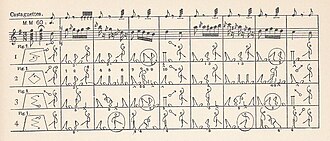
In dance, choreography may also refer to the design itself, sometimes expressed by means of dance notation. Dance choreography is sometimes called dance composition. Aspects of dance choreography include the compositional use of organic unity, rhythmic or non-rhythmic articulation, theme and variation, and repetition. The choreographic process may employ improvisation to develop innovative movement ideas. Generally, choreography designs dances intended to be performed as concert dance.
The art of choreography involves specifying human movement and form in terms of space, shape, time, and energy, typically within an emotional or non-literal context. Movement language is taken from dance techniques of ballet, contemporary dance, jazz, hip hop dance, folk dance, techno, K-pop, religious dance, pedestrian movement, or combinations of these.
The word choreography literally means "dance-writing" from the Greek words "χορεία" (circular dance, see choreia) and "γραφή" (writing). It first appeared in the American English dictionary in the 1950s, and "choreographer" was first used as a credit for George Balanchine in the Broadway show On Your Toes in 1936. Before this, stage and movie credits used phrases such as "ensembles staged by", "dances staged by", or simply "dances by" to denote the choreographer.
Dances are designed by applying one or both of these fundamental choreographic methods:
Improvisation, in which a choreographer provides dancers with a score (i.e., generalized directives) that serves as guidelines for improvised movement and form. For example, a score might direct one dancer to withdraw from another dancer, who in turn is directed to avoid the withdrawal, or it might specify a sequence of movements that are to be executed in an improvised manner over the course of a musical phrase, as in contra dance choreography. Improvisational scores typically offer wide latitude for personal interpretation by the dancer.
Planned choreography, in which a choreographer dictates motion and form in detail, leaving little or no opportunity for the dancer to exercise personal interpretation.
Several underlying techniques are commonly used in choreography for two or more dancers:
Mirroring - facing each other and doing the same
Retrograde - performing a sequence of moves in reverse order
Canon - people performing the same move one after the other
Today, choreography must impose some kind of order on the performance, within the three dimensions of space, the fourth dimension of time, and the capabilities of the human body.
In the performing arts, choreography applies to human movement and form. In dance, choreography is also known as dance choreography or dance composition. Choreography is also used in other fields, including opera,
cheerleading, theatre, marching band, synchronized swimming, cinematography, ice skating, gymnastics, fashion shows, show choir, cardistry, video game production, and animated art.
The International Choreographic Competition Hannover, Hanover, Germany, is the longest-running choreography competition in the world (started c. 1982), organised by the Ballett Gesellschaft Hannover e.V. It took place online during the COVID-19 pandemic in 2020 and 2021, returning to the stage at the Theater am Aegi in 2022. Gregor Zöllig, head choreographer of dance at the Staatstheater Braunschweig was appointed artistic director of the competition in 2020. The main conditions of entry are that entrants must be under 40 years of age and professionally trained. The co
出典: Choreography (CC BY-SA)
構造化された情報、ユーザーの意見、AIが抽出した関係を区別して表示します。
The ballet master or choreographer during this time became the "arranger of dance as a theatrical art", with a well-known master of the late 18th century being Jean-Georges Noverre, with others following and developing techniques for specific types of dance, including Gasparo Angiolini, Jean Dauberval, Charles Didelot, and Salvatore Viganò. Ballet eventually developed its own vocabulary in the 19th century, and romantic ballet choreographers included Carlo Blasis, August Bournonville, Jules Perrot and Marius Petipa.
Modern dance brought a new, more naturalistic style of choreography, including by Russian choreographer Michel Fokine (1880–1942) and Isadora Duncan (1878–1927), and since then styles have varied between realistic representation and abstraction. Merce Cunningham, George Balanchine, and Sir Frederick Ashton were all influential choreographers of classical or abstract dance; Balanchine and Ashton, along with Martha Graham, Leonide Massine, Jerome Robbins and others also created representational works. Isadora Duncan favored natural movement and improvisation. The work of Alvin Ailey (1931–1989), an African-American dancer, choreographer, and activist, spanned many dance styles, including ballet, jazz, modern dance, and theatre.
Shadowing - standing one behind the other and performing the same moves
Unison - two or more people doing a range of moves at the same time
Movements may be characterized by dynamics, such as fast, slow, hard, soft, long, and short.