
項目
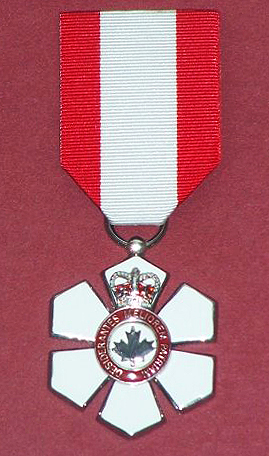
カナダ勲章オフィサー
Officer of the Order of Canada
The Order of Canada is a Canadian national order and the second-highest honour for merit in the system of orders, decorations, and medals of Canada, after the Order of Merit.
項目
Officer of the Order of Canada
The Order of Canada is a Canadian national order and the second-highest honour for merit in the system of orders, decorations, and medals of Canada, after the Order of Merit.
この項目を含む事件ファイルで情報と関係を見てみましょう。
この項目を含む事件ファイルはまだありません。
この項目から調査する最初のコメントをお待ちしています。
The Order of Canada is a Canadian national order and the second-highest honour for merit in the system of orders, decorations, and medals of Canada, after the Order of Merit.
The Order of Canada (French: Ordre du Canada) is a Canadian national order and the second-highest honour for merit in the system of orders, decorations, and medals of Canada, after the Order of Merit.
To coincide with the centennial of Canadian Confederation, the three-tiered order was established in 1967 as a fellowship recognizing the outstanding merit or distinguished service of Canadians who make a major difference to Canada through lifelong contributions in every field of endeavour, as well as efforts by non-Canadians who have made the world better by their actions. Membership is accorded to those who exemplify the order's Latin motto, desiderantes meliorem patriam, meaning "they desire a better country", a phrase taken from Hebrews 11:16. The three tiers of the order are Companion, Officer and Member. Specific people may be given extraordinary membership and deserving non-Canadians may receive honorary appointment into each grade.
King Charles III, the reigning Canadian monarch, is the order's sovereign. The governor general administers the order as its Chancellor and Principal Companion. Appointees to the order are recommended by an advisory board and formally inducted by the governor general or the sovereign. Initially awards required the prior approval of the sovereign; however since 1978 the sovereign is only informed of awards after they have been made.
As of January 2026, 8,729 people have been appointed to the order, including scientists, musicians, politicians, artists, athletes, business people, film stars and benefactors. Some have resigned or have been removed from the order, while other appointments have been controversial. Appointees are presented with insignia and receive the right to armorial bearings.
The process of founding the Order of Canada began in early 1966 and concluded on 17 April 1967, when the organization was instituted by Queen Elizabeth II, on the advice of the Canadian prime minister, Lester B. Pearson, who was assisted with the establishment of the order by John Matheson. The snowflake design for the order was suggested by the diplomat John G. H. Halstead. The association was officially launched on 1 July 1967, the 100th anniversary of Canadian Confederation, with Governor General Roland Michener being the first inductee to the order, to the level of Companion, and on 7 July of the same year, 90 more people were appointed, including former Governor General Vincent Massey, former prime minister Louis St. Laurent, novelist Hugh MacLennan, religious leader David Bauer, novelist Gabrielle Roy, historian Donald Creighton, feminist politician and future senator Thérèse Casgrain, pioneering neurosurgeon Wilder Penfield, painter Arthur Lismer, public health leader Brock Chisholm, former political leader M. J. Coldwell, disability advocate Edwin Baker, painter Alex Colville, and ice hockey player Maurice Richard. During a visit to London, United Kingdom, later in 1970, Michener presented the Queen with her Sovereign's badge for the Order of Canada, which she first wore during a banquet in Yellowknife in July 1970.
The Canadian monarch, seen as the fount of honour, is at the apex of the Order of Canada as its Sovereign, followed by the governor general, who serves as the fellowship's Chancellor. Thereafter follow three grades, which are, in descending order of precedence:
Companion (French: Compagnon)
Officer (French: Officier)
Member (French: Membre)
Additionally, any governor general, viceregal consort, former governor general, former viceregal consort, or member of the Canadian royal family may be appointed as an extraordinary Companion, Officer, or Member. Each incumbent governor general is also installed as the Principal Companion for the duration of his or her time in the viceregal post and continues as an extraordinary Companion thereafter.
Each has an accordant post-nominal letters that members are entitled to use. Promotions in grade are possible, though this is ordinarily not done within five years of the initial appointment, and a maximum of five honorary appointments into any of the three grades may be made by the governor general each year. As of August 2025, there have been 27 honorary appointments. Since 1994, Order of Canada recipients are the only regular citizens who are empowered to administer the Canadian Oath of Citizenship.
Companions of the Order of Canada (post-nominals: CC, in French: Compagnon de l'ordre du Canada) have demonstrated the highest degree of merit to Canada and humanity, on either the national or international scene. Up to 15 Companions are appointed annually, with an imposed limit of 180 living Companions at any given time, not including those appointed as extraordinary Companions or in an honorary capacity. As of August 2017, there are 146 living Companions.
Officers of the Order of Canada (post-nominals: OC, in French: Officier de l'ordre du Canada) have demonstrated an outstanding level of talent and service to Canadians, and up to 64 may be appointed each year, not including those inducted as extraordinary Officers or in an honorary capacity, with no limit to how many may be living at one time. As of August 2017, there were 1,049 living Officers.
Members of the Order of Canada (post-nominals: CM, in French: Membre de l'ordre du Canada) have made an exceptional contribution to Canada or Canadians at a loca
出典: Order of Canada (CC BY-SA)
構造化された情報、ユーザーの意見、AIが抽出した関係を区別して表示します。
From the Order of Canada grew a Canadian honours system, thereby reducing the use of British honours (i.e. those administered by the Queen in her UK Privy Council). Among the civilian awards of the Canadian honours system, the Order of Canada comes third, after the Cross of Valour and membership in the Order of Merit, which is within the personal gift of Canada's monarch. By the 1980s, Canada's provinces began to develop their own distinct honours and decorations.
Canadian historian Margaret MacMillan represented the order at the coronation of King Charles III and Queen Camilla at Westminster Abbey on 6 May 2023.