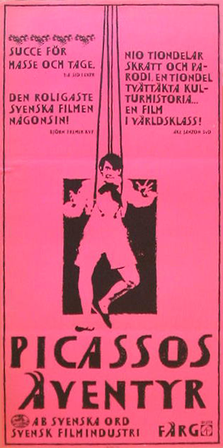
The Adventures of Picasso is a 1978 Swedish surrealist comedy film directed by Tage Danielsson, starring Gösta Ekman, as the famous painter. The film had the tag-line Tusen kärleksfulla lögner av Hans Alfredson och Tage Danielsson. At the 14th Guldbagge Awards it won the award for Best Film.
The Adventures of Picasso is a 1978 Swedish surrealist comedy film directed by Tage Danielsson, starring Gösta Ekman, as the famous painter. The film had the tag-line Tusen kärleksfulla lögner av Hans Alfredson och Tage Danielsson. At the 14th Guldbagge Awards it won the award for Best Film.
詳しい紹介を読む
The Adventures of Picasso (Swedish: Picassos äventyr) is a 1978 Swedish surrealist comedy film directed by Tage Danielsson, starring Gösta Ekman, as the famous painter. The film had the tag-line Tusen kärleksfulla lögner av Hans Alfredson och Tage Danielsson (A thousand loving lies by Hans Alfredson and Tage Danielsson). At the 14th Guldbagge Awards it won the award for Best Film.
The film uses ten languages: Spanish, French, Swedish, German, Finnish, Italian, English, Russian, Norwegian and Latin. Most of these words are very simple (agua, water), sometimes meaning something different from what they seem (Don Jose's military rank, Hauptbahnhof, which means "central rail station" in German) and other times just being complete nonsense.
The film is very loosely based on Pablo Picasso's life, narrated by Toivo Pawlo, who introduces himself as Elsa Beskow. It opens with a quote by Picasso himself: "Art is a lie that leads us closer to the truth."
The story starts with Picasso's birth in Málaga, Spain. His father, Don Jose (Hans Alfredson), is an artist and discovers early his son's talent when the young boy makes a sculpture of Don Jose with his food.
When Pablo is old enough (and now portrayed by Gösta Ekman) his father takes him to Madrid, so that Pablo can study art. On their way, they encounter two robbers who try to hurt a beautiful girl named Dolores (Lena Olin). After a slapstick number in which Picasso defeats the two attackers, she gives him a bottle of paint, containing a djinn. With the paint from that bottle he signs all his paintings.
At the academy of art Pablo's talent is praised and awarded. When he returns home with a portrait of his mother Dona Maria (Margaretha Krook), he is equally praised there. Unfortunately, their happiness is ruined when Don Jose suddenly dies - or so it seems. At the funeral it turns out he's actually still alive. Despite this, Dona Maria keeps ignoring him with the words: "Idioto, tú es muerta" (= approximately, "You are dead, fool").
Pablo leaves for Paris, but has a hard time selling any of his paintings. One day his father comes to visit him, bringing the sad news that Dona Maria is dead. When Don Jose starts to eat an apple that Pablo used as a reference for his painting, Picasso starts to draw faster, still using the apple as reference. The result is the birth of cubism.
This new style, however, is very hard to sell - until Pablo's father gets an idea from a fishing rod. He lowers the painting down from a window during a vernissage. The overall reaction is negative, with comments like "Scandal", "Merde", "Oh, mon dieu" and "piss".
One of the guests however, finds the picture both charming and marvelous and declares that she wants to buy it. This lady is none other than the great writer Gertrude Stein (Bernard Cribbins), who is attending the vernissage with her companion Alice B. Toklas (Wilfrid Brambell).
After this, Picasso becomes the center of the art world of Paris. Along with names like Braque, Matisse, Fernand Léger, Pompidou, Entrecôte, Carl Larsson, Karl-Alfred, Loulou, Dodo, Jou-Jou, Clo-Clo, Margot, Frou Frou, Jenny Nyström, Hejsan-Tjosan, Corselet, Omelette and Rembrandt (most of these names are just nonsense and mean other things than you might suspect). The Paris artworld also included Hemingway, who enjoys knitting, Erik Satie, Guillaume Apollinaire, Henri Rousseau, Vincent van Gogh and no less than two Toulouse-Lautrec. Along with Mimi, a waitress who gave Puccini the inspiration to "Thy tiny hand is frozen", the reason for this being that she is carrying a wine cooler.
After this introduction to the artworld of Paris, the narrator tells about a "normal" day in Picasso's life. It ends with a visit from Mr. and Mrs. Guggenheim from New York City. Although the Swedish American multimillionaire Ingrid Svensson-Guggenheim (Birgitta Andersson) doesn't understand Picasso's art, she knows that it is expensive, and therefore immortal. She becomes a pest and at whatever the cost she is determined to become a part of Picasso's art and world. When Picasso no longer seems to be able to escape the annoying American, his two friends Rousseau (Lennart Nyman) and Apollinaire (Per Oscarsson) invite him to Rousseau's hidden forest, where Apollinaire reads aloud some of his poems for his friends. This gives Picasso an idea. They will have a masquerade in Rousseau's honor.
This masquerade has a lot of famous historic persons, most of them dressed as furniture. It all ends with Rousseau, while playing his violin, flying out the window and into the night of Paris.
Now it's 1914 and Picasso and all of humanity is looking forward to a bright future full of liberty, equality and fraternity. This is all destroyed however with the coming of World War I and the headlines "KRASH! BOM! BANG!"
In 1918, when the war is over, Pablo once again meets his father, who has invented a new shampoo that will regrow hair. It has another effect on Pablo however, who loses all of his hair and gives him his famous bald look.
Shortly after this, Pablo gets the job to make the sets and clothes for the Russian ballet. The ballet, premiering in London, is not a success however. Don Jose makes the dancers' food and all the performers end up passing gas.
Picasso returns to Paris, where he meets Sirkka (Lena Nyman), a Finnish singer who sings a song that he becomes enchanted by. However, when it turns out that that song (which is essentially a recipe for making a kalakukko) is the only one Sirkka has got in her repertoire, Picasso soon gets sick of it and leaves for New York City with his father.
In America there is a prohibition on art (a reference to the real Prohibition era of liquor). Pablo works underground and one day he is asked to deliver a set of pictures to a Mrs. X. It turns out that this mysterious woman is none other than Ingrid Svensson-Guggenheim. She doesn't give up so easily, but Picasso manages to escape her flirting.