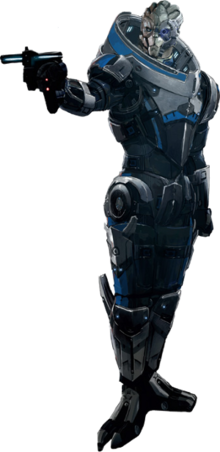
Garrus is a fictional character in BioWare's Mass Effect franchise who acts as a party member in each of the three games in the original trilogy. Garrus is a turian, one of the various alien species in Mass Effect, and is voiced by Brandon Keener.
Garrus is a fictional character in BioWare's Mass Effect franchise who acts as a party member in each of the three games in the original trilogy. Garrus is a turian, one of the various alien species in Mass Effect, and is voiced by Brandon Keener.
詳しい紹介を読む
Garrus (full name Garrus Vakarian) is a fictional character in BioWare's Mass Effect franchise who acts as a party member (or "squadmate") in each of the three games in the original trilogy. Garrus is a turian, one of the various alien species in Mass Effect, and is voiced by Brandon Keener.
The character is initially introduced in the first game as an officer for Citadel Security (C-Sec), the space station's police force, frustrated by the rules and regulations of his job. By Mass Effect 2, Garrus forms a vigilante group on the crime-ridden Omega, with his team later being wiped out due to betrayal. Mass Effect 3 features him advising the other turians on how to defeat the Reapers. In addition to the Mass Effect game trilogy, Garrus also appears in the third issue of Homeworlds, which tells the story of how Garrus ends up on Omega and elaborates on his backstory.
Garrus' design was altered throughout the series, though his blue-and-black colour scheme and visor were maintained in all his appearances. Developers initially worried that Garrus, along with the rest of the alien squadmates, might not prove emotionally compelling. However, surprised by positive fan feedback, they included Garrus as a romance option in Mass Effect 2. Since his debut in Mass Effect, Garrus has received widespread acclaim. Various merchandise featuring Garrus has been produced, including action figures, a T-shirt, and a bust.
Visual design
Garrus is a turian, an alien race with avian features, from a society which values discipline and possesses a strong sense of personal and collective honor. Not many pieces of concept art were developed for Garrus' visual design in the first game. His armor was created by taking one of the existing Turian armor concepts created by concept artist Matt Rhodes, and assigning it the colors blue and black. To further differentiate him from other Turians, the art team gave him a visor and visible facial tattoos. These facial patterns went through several iterations before settling on the final aspect of Garrus' face.
Narrative design
Then senior writer Mac Walters, one of the lead writers for Mass Effect 2 and Mass Effect 3, was in charge of writing Garrus in the first Mass Effect game. Walters designed Garrus to be a malleable character, waiting to be shaped by a strong figure. He found a challenge in writing a character that could both stand out individually and serve as an introduction to the Turian species. For Mass Effect 2, the narrative team was initially unsure which characters from the original game would make a return as squadmates, and what implications they would have in the game's final mission, the Suicide Mission. Garrus, alongside Tali, was selected as one of two returning squadmates, with his writing being once again handled by Walters. Garrus was conceived as a bounty hunter fighting organized crime in Omega, a crime-ridden space station built in the crust of a metallic asteroid that appears in Mass Effect 2. Early versions of his recruitment mission saw Garrus attempt to track down the final accomplices of Dr. Saleon, the antagonist of his personal quest in the first Mass Effect game. Walters decided to give Garrus a false identity, "Archangel", to deceive players into believing they were recruiting a "cool, renegade character" instead of Garrus. Elements from a discarded character concept, the "Quarian Infiltrator", inspired by Butch Cassidy and the Sundance Kid, were incorporated into Garrus. In Mass Effect 3, Garrus was written by senior writer John Dombrow.
Due to Garrus' popularity, his design in Mass Effect 2 mostly kept his visor and the blue-and-black coloring of his armor intact, as it was assumed that those alone were enough to make him recognizable. However, his armor was given further detail, including a set of side-plates and a wide range of materials, such as cloth and weathered metal. In his recruitment mission, Garrus receives significant damage to his face. This injury meant that two different variants of Garrus had to be produced, one with the damage present, and one without it. To help convey the amount of damage his armor would receive, the art team created several pieces of concept art. In designing the facial scar Garrus receives in that quest, an extensive referencing process was made so it did not feel gruesome, but rather "good looking". In an interview, art director Derek Watts compared its final design to "a Hollywood scar". Early renditions of Garrus' facial 3D model included a bandage to cover the injury. Several in-game alternate costumes for the character were developed, such as an undamaged version of his armor with a slight color variation to make it look unique.
The color of his armor in Mass Effect 3 was altered to also contain silver, alongside blue and black, to indicate Garrus' new rank in the Turian military. The art team added further detail on its legs and sides, including a set of buckles meant to hold the side plates together. These changes were meant to reflect Garrus' familiar look, while making him appear more resistant in battle. Similar to Mass Effect 2, the art team created alternate costumes for the character. Among these was a more worn and contemporary military style armor with grenades on its belt.
For the remastered compilation of all three games in the Mass Effect trilogy, Mass Effect Legendary Edition, the developers made several visual changes to make all three games look visually consistent. However, slight differences in recurring characters, such as in Garrus, were maintained, as they were meant to show how the characters aged and matured.
When deciding the romance options for the first Mass Effect game, the development team was unsure whether the alien characters would be "compelling in terms of human emotion". As such, the developers initially pictured Garrus as a non-romanceable character in the first game. However, the amount of interest shown by players in starting relationship with Garrus ultimately led t