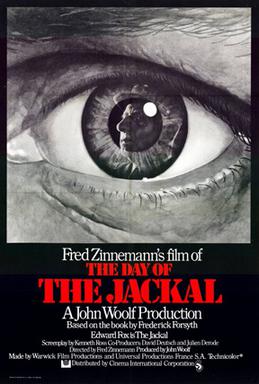
The Day of the Jackal is a 1973 political thriller film directed by Fred Zinnemann and starring Edward Fox and Michael Lonsdale. Based on the 1971 novel by Frederick Forsyth, the film is about a professional assassin known only as the "Jackal" who is hired to assassinate French president Charles de Gaulle in the summer of 1963. It stars Edward Fox as the title character, with Michael Lonsdale, Derek Jacobi, Terence Alexander, Michel Auclair, Alan Badel, Donald Sinden, Tony Britton, Cyril Cusack, Maurice Denham and Delphine Seyrig. The musical score was composed by Georges Delerue.
The Day of the Jackal is a 1973 political thriller film directed by Fred Zinnemann and starring Edward Fox and Michael Lonsdale. Based on the 1971 novel by Frederick Forsyth, the film is about a professional assassin known only as the "Jackal" who is hired to assassinate French president Charles de Gaulle in the summer of 1963. It stars Edward Fox as the title character, with Michael Lonsdale, Derek Jacobi, Terence Alexander, Michel Auclair, Alan Badel, Donald Sinden, Tony Britton, Cyril Cusack, Maurice Denham and Delphine Seyrig. The musical score was composed by Georges Delerue.
詳しい紹介を読む
The Day of the Jackal is a 1973 political thriller film directed by Fred Zinnemann and starring Edward Fox and Michael Lonsdale. Based on the 1971 novel by Frederick Forsyth, the film is about a professional assassin known only as the "Jackal" who is hired to assassinate French president Charles de Gaulle in the summer of 1963. It stars Edward Fox as the title character, with Michael Lonsdale, Derek Jacobi, Terence Alexander, Michel Auclair, Alan Badel, Donald Sinden, Tony Britton, Cyril Cusack, Maurice Denham and Delphine Seyrig. The musical score was composed by Georges Delerue.
A co-production of the United Kingdom and France, The Day of the Jackal received positive reviews and went on to win the BAFTA Award for Best Editing (Ralph Kemplen), five additional nominations (including Best Film and Best Direction), two Golden Globe Award nominations, and one Oscar nomination. The film grossed $16,056,255 at the North American box office, returning $8,525,000 in rentals to the studio. In 1999, the British Film Institute ranked it the 74th greatest British film of the 20th century.
A remake of the film was released in 1997. A TV adaptation of the novel and film aired on Sky Atlantic in 2024.
Production
The Day of the Jackal was originally part of a two-picture deal between John Woolf and Fred Zinnemann, the other being an adaptation of the play Abelard and Heloise by Ronald Millar.
Universal Studios initially wanted to cast a major American actor as the Jackal, with Robert Redford and Jack Nicholson flown to Europe to audition. Although Universal favoured Nicholson, Zinnemann ultimately secured a production agreement stipulating that only European actors would be cast. Afterwards, British actors David McCallum, Ian Richardson and Michael York were considered, before Zinnemann cast Edward Fox. Jacqueline Bisset was offered the role of Denise, but had to decline due to scheduling conflicts.
The Day of the Jackal was filmed in studios and on location in France, Britain, Italy and Austria. Zinnemann was able to film in locations usually denied to filmmakers — such as inside the Ministry of the Interio
The far-right Organisation armée secrète ("Secret Army Organisation") plots to assassinate President de Gaulle. The first attempt on 22 August fails, leaving de Gaulle and his entourage unharmed. Within six months, OAS leader Jean Bastien-Thiry and several members are captured, and Bastien-Thiry is executed. The remaining OAS leaders, hiding in Austria, hatch a new plan. They enlist the services of an apolitical British assassin given the code name "The Jackal," a figure already credited with the assassinations of Patrice Lumumba and Rafael Trujillo. The Jackal is aware targeting de Gaulle is extremely risky, but desires a comfortable retirement in anonymity. He insists on a fee of $500,000, half to be paid upfront into his Swiss bank account. The OAS uses its extensive network to raise the money through a series of bank robberies.
Preparing for his mission, the Jackal travels to Genoa where he commissions a custom single-shot rifle from a skilled gunsmith and secures fake identity papers, later killing the forger when he attempts to extort him. In Paris, the Jackal duplicates a key to a flat overlooking a square, setting the stage for the planned assassination. The OAS leadership has meanwhile relocated to Rome, still under the scrutiny of French security forces. French intelligence kidnap the OAS's chief clerk, Viktor Wolenski, who dies during interrogation but not before revealing crucial details of the plot, including the code word "Jackal". The Interior Minister convenes with top security officials and Police Commissioner Berthier recommends his deputy, Claude Lebel, lead the investigation under the constraints of secrecy. Lebel is granted special emergency powers despite de Gaulle's insistence on maintaining his public schedule.
Colonel St Clair, who is de Gaulle's personal military aide and a cabinet member, divulges classified details to his new mistress, Denise, an OAS agent. At the same time, Lebel is informed by Special Branch that a British national, Charles Harold Calthrop, might be connected to the assassination plot and travelling under an alias. The Jackal learns his plot is compromised, but decides to press forward with the mission. He seduces the aristocratic Colette de Montpellier in a hotel in Nice, but narrowly evades capture by Lebel and his team. He survives a motor vehicle collision and flees to Madame de Montpellier's country estate, and kills her when she reveals the police have already questioned her. Dyeing his hair and donning spectacles, he assumes another identity, that of a Danish schoolteacher, Per Lundquist, and boards a train for Paris.
Madame de Montpellier's murder allows Lebel to drop secrecy constraints and launch a public manhunt. The Jackal temporarily hides at the flat of a man he picks up in a Turkish bath, killing him when the man learns of Montpellier's murder. At a subsequent cabinet meeting, Lebel predicts the Jackal will try to shoot de Gaulle during the upcoming Liberation Day ceremony marking Paris's liberation during World War II. Lebel is dismissed from the investigation so the Minister can assumes personal command, and is then reinstated less than a day later when the Minister recognizes Lebel's expertise.
On Liberation Day, the Jackal disguises himself as an elderly French veteran, conceals his rifle within crutches, and accesses the room overlooking the ceremony. He takes aim but de Gaulle unexpectedly leans forward while presenting a medal, and the Jackal's shot narrowly misses. Jackal reloads for a second attempt, and Lebel and a gendarme storm the room. The Jackal kills the policeman before being fatally shot by Lebel.
Back in London, the real Charles Calthrop arrives at his flat, interrupting policemen sifting through his belongings. The assassin is interred in an unmarked grave, leaving the true identity behind his many disguises an enduring mystery.