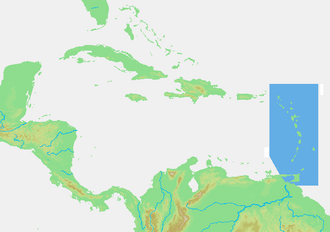
The Windward Antilles are a group of islands part of the Lesser Antilles, forming a volcanic arc to the East of the Caribbean Sea, preferably subdivided in English into:The "Leeward Islands", between the Virgin Islands and Dominica.
The "Windward Islands", between Martinique and Grenada, generally extended to Trinidad and Tobago.
詳しい紹介を読む
The Windward Antilles are a group of islands part of the Lesser Antilles, forming a volcanic arc to the East of the Caribbean Sea, preferably subdivided in English into:
The "Leeward Islands" (the northeastern subgroup), between the Virgin Islands and Dominica.
The "Windward Islands" (the southeastern subgroup), between Martinique and Grenada, generally extended to Trinidad and Tobago.
Terminological use
This term is almost completely absent in the English language. Although it is common in Spanish, French and Dutch, in English, it is sometimes used in reference to the Windward Antillean SSS Islands in contraposition to the Leeward Antillean ABC Islands in Dutch contexts. The table below provides a comparison across different local languages.
Geographic distribution
Windward Antilles are the following (from north to south):
Political status
Thirteen countries claim sovereignty of the Windward Antilles. Eight of these are totally part of the islands (Trinidad and Tobago, Dominica, Saint Lucia, Saint Kitts and Nevis, Antigua and Barbuda, Saint Vincent and the Grenadines, Grenada and Barbados). The other five countries have most of their territory outside of the region (France, the USA, the Netherlands, the UK and Venezuela).
The Windward Antilles, part of the Lesser Antilles of the Caribbean Sea, have a surface of almost 12,000 km2 (4,600 sq mi) and more than two thirds belong to only two countries: Trinidad and Tobago (with 5,100 km2 (2,000 sq mi) totally part of the region) and France (2,800 km2 (1,100 sq mi) of French territory in the Antilles).
Demography
Trinidad and Tobago (with almost 1.4 million people), plus the French territories (Guadaloupe, Martinique, Saint-Martin and Saint-Barthélemy, with almost 0.9 million people), represent almost two thirds of the Windward Antillean population from a total of 3.5 million people.
The local population mostly consists of Afrodescendants, racially mixed people from Indigenous peoples and descendants of centuries-old migrations, recent immigrants from other Antillean islands and a very small minority of European descendants.
Languages
English and French are the official and most spoken languages in the Windward Antilles.
Saint Martin island is the only one where both languages are the most prevalent ones but French is the only local official language due two the island being a territory of France (Slightly more than the northern half, part of the European Union) and the Kingdom of the Netherlands (southern half of the island), leaving Dutch as the official language of the Dutch side of the island.
Oostindie claims that on the Dutch Windward Antilles, the SSS Islands, English is the vernacular languages unlike on the Dutch Leeward Antilles, the ABC Islands, where Papiamentu is the vernacular, although all of these territories share Dutch as the official language. Sint Maarten stands out because Dutch is not even the second most spoken language due to Spanish-speaking and Haitian Creole-speaking immigrants.
Caribbean English and French-based creoles are the most spoken linguistic varieties in the region. Some Islands use English as the co-official language with Dutch, but the latter is scarcely used. Other common regional languages are Papiamentu and Spanish.
The indigenous languages of the islands became extinct. The languages spoken by Subsaharan Africans brought to the islands could not survive either. Although both groups left a substrate on both English and French-based creoles.