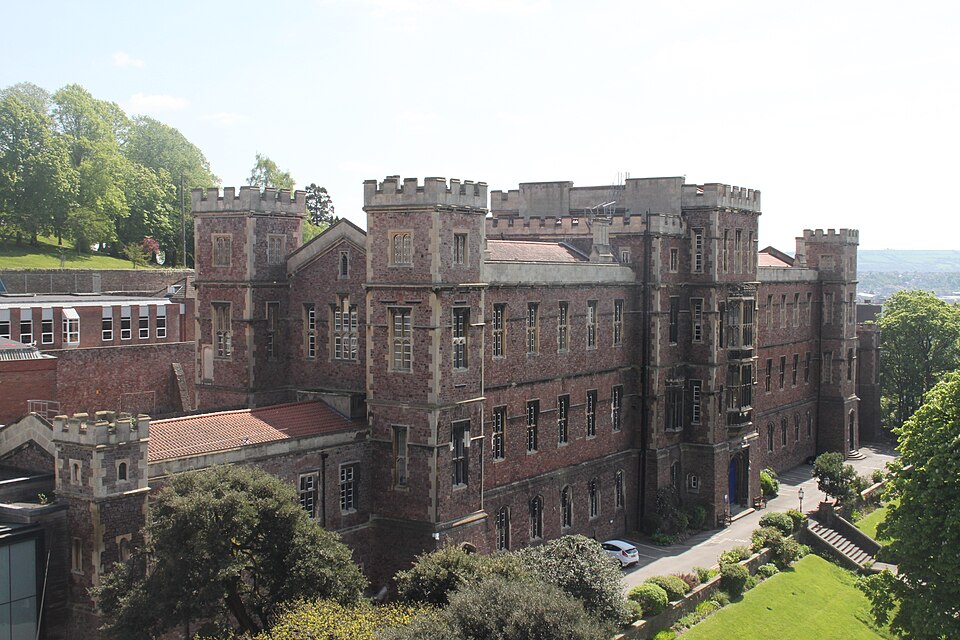
Queen Elizabeth's Hospital (QEH) is a 7–18 private boys' day school in Clifton, Bristol, England, founded in 1586. QEH is named after its original patron, Queen Elizabeth I. Known…
Queen Elizabeth's Hospital (QEH) is a 7–18 private boys' day school in Clifton, Bristol, England, founded in 1586. QEH is named after its original patron, Queen Elizabeth I.
Queen Elizabeth's Hospital (QEH) is a 7–18 private boys' day school in Clifton, Bristol, England, founded in 1586. QEH is named after its original patron, Queen Elizabeth I. Known traditionally as "The City School", Queen Elizabeth's Hospital was founded by the will of affluent soap merchant John Carr in 1586, gaining its first royal charter on 21 March 1590.
The school accepts boys from ages 7 to 18 and, since September 2017, girls aged 16 to 18 into the co-educational Sixth Form. The school began as a boarding school, accepting day boys for the first time in the early 1920s. Boarders continued to wear the traditional bluecoat uniform on a daily basis until the 1980s. After that, it was only worn on special occasions. Following a steady decline in numbers QEH stopped accepting new boarders in 2004, and boarding closed completely in July 2008. A Junior School opened in September 2007 in terraced Georgian town houses in Upper Berkeley Place, adjacent to the main school.
Overview
The school is located in central Bristol, near Cabot Tower on Brandon Hill, in a building built of Brandon stone, designed by local architects Foster and Son and dating from 1847. It has been designated by English Heritage as a grade II listed building. The terrace steps and walls are also grade II listed, as are the walls, lodge and gates. Before moving to the site on Brandon Hill, which was previously known as the Jews Acre, the school was housed at Gaunt's Hospital mansion house, Unity Street (1590–1767) and St. Bartholomew's, Christmas Steps (1767–1847). QEH has had close associations with Redmaids' High School since the latter's founding in 1634.
To celebrate 425 years since the school's opening, a new school song was composed in 2015.
Admittance
For much of its history, QEH has provided education for boys aged 11 to 18, although it now has an all-boys junior school from age 7 as well. In 2014 QEH began working with Redland High School on a co-educational infant school from age 2 to 7 years. Since September 2017, the Sixth Form has been co-educational. QEH Senior School has an entrance examination in January for students entering at Year 7 and Year 9 levels, boys take papers in Maths, English, Verbal Reasoning and Non Verbal Reasoning. These papers are used to select those eligible for John Carr academic scholarships. Boys applying for Music scholarships are invited to an interview and audition, at which they perform music and complete an aural and sight reading test. Sports scholarships are awarded based on an interview and practical tasks. The Year 7 entrants are generally chosen by around Easter and attend an initiation day during the summer term. Boys and girls also regularly enter the school at Sixth Form level, including international students.
Facilities
The school has four ICT suites and several sets of laptops, and most classrooms contain Smart Boards. Pupils are given a school email address and can connect to the school network from home to access files and other resources.
The school library, located at the top of the main building, contains more than 10,000 books and takes 35 periodicals, including magazines and national newspapers. Pupil librarians help to run the library and the role of Head Librarian is given to a student in the Upper Sixth.
The school possesses 23 acres of playing fields outside Bristol, near the village of Failand, which are managed in partnership with Bristol City F.C., who use the land for training.
The Sixth Form centre includes its own IT suite, communal study area and common room, with a cafeteria serving hot and cold food at break and lunchtimes.
They have recently opened a new £3.5 million ceramic and science block and have recently completed a £2.5 million redevelopment of their playing fields near Failand.
School day
The school day begins at 08:35 am with registration in each class's form room. This is followed on Mondays by a school assembly attended by years 11 to 13 in the dining hall led by the Headmaster with years 7 to 10 having this on Wednesday. The day is divided into eleven 35-minute periods. The first two are from 9–10:10 am, followed by a 30-minute break, then three more periods, before lunch starts at 12:30 pm and ends at 1:40 pm. After four more lessons, at 4:00 pm the school day ends.
All boys have one afternoon of sports per week. For year 7, it takes place on Monday while for year 8, it takes place on Wednesdays at the school's Failand playing fields, where rugby is played during the autumn term and football in the spring term, and cricket or athletics during the summer. Years 9 and 10 have games on Tuesdays, and are given a choice of sports, while year 11 and sixth form have games on Thursdays. There are also gym periods for years 7–11 during the rest of the week.
In year 7, boys are taught Latin, English, Spanish, maths, geography, history, religious studies, Art, biology, physics and chemistry, as well as periods for sport. In year 8, boys are taught all of the above as well as an extra language (German or French). In year 9, boys must choose two creative subjects (design technology, information technology, art, drama, music or Latin, the latter occupying both choices), which are each taught once a week for a double period. Boys are expected to take up to ten GCSEs, including a modern foreign language, maths, English language, English literature, and two out of the three sciences, taught as separate disciplines. Students take four subjects in the lower Sixth Form, with new subjects such as economics, classical civilisation, further mathematics and politics also available. One subject can then be dropped for their final year at the school in the Upper Sixth. The School also offers the Extended Project Qualification (EPQ) in Sixth Form.
Annual events
At the end of the first half of the autumn term, the school holds its prize giving in the Roman Catholic Clifton Cathedral. The headmaster reads his annual report, and a guest speaker gives the prizes to the winning pupils.