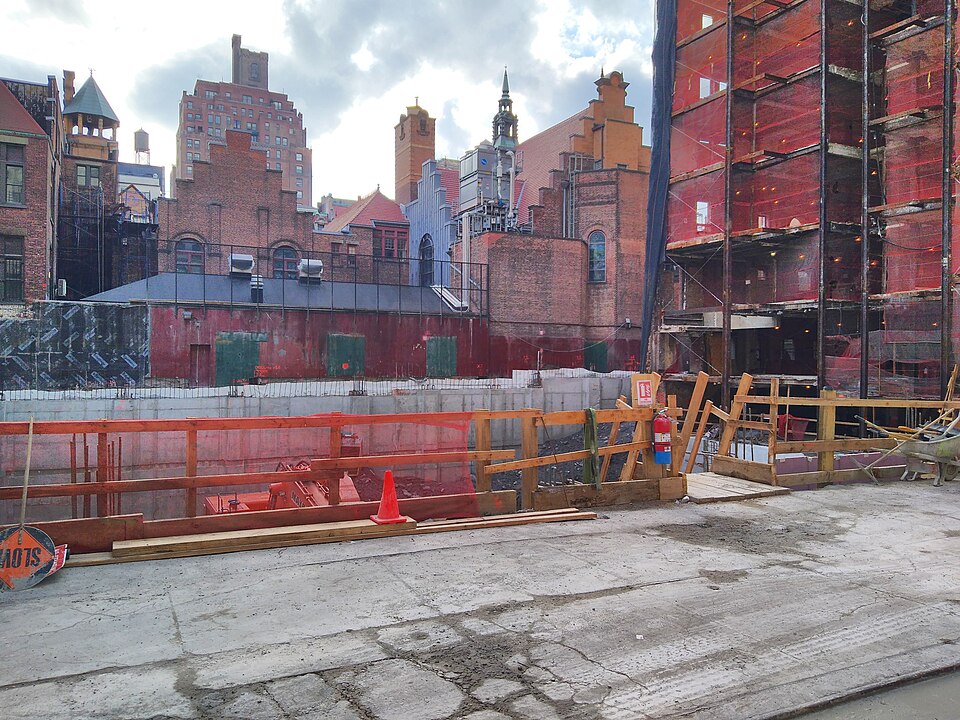
Collegiate School is an all-boys private school on the Upper West Side of Manhattan, New York City. Founded by Dutch colonists in either 1628 or 1638, it is the nation's oldest pr…
Collegiate School is an all-boys private school on the Upper West Side of Manhattan, New York City. Founded by Dutch colonists in either 1628 or 1638, it is the nation's oldest private secondary school, and claims to be the nation's oldest school without qualification.
Collegiate School is an all-boys private school on the Upper West Side of Manhattan, New York City. Founded by Dutch colonists in either 1628 or 1638, it is the nation's oldest private secondary school, and claims to be the nation's oldest school without qualification. It educates around 670 boys in grades K–12, with approximately 50–55 students per grade.
It is a member of both the New York Interschool Association and the Ivy Preparatory School League, two groups of New York City secondary schools.
Establishment and founding date controversy
In 1628, the Reverend Jonas Michaëlius, the first minister of the Dutch Reformed Church in America, arrived in the Dutch colony of New Netherland. That August, he wrote to an Amsterdam preacher that he wanted "to place [Native American] students under the instruction of some experienced and godly schoolmaster, where they may be instructed not only to speak, read, and write in our language, but also especially in the fundamentals of our Christian religion." It appears that some form of Dutch "school" existed on Manhattan no later than 1632, when a marriage contract instructed a husband to "keep [his step-children] at school."
In August 1637, the Dutch West India Company and the Classis of Amsterdam, the supervising body of the Dutch Reformed Church, licensed Adam Roelantsen to open a state-funded school in Manhattan, which opened in 1638. The school began as a co-ed school located south of Canal Street, but became an all-boys institution at the end of the 19th century.
The school has revised its founding date over the years. The school initially set the founding date at 1633, but later changed it to 1638, as archival research suggested that Roelantsen visited Manhattan in 1633, but was not teaching at that time. In 1982, the New-York Historical Society revealed a 1628 letter from Michaëlius discussing his teaching efforts. Based on this letter, the school announced in 1984 that it was changing the foundation date to 1628, allowing it to (somewhat controversially) claim the title of the oldest school in America. (Boston Latin School, the nation's oldest public school, was founded in 1635, and Harvard University, the nation's oldest university, was founded in 1636.)
Collegiate asserts continuity with Michaëlius' tutoring work because "the minister's efforts later led to the founding of Collegiate" and Dutch Reformed ministers frequently took on teaching duties in the Dutch colonies. In 2009, a Dutch historian contested Collegiate's position and supported the 1638 date, albeit in a summary footnote.
Dutch bastion in English New York
Collegiate traditionally catered to Manhattan's Dutch settler population, even after the English conquest. Under English and later British rule, in the years before free, universal public education, the various religious denominations sponsored schools for their own communities. Collegiate was funded by New York's Collegiate Reformed Protestant Dutch Church, hence the name. (The term "collegiate" refers to a network of churches that "shared ministers and kept a single set of registers.")
The school stubbornly retained its Dutch identity for over a century after the English conquest. In 1705, it fended off the English colonial governor's (Lord Cornbury) attempts to take over the school, after which Cornbury encouraged William Huddleston to establish the Anglican Trinity School in 1709. Classes were conducted exclusively in Dutch until 1773. The school educated only members of the Dutch Reformed Church until 1869, and even after 1869, Dutch Reformed children had an advantage in the admissions process.
Collegiate gained independence from the Reformed Church in 1808, but retained its association with the Church until 1940, when it became a non-profit corporation. The Church continued to be the school's landlord, but charged low rent in exchange for seats on the school's board of trustees, an arrangement that lasted until 2015.
Due to the school's long history, it has taken on several names, including Charity School of the Reformed Protestant Dutch Church and School of the Collegiate Reformed Dutch Church. The school was renamed Collegiate School of the Reformed Protestant Dutch Church in 1860 and Collegiate Grammar School in 1887. It has also moved 17 times over the last four centuries.
Transition to college-preparatory school
LeMuel C. Mygatt served as headmaster from 1887 to 1910. Under his leadership, Collegiate – which was challenged by declining financial support from the Collegiate Church – transitioned from a co-educational, tuition-free "charity school" to the present-day all-boys college-preparatory school. In 1887 the school moved uptown from 29th Street to 74th Street and began charging tuition. Tuition for the college-preparatory division was set at $200 a year, a princely sum at a time when Phillips Exeter charged day students $45–60 a year. The school generally stopped admitting girls in 1892, but operated a co-educational kindergarten from 1935 to 1961.
Under Mygatt, the school moved to the 77th Street grounds of the West End Collegiate Church (a division of the broader Collegiate Church) in 1892, where it would remain until 2018. (A 78th Street extension was added in 1968.) The school's original building at the West End location was listed on the National Register of Historic Places.
Collegiate historically catered to an upper-class clientele – in 1972, The New York Times wrote that "from its inception, Collegiate's student body has included the children of some of the best known families in New York" – and its middle school traditionally served as a feeder school to (mostly Eastern) boarding schools with similarly affluent student bodies. However, in the 1960s, the American upper class increasingly leaned towards sending their children to day schools. From 1961 to 1970, the share of Collegiate students who left for boarding school declined from 75% to 9%.
The school also offered an extensive financial aid program. In 1971, nearly a third of Collegiate's 518 students were on scholarship.
21st century
Collegiate has had six Heads of School (including one interim head) in the 21st century. Kerry P. Brennan, the former head of the Upper School at Ohio's University School, led the school from 2000 to