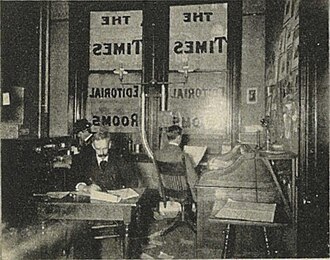
Editing is the process of preparing written, visual, audible, or cinematic material with the intention of producing a correct, consistent, accurate and complete final product. Mod…
Editing is the process of preparing written, visual, audible, or cinematic material with the intention of producing a correct, consistent, accurate and complete final product. Modifications can include correcting, condensing, or re-organizing the original material.
Editing is the process of preparing written, visual, audible, or cinematic material with the intention of producing a correct, consistent, accurate and complete final product. Modifications can include correcting, condensing, or re-organizing the original material.
Editing process
The editing process often begins with the author's idea for the work itself, continuing as a collaboration between the author and the editor as the work is created. Editing can involve creative skills, human relations and a precise set of methods. Practicing editing can be a way to reduce language error in future literature works.
Editing is a dynamic process. An editor must have the knowledge to identify and to correct errors in a piece of work to refine and deliver its message. However, there are times when correcting an error may change the original message of the work. In such cases, editors must also know when to ignore certain errors and to identify the next best possible course of action, which may involve undoing past corrections. Effective editing comes from not only making corrections, but making corrections that still convey the original message of the work.
Scholarly books and journals
Within the publishing environment, editors of scholarly books are of three main types, each with particular responsibilities:
Acquisitions editor (or commissioning editor in Britain), who contracts with the author to produce the copy
Project editor or production editor, who sees the copy through its stages from manuscript to bound book and usually assumes most of the budget and schedule responsibilities
Copy editor or manuscript editor, who prepares the copy for conversion into printed form.
In the case of multi-author edited volumes, before the manuscript is delivered to the publisher it has undergone substantive and linguistic editing by the volume's editor, who works independently of the publisher.
As for scholarly journals, where spontaneous submissions are more common than commissioned works, the position of journal editor or editor-in-chief replaces the acquisitions editor of the book publishing environment, while the roles of production editor and copy editor remain. However, another editor is sometimes involved in the creation of scholarly research articles. Called the authors' editor, this editor works with authors to get a manuscript fit for purpose before it is submitted to a scholarly journal for publication.
The primary difference between copy editing scholarly books and journals and other sorts of copy editing lies in applying the standards of the publisher to the copy. Most scholarly publishers have a preferred style that usually specifies a particular dictionary and style manual—for example, The Chicago Manual of Style, the MLA Style Manual or the APA Publication Manual in the U.S., or the New Hart's Rules in the U.K.
Editing in the 21st century
Editing has a long history dating back to the earliest times of written language. Over time, editing has evolved greatly, particularly with the emergence of new forms of media and language that have led to a move towards multimodality. Today, hardcopies and print are no longer the main focus of editing as new content like film and audio require different kinds of edits.
Technical editing is now more commonly done using applications and websites on devices, which requires editors to be familiar with online platforms like Adobe Acrobat, Microsoft Office, and Google Docs. The significance and intentions behind editing have also changed, moving beyond print due to the continuous advancements in technology. As a result, the grounds and values of editing have changed as well. For instance, text is often shortened and simplified online because of the preference for quick answers among this generation. Additionally, the advancement in social issues has made it possible to offer easy access to vast amounts of information.
How editing is being taught has also changed. Editing writing used to put emphasis on correcting surface-level errors, such as grammar and spelling. While these errors should still be corrected during the editing process, the focus is now shifting towards understanding the meaning of these errors to use the best method to correct them. Simply correcting errors by following a set of rules limits a student's ability to adapt to different situations. Therefore, to make meaningful edits, the student must be able to understand the original message of the writing and why an error was made, whether it was a simple spelling error or incorrect word choice.
Apart from editing written work, video editing has also evolved. Nowadays, non-linear editing is the main way of editing video clips, but in the 1900s, it was linear editing. As computer systems and software have developed, video clips are now able to be uploaded directly to the editing software, making the editing process quicker. With this evolution of editing, creativity has been sped up, editing has become easier, and there are now countless ways for writers to tell stories.
Visual editing
In terms of editing visual content, the two main forms are photographic and cinematic. Photo editing has evolved considerably from humble means, dating back to the early 20th century. During the 1920s, photographers established a new discipline of creative editing by creating collages from multiple photos. By the late 1980s, it became possible to computerize images by running physical photos through a scanner. Over time, software began to develop, aimed toward the manipulation of different qualities of a photo. Today, there are a multitude of applications to choose from to edit the content or qualities of photos; Adobe Photoshop is a common example, as well as other applications such as Adobe Lightroom. Modern photo editing techniques include, but are not limited to linearization, white balance, noise reduction, tone reproduction and compression.
The other form of visual editing is cinematic editing. Cinematic editing entails anything that is to be used as cinematic material, mainly films. Cinematic editing d